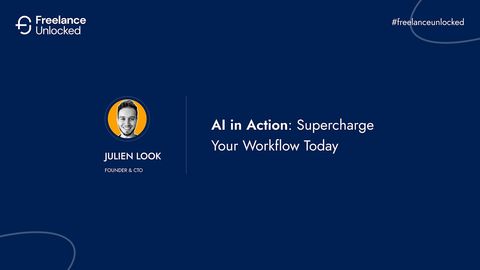

Every freelancer has sat through the same AI keynote by now: big promises, zero workflows you could run on Monday morning. Julien Look opened his Freelance Unlocked 2025 session by naming that gap: "Not many people are talking about what tools are actually helpful today." Then he spent twenty-five minutes on exactly that. Live demos, chained tools, failures included.
Julien Look is a software engineer turned freelancer and agency founder, and he presented as a practitioner, not a vendor. Nobody paid him to recommend anything in the talk, and he said so. Here's what holds up, and where the research backs him.
Six levers, not one magic button
Most freelancers treat AI as one question ("should I use ChatGPT?"). Look's first move was to split productivity into six levers: speed, scale, personalization, cost, decision-making, and performance. Each one points at a different part of your business. Speed means automating the repetitive middle of your workflow. Scale means multiple agents running tasks in parallel while you do something else. Personalization covers AI-drafted proposals and LinkedIn content tuned to a specific reader. Decision-making means using AI as a sparring partner on business direction, where a solo freelancer usually has no one.
His own before-and-after is the honest version of the pitch: "I'm way faster at retrieving information for myself. Before it was Google, now I'm using mostly AI generator tools." Faster research, faster proposal drafts, semi-automated content, better debugging. No revolution. Compounding minutes.
The macro data says those minutes add up. Look cited a PwC projection of 30–50% productivity gains in the talk; PwC's ongoing AI Jobs Barometer now measures the gap in practice: productivity growth runs roughly 40% higher at the companies most exposed to AI than at the least exposed. McKinsey estimates that generative AI could automate activities absorbing 60–70% of employees' time. The freelancer-specific number is the sharpest: Upwork's Future Workforce Index finds freelancers who incorporate AI into their work earn 34% more per hour than those who don't. For a one-person business, that's margin.
Build your stack by function, not by hype
Look's tool tour (as of the 2025 talk) was organized the way a freelancer's week is: by job to be done, not by what's trending.
- Operations and research: ChatGPT for general research, NotebookLM for pulling answers out of long documents, Perplexity for search, Notion AI for project organization, an AI notetaker for meetings, and ElevenLabs for voice, including conversational agents that can execute tasks like booking meetings.
- Content production: Gamma for slide decks (his pick as a self-declared non-designer), Pitch for client decks, Adobe Express for image work, HeyGen for AI avatar video, CapCut for editing.
- Sales and outreach: Apollo for pipeline, Crystal for reading a prospect's communication style from their LinkedIn profile, Clay for lead enrichment and outreach.
- Engineering: Cursor and GitHub Copilot, if code is your craft.
Specific tools will churn; half this list will look different in two years. The durable part is the sorting principle. Almost everything he showed has a free tier, so testing your way through a category costs an afternoon, not a subscription audit. Pick one category where you bleed hours, trial two tools, keep one. Ignore the rest until they solve a problem you actually have.
Three workflows worth stealing, caveats included
The core of the session was three live systems, each with a warning label the marketing pages omit.
1. A customer-facing voice agent. Look fed the conference's own data into a voice agent and let it field questions live (which speaker covers what, when sessions run), with the agent ending calls on its own so it didn't burn credits. The voice was still slightly robotic, and he said so. His bigger point was who can build this: "Everybody of you can do this because it doesn't require any software engineering skills." For a freelancer, that's a first-line FAQ handler for inbound inquiries, or a service you sell to clients.
2. A content pipeline that runs itself. Make.com is the connective tissue: ChatGPT drafts a script, HeyGen turns it into an avatar video, AI writes the LinkedIn caption, and the post goes out with no manual steps. It attacks the real reason most freelancers post inconsistently: production is tedious and billable work always wins. The warning label was blunt: "You cannot edit the video. You kind of have to trust the AI that it's giving you output that will not damage your reputation." Avatars gesture oddly when the script's emotion doesn't match, and the format suits explainer content, not nuance. His audience mostly failed to spot his AI video next to a real one. That result is the pitch and the caution in one.
3. Lead generation with enrichment. Clay scrapes public data on a prospect, AI drafts a personalized cold email inside a template that keeps your own phrasing, the lead lands in a table, and triggers handle the sending. The design detail that matters: the templates blend AI-generated text with lines you wrote, so the output still sounds like you. You stay in control of the flow. The machine does the assembly.
The pattern across all three: chains of cheap tools, a human decision at the top, and a trade-off acknowledged at each step. That separates a workflow from a demo.
Pilot like an engineer, not like a fan
The most transferable part of the talk was Look's adoption framework. It's how engineering teams ship, and how most freelancers don't operate.
First, diagnose before you subscribe: "What are your actual pain points? What are the things that are taking so much time away from you?" Second, run a small pilot; his sizing was "something that maybe takes a week or so, with clearly defined KPIs." Third, if you work with subcontractors or a small team, train them so nobody gets left behind. Fourth, scale only what measurably worked.
And expect casualties. "Many of these pilot projects might not work," he said. "I need to iterate fast and not get too stuck up with the things I originally envisioned." That sentence separates his talk from the hype cycle: tools that demo beautifully routinely die on contact with a real workflow, and the right response is to kill them quickly, not force them to fit.
His view of where this goes matches what the labor data is starting to show. Look described work shifting away from hands-on execution toward requirements, judgment, and managing a set of AI copilots "from the top." Upwork's 2026 research gives that role a name, the "AI orchestrator," and a finding to go with it: the earnings premium flows to people who combine AI fluency with domain expertise and business judgment, while low-complexity AI production work grows in volume and falls in price. The freelancers who win are the ones directing the output, not producing the most of it.
Which is why his closing line is a positioning strategy, not a comfort blanket: "AI is not your replacement. It's going to be an extension of your core skills."
Your one-week pilot, concretely
Distilled from the talk into steps you can run this week:
- Write down your three biggest time sinks. Not tools you're curious about. Hours you resent: admin, proposals, content production, lead research.
- Pick one, and pick one workflow for it from the three above: voice agent for inbound, content pipeline for visibility, enrichment for outreach.
- Define one KPI before you start. Hours saved per week, posts shipped, qualified replies. If you can't measure it, you can't decide.
- Run it for one week on free tiers. Nearly every tool in the talk lets you test without paying.
- Keep, kill, or iterate. Fast. No sunk-cost loyalty to the setup you imagined.
- Keep yourself at the top of the chain. Anything client-facing gets your review until it has earned trust. Look's video caveat applies to everything: your reputation is the asset AI can't rebuild.
The freelancers pulling ahead right now don't have the longest tool lists. They treated one painful week of admin as an engineering problem and shipped a fix.
Want more sessions like this? 9am brings together practitioners who show their actual systems. Subscribe to the Freelance Unlocked YouTube channel for the full 2025 talks, and build your freelance business on 9am.works.
Freelance Unlocked is co-organized by 9am together with Uplink and freelancermap. This article is based on Julien Look's session at Freelance Unlocked 2025. Watch the full talk above, and join us at the next edition: freelanceunlocked.com.