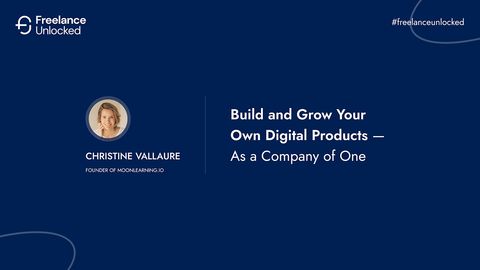

Christine Vallaure runs a learning platform with a few thousand students worldwide. Her recording studio, design department, dev team, post-production, client services, accounting, and marketing all share one address: a small desk in the corner of her Berlin home. Total running costs: €324 a month. No employees, no investors, no exit plan, and no interest in any of them. At Freelance Unlocked 2025 she explained how that works, and why the startup script is the wrong template for freelancers who want product income.
Christine Vallaure is the founder of moonlearning.io, where she teaches UI design, Figma, and how design connects to code. She also wrote Solo, a guidebook on building and growing digital products on your own.
The viral-course story is a lie
Vallaure started as a UI freelancer in Berlin, in the friction zone between design and development, "the area where designers and developers try really hard not to kill each other," as she put it. When the pandemic freed up her calendar, she packaged what she'd learned into an online course.
Then comes the part every conference audience wants to hear: "I put that course online and within a few weeks it went viral and I could literally just live off that one course."
She let the line land before pulling it apart: "That's really nice that you believe everything people say on stage, because that never happened." The real version was less cinematic: "It was very slow and steady organic growth. The more I put in there, the more I saw happening, but very, very slowly and over time."
That correction is the most useful thing in the talk. The overnight-success myth makes slow organic traction feel like failure, exactly where most freelancers quit a product that's working. The data backs her. Stripe's analysis of the creator economy found that 50 platforms on its network onboarded over one million creators and paid out more than $25 billion, with creator-educator platforms (the kind powering course businesses) growing revenue 120% in two years. A compounding market, not a lottery.
One detail for DACH readers: in Stripe's data, Europe and the Middle East doubled their share of new creators from 11% to 22% between 2021 and 2023. The wave is no longer an American phenomenon.
"Just because you can make yourself fit in doesn't mean you're in the right place"
As Moon Learning grew, the questions started. Are you going to hire? Turn this into a real company? Event hosts introduced her as a "founder", a label she has mixed feelings about. When she looked into what founderhood was supposed to mean, she found one glorified path: funding, growth, exit.
Her issue isn't with that path ("a lot of products really need that") but with its monopoly on ambition: "If we only show this one idea of building, then we start molding ourselves to this idea if we want to carry on with our product. But just because you can make yourself fit in it doesn't mean that you're in the right place. And if you're not in the right place, then you'll never fully thrive, and neither will your product."
Her reframe is concrete, not motivational. Build a product that generates stable returns and fits your life, and you'll never want to sell it. "Then suddenly time, and not funding, is your most important asset." That sentence reorders every decision after it: no meetings fragmenting your deep-work blocks, no team politics, no Slack. She was blunt about the taboo underneath, too. People come up after talks and quietly confess they hate working in teams. Her answer: if you function better alone, that's a legitimate way to work, not a character flaw.
The second reframe is financial. Freelancers and founders alike are trained to stare at revenue, but "you cannot compare yourself with a funded startup. The number that you're going to look at is the profit margin. And in a lot of one-person companies, the profit margin is way above 90%." Moon Learning's fixed costs are €324 a month. Small growth, but all yours to keep.
For DACH freelancers this math matters more than it looks. The Freelancer-Kompass 2025 puts the average DACH freelance rate at €104 an hour and monthly income at €8,022. Good numbers, hard ceiling: they only exist while you're selling hours. A 90%-margin product is the first income that doesn't stop when your calendar does. It also softens a specific DACH pain point: 44% of freelancers in the same study worry about financial security in retirement.
Own the core: "don't outsource the heart and soul of your product"
Vallaure's one non-negotiable rule: "Whatever you build, if you want to be a company of one, then own the core. Don't outsource the heart and the soul of your product." The failure pattern she sees most: someone raises a bit of money, pays a developer to build the thing, then takes it back to run, "and you're giving away all your power of being small and agile and in control."
Owning the core doesn't mean writing everything yourself. She's not a developer ("I write a little bit of CSS"), but with AI coding tools like Cursor she now builds products she couldn't have built before. Moon Learning runs entirely on a no-code platform, which she defends unapologetically: it buys her time for courses and adds a security layer for student data. Her caveat is honest. This fits simple products, which is what a company of one should be building anyway.
Simplicity, in her framing, is a feature: "There are no bells and whistles. It's literally MVP for life. But that's great, because that means you're going to be really, really fast. You can pivot overnight." Shipping small and fast also surfaces what she calls satellite products: offers that emerge from unexpected audience interest. People kept asking why she doesn't hire, so she wrote Solo. Writing Solo pushed her into AI coding tools, which spawned her next project, Pretty Cheap Houses, a platform using AI and image recognition to find affordable renovation homes across Europe. None of it was in a business plan. A portfolio of small products also hedges itself: when one dips, another picks up.
Growing alone: automation, a "fax machine" AI, and the bookstore test
Growth as one person only works if the product decouples time from money, the thing classic freelancing structurally can't do. Vallaure's growth stack is unglamorous. Automation first: Zapier chains that take a student payment and trigger platform sign-up, data sync, and newsletter enrollment without her touching anything.
Then AI, introduced with a disarming metaphor. In Back to the Future, the future of live communication was fax machines everywhere: yesterday's tech, imagined bigger. "Anything I'm going to show you, my AI is just a fax machine. There is nothing you haven't seen before." She doesn't generate content with LLMs. She uses them as an assistant. She's dyslexic, and AI editing let her write her book in her own voice, without the shame of needing someone to correct every page. AI translation and voice cloning turn her English course videos into Spanish ones (her voice, her content, new markets), because a niche solo product often lives in markets whose languages you don't speak. She's ahead of a broad curve: Upwork's Freelance Forward research found freelancers adopt generative AI at more than twice the rate of traditional employees (20% vs 9%), in a US freelance economy now worth $1.27 trillion in annual earnings.
And the audience question, the one that stops most people from ever launching? She answers it with a bookstore: "You don't go in and say, 'Hello, I would like to purchase the world's best book, please.' You look around, and something resonates with you." Every person walks out with a different book. "Whatever you build, if you build a good quality product, there is going to be an audience out there somewhere. The tricky part is finding that audience." Her method contains no tricks at all: "I have no growth hacking. I have no clickbait. I just make stuff and I hope it resonates with people and it helps them, and it actually worked quite well."
Same-day proof that you'll never please everyone: one review praised her "incredibly soothing voice"; another called it "fake, like an Alexa voice." Her policy: fix bugs, correct mistakes, and build for the people the product is for.
Practical takeaways
- Judge your product on margin, not revenue. A solo product at 90%+ margin beats vanity revenue. Know your fixed costs to the euro. Vallaure's are €324/month.
- Own the core. Try no-code or AI coding tools before you outsource the heart of the product to an agency or contractor.
- Ship the simplest possible version now. Her advice for square one: "Make the simplest thing you can think of and put it online... and see what happens."
- Expect slow, and plan for it. Keep freelance income running while the product compounds. Viral is a stage story, not a strategy.
- Watch for satellite products. Your audience's random questions are your roadmap. React fast; don't over-plan.
- Automate the plumbing, keep the voice. Zapier for operations, AI for translation and editing. Never for replacing the content only you can make.
She closed with the line that sums it all up: "The generation before you needed a garage. All you need is the cheapest desk from IKEA." If you're freelancing in DACH and part of your income doesn't yet survive a week off, that desk is available.
Want to build alongside client work rather than in place of it? 9am helps you keep the freelance pipeline full while your first product finds its audience.
Freelance Unlocked is co-organized by 9am together with Uplink and freelancermap. This article is based on Christine Vallaure's session at Freelance Unlocked 2025. Watch the full talk above, and join us at the next edition: freelanceunlocked.com.