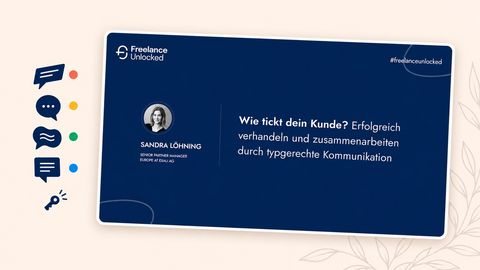

Sandra Löhning teaches a four-colour model for reading clients: red wants results fast, yellow wants an idea and energy, green wants time and trust, blue wants numbers and sources. She says you can guess the colour in five minutes from public cues before the first call, then change three things: length, evidence and tempo. When you know nothing, she builds the pitch for red-blue, short and factual, and adjusts in the room. She calls it a first guess at the surface, never a diagnosis.
Imagine you sell software to a pharma buyer. You build the deck sober and factual, because that is what buyers want. Now imagine the same software going to a room of Montessori educators. Is the colourful, creative layout still wrong?
That was one of the first exercises in Sandra Löhning's workshop at Freelance Unlocked 2025, and it is the whole argument in one slide. Sandra Löhning is Senior Partner Manager Europe at exali AG, with, in her words, more than 20 years in sales behind her. She gave this workshop in Berlin in May 2025, in about 40 minutes instead of the four to six hours the topic could fill.
A model she calls the Farbenmodell
Sandra starts by naming what already exists: the DISG model, Insights Discovery and the Big Five personality dimensions. Then she says she has prepared a different model for the workshop, "das Farbenmodell", the colour model, with four colours: red, yellow, green, blue. She credits no author or source for it in either recording. We call it what she calls it, and it is not DISC.
She is careful about what it is not. In her words, translated from German:
"With all these models we only ever scratch the surface. This is not a psychological assessment, that is not our place. We want to think about what we see and derive our own measures from it, to get better access to the person across from us." (Sandra Löhning)
And: "Nobody is purely red and only dominant." The owner of a creative agency still runs a company, so there is some blue in there too. Expect a main colour and a mix. For the basics of keeping clients informed, see our guide to client communication as a freelancer.
The four colours and what each wants
Her cues are heuristics, not rules. She calls her own reading the "Klischeekiste", the box of clichés, and frames her cues as a first step, not a verdict. Use them to form a guess, then correct it.
- Red. Cue: trophies from competitive sport in the office. Wants: short, clear, concise, a quick decision. Dominant, willing to take risks. If you have something strong at a higher price that gives a competitive edge, argue exactly that, because this type is less price-sensitive. The risk: little patience. "I will not be able to, or need to, build a base over seven business dinners."
- Yellow. Cue: a hand-made pottery mug. Wants: enthusiasm and a new idea. If you have something unconventional without perfectly clean data, take it to the yellow-leaning client first. "The chance is high that he says: you know what, let's try it."
- Green. Cues: family photos in the office, charities listed on LinkedIn. Wants: relationship and long-term thinking. Mention the causes you support and build slowly. "He will not decide quickly. He needs time, he needs relationship, he needs trust."
- Blue. Cues: a technical or science background, an office full of gear, functional clothes, no trophies on show. Wants: numbers, data, facts, source references. "More, more, even more."
Read the colour before the first call
Her method has the feel of a five-minute detective job. Look at:
- LinkedIn and social media
- photos on the company website (suits, or jeans and T-shirts?)
- how the person behaves in video calls
- the style of their e-mails: "Hello Ms. Löhning, how was the holiday in the mountains?" or "the figures from quarter X are still missing"
- the phrases they use
Two of her examples. A client who keeps saying "get to the point" is probably red-blue, in her reading. A client who says "we have worked with our suppliers for over 20 years" is probably green, and it does no harm to answer that you, too, value long cooperation and have clients of more than ten years. That is a real reply of hers. The cue becomes useful when you answer it.
Know your own colour first
Sandra's second warning is aimed at you. If you are a yellow-green type and prepare a presentation the way you find clear and beautiful, it can mean nothing to a red-green counterpart. A sneakers-and-T-shirt look may read as unprofessional, even disrespectful, to a strict red-blue buyer.
She is explicit that this is not about acting:
"None of this is about behaving differently, dressing up or being inauthentic. On the contrary, it is a sign of respect and professionalism that I engage with what my client, my counterpart, my negotiating partner needs from me." (Sandra Löhning)
When you know nothing, aim for red-blue
What if LinkedIn gives you nothing, the e-mails are cryptic and there is no direct contact? Sandra falls back on experience: whom does she negotiate with most often? Buyers and managing directors, and in her experience those are most often red-blue. So her default is, translated: "If I know nothing, I aim my presentations at red-blue." Short, factual, sober. Then she adjusts once the conversation shows more. Our guide to making clients listen and trust you covers what comes after that first impression.
Bad news: she covers two types
In the pre-event interview, recorded in February 2025 before the conference, she describes how she delivers a message the client does not want to hear. For the red type she talks about the result and frames the new route by what it does for the outcome. For the relationship-focused, green type she would invite the client to dinner or run a brainstorming session, "so they feel comfortable with me" and listen to her expertise. She gives no bad-news advice for yellow or blue, and neither do we. If the bad news is about a difficult client, our piece on difficult clients and their red flags is the companion. As our reading only: yellow probably needs the idea before the problem, blue the evidence behind it.
Her one-minute question works for every type:
"Take a minute and ask yourself with each and every client: what does my client need from me in order to trust me? Hard facts, enthusiasm, empathy, stability. And then you deliver the message they need to hear from you in the way they need to hear it." (Sandra Löhning, speaker interview, February 2025)
She does not map those four words to the four colours herself. Doing so is an inference, and a handy one: facts for blue, enthusiasm for yellow, empathy and stability for green, and results for red.
What to do on Monday
- Guess three colours. For your next three meetings, spend five minutes on LinkedIn, the company site and the last e-mail. Write a colour and the cue next to each name.
- Name your own. Think of how you built your last offer. Write down which colour it would please, and which it would lose.
- Change three things per type: length, evidence, tempo. Red gets the result first and fewer words. Yellow gets the idea. Green gets time and references. Blue gets the numbers and sources.
- Keep a red-blue default. For every contact you know nothing about, send the short, factual version first.
- Before your next piece of bad news, ask her trust question and pick the delivery that fits.
Clients read your profile the way you read theirs. A free 9am profile is your first impression before the first call, so give it a short headline for the red, a result or two for the blue, and a human sentence for the green.
Quotes translated from German and lightly cleaned from automatic captions. The colour cues are Sandra's heuristics, not research findings. Sandra Löhning was also on the schedule for Freelance Unlocked 2026, with a session on deep networking.
Freelance Unlocked is co-organized by 9am together with Uplink and freelancermap. This article is based on Sandra Löhning's session at Freelance Unlocked 2025. Watch the full talk above, and join us at the next edition: freelanceunlocked.com.