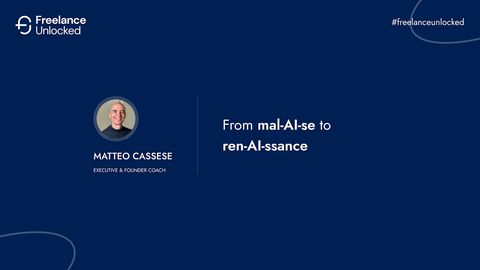

We were promised that automation would come for the forklifts. Instead it came for the first drafts, the logo concepts, the copyedits: the work many freelancers get paid for. "The robots came for the creatives," Matteo Cassese told the audience at Freelance Unlocked 2025. "They came for the poets. And that's a problem."
He calls the resulting mood mal-AI-se: that low-grade dread of not knowing what your job looks like in two years. His talk is about the way out, which turns out to be less a prompt library than a career-wide identity renovation. He calls that part ren-AI-ssance.
Cassese is a digital strategist and founder coach at La Fabbrica della Realtà, an eight-careers-in-29-years veteran who built websites back in 1993 and has advised some of the world's largest media companies. Which is why his talk barely mentions tools.
The maps are broken
Cassese opens with William Gibson's line that "the future is already here: it's just not widely distributed," and asks the room to run a thought experiment. Assume the hype is real. Assume tools as smart as humans, deployable at scale, cheap to run. Now what?
His diagnosis: "The issue that we have is simply that our current maps suck, and they suck badly." The longitudinal career, one profession compounding seniority for decades, "was already in trouble, but what is happening right now will definitely put it in the ICU."
The erosion is already visible. Legal-tech companies like Casetext have effectively productized the paralegal's job description. When the games industry shed thousands of jobs, it was largely creatives who went; companies kept the lead designer and trained AI on the fill-in work. And the CTOs Cassese talks to "are still hiring developers, but they're not hiring junior developers. They prefer to train a junior AI developer."
That last claim sounded provocative on stage. The data since has been uncomfortably supportive. Stanford's Digital Economy Lab, in the widely cited "Canaries in the Coal Mine" study by Erik Brynjolfsson and colleagues, finds employment for 22–25-year-olds in AI-exposed occupations running roughly 19% below where it would be had it tracked less-exposed peers. The drop comes almost entirely from reduced hiring of juniors, not layoffs; experienced workers show no comparable decline.
What the numbers actually say: repricing, not collapse
The doom version of this story is as lazy as the denial version.
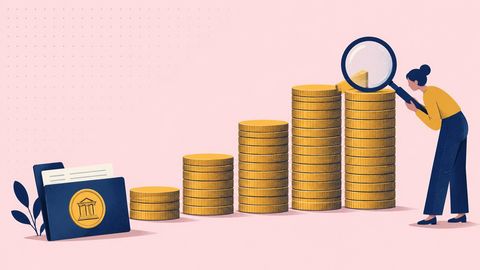
Yes, the robots came for the creatives first. Research by Xiang Hui and Oren Reshef, summarized by Brookings, found that after ChatGPT's release, freelancers in writing-heavy categories saw new contracts drop about 2% and monthly earnings fall roughly 5%, with graphic designers hit similarly after image models arrived. The striking detail: the most experienced freelancers in those categories lost the most, because AI compresses the gap between good and average execution.
But a 2–5% decline is a repricing, not an extinction. The same marketplaces show the other side of the trade. Upwork's Future Workforce Index 2026 reports that freelancers doing AI work earn 34% more per hour than those who don't, while low-complexity AI tasks are commoditizing fast (earnings down 28% year over year) and complex, judgment-heavy AI work keeps rising in value. The Stanford team, for its part, explicitly finds "no evidence of widespread, economy-wide job displacement."
Read together, the evidence says what Cassese argues from the stage: execution is deflating, judgment is inflating. The question is which side of that trade your freelance business sits on.
The first casualty: hustle culture
Cassese's core observation is psychological, not economic. Freelancers are unusually identified with their output. "We are very invested in what we do, and part of our identity is in our output as professionals," he says. Then the trap snaps shut: "I just gave you something that is more capable than you at outputting, at creating, at generating. What does that leave you with? An existential crisis."
Hustle culture, the industrial-era ideology that "more is better: more work, late hours, more Red Bull," only made sense while output was the scarce thing. Cassese declares it dead, and he's cheerful about the funeral. If a machine wins the productivity contest by default, productivity stops being a viable identity.
The replacement is harder: "We are going from focusing on raw output to refined input." Thinking, observing, asking better questions. In hustle culture every problem had a comfortable answer. Do more, power through. "When I ask you to stop, slow down, think, philosophize, strategize, that is much harder."
For a freelancer this is brutally practical. The deliverable was never really the value; it was just the part that was easy to invoice. What clients will keep paying for is the input: knowing what to build, what to skip, what question the brief is quietly avoiding.
The second casualty: frameworks
The second thing Cassese buries is the freelancer's security blanket, the five-step playbook. His logic is hard to argue with: "If something can be boiled down to a step-by-step, paint-by-numbers instructional system, isn't that akin to a prompt? If I can explain it to a language model, why would I do it?"
Frameworks won't disappear; they'll become the instructions you give the machine. Which means they can't be your differentiation. What's left for the human is the layer underneath: "principles: unchanging laws of physics, of psychology, of behavioral economics, of markets. Philosophers instead of hustlers."
He illustrates with his own YouTube dashboard: real-time analytics, gamified green arrows, engineered for the refresh reflex. "That is a horrible use of my brain," he says. "I'm accepting to become reactive rather than active. Reactive rather than creative." Data can flow straight to the model now. The distinctly human failure mode is letting the outside world (dashboards, inboxes, other people's to-do lists) set your agenda while your own intuition goes unconsulted.
That intuition is the cave in his Joseph Campbell reference: the cave you fear to enter, holding the treasure you seek. Working from the inside out is uncomfortable. It's also the one workflow no one can automate against you.
There is no map. There is mapmaking.
So what replaces the broken career map? Cassese refuses to hand out a new one; that would just be another framework. "There's no map, but there is mapmaking. There is a new skill that every one of us can learn."
His proof points are anecdotal but pointed. His own copywriting-optimized marketing funnel burned him out and lost money; when he refocused on his craft, "the craft became my marketing. I stopped solving the problem, and the problem solved itself." His client Frank quit following corporate rules and thrives as an entrepreneur. His client Sophie abandoned a SaaS she didn't love to build the movement she actually cared about.
The unlikely patron saint here is H.R. Giger, the Oscar-winning creator of the Alien creature, whose museum in Gruyères stunned Cassese weeks before the talk. Giger painted his nightmares in an era of neon and floral patterns. "Imagine that he asked for permission," Cassese says. "That would have been a disaster. We all need to learn to be more ourselves, to be, in a way, artistic, and to work from the inside out."
And where machines flood the market with output, scarcity migrates to presence. "Stuff that we do in person is just going to be more and more important," he says. His one piece of investment advice: "invest in conferences like this one. Invest in retreats." His own answer is hosting clients in his garden in Brandenburg, over green tea and hard questions. "I don't think this is an experience that can be automated."
He closes with producer Rick Rubin's ordering from The Creative Act: inspiration first, you second, the audience last. "If this was a framework, the audience would be first, the messaging second," Cassese notes. "If you're looking for a map, this is as close as it gets."
What to actually do next week
From the talk and the Q&A that followed:
- Get the tools into your daily workflow now. Cassese was blunt with the hands that stayed down: "I'm concerned about you. The future is happening." Even Bill Gates underestimated the web in 1993; assume you're underestimating this. The Upwork data puts a price on it: +34% per hour.
- Carve out 15 minutes a day without input. No phone, no feed, before the inbox. His starting point for mapmaking: "Once you are bored, you know that you're there. And if you endure that boredom, then there's something."
- Audit your services for prompt-shaped work. Anything you deliver by following a step-by-step playbook is on the deflating side of the trade. Move your offer up a level, toward diagnosis and judgment: the refined input.
- Ignore vanity dashboards. Define your own success metric (Cassese's: genuinely reaching three to five people a month) and let it beat the gamified one.
- Invest in being there in person. Conferences, retreats, client days. Presence is the one deliverable with no API.
- Do your own "junior work." With entry-level rungs disappearing, the path to senior judgment now runs through self-directed reps. Uncomfortable, but as Cassese says, it's supposed to be hard.
The malaise is rational; the data confirms the ground really is moving. So is the renaissance. The same marketplaces punishing routine execution are paying a premium for judgment and for a self you didn't outsource. There are ears that ask questions and ears that answer, as Zora Neale Hurston wrote. Cassese's bet is that freelancers who enter the cave get to be the ones answering.
Freelance Unlocked is co-organized by 9am together with Uplink and freelancermap. This article is based on Matteo Cassese's session at Freelance Unlocked 2025. Watch the full talk above, and join us at the next edition: freelanceunlocked.com.