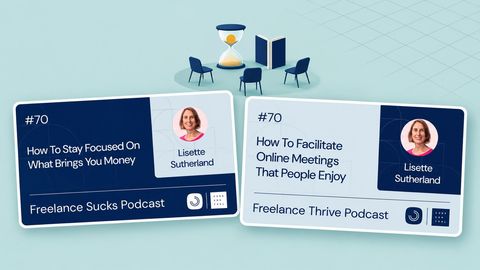
Lisette Sutherland has run a remote-work business for two decades and still calls the hardest part of freelancing "working on the most important thing first", every day. Her fixes are unglamorous: do the money task first, for 15 minutes if that is all you can face, run a Money Monday checklist so finance never eats a day, and price the three hours of client paperwork into the 90-minute webinar. On the thriving side she designs online meetings people stay in: five minutes of content, ten of exercise, five of debrief, and a personal user manual for every new team.
Most freelancers know exactly which task would bring in money today. The problem is that it is rarely the one they feel like doing.
Lisette Sutherland is, in her own words, a remote-working, German-born, Dutch-American living in the Netherlands. She founded Collaboration Superpowers, wrote the Work Together Anywhere handbook (Wiley, 2020), hosts a podcast on remote work and has facilitated online workshops since long before 2020 made everyone try. In October 2024 she sat down with Yurii, then community builder at CodeControl and 9am, for both halves of episode 70: Freelance Sucks first, Freelance Thrive second. Two years on, none of it has aged.
What sucks: the money task has to be done on Tuesday too
Asked for the most challenging part of freelancing, she did not mention clients or cash flow.
"Working on the most important thing first. Because there's things that I really like doing, like making the graphic for the event I'm facilitating next week, but then there's the thing that I need to do to make money. It's easy to do it on Monday, but then you also have to do it on Tuesday, Wednesday, Thursday and Friday, and then on Monday again." (Lisette Sutherland)
Her test for what that thing is comes from Alex Goldfayn's The Revenue Growth Habit, which she holds up to the camera: if you needed money today, what would you do? "You would not send out a social media post. You would call somebody. You wouldn't set up a website." Whatever you would do under that pressure is the number one task, and it goes first.
The discipline for doing it is small on purpose. "I do it first, the very first thing in the day." If the task is ugly, she gives it 15 minutes: "I just need to start it, and then I leave it after 15 minutes." The fun work, the graphics and the file clean-up, waits for the end of the day, "when my brain is totally fried".
What sucks: the hours nobody pays for
The most time-consuming part of her business, outside the work itself, is staying relevant: the marketing, the proposals, the back-and-forth on scheduling and pricing. "It takes hours to get any event, so you have to build that into your pricing."
Finance she has beaten with a routine that is 20 years old.
"I started Money Monday like 20 years ago and I have a checklist on Mondays. I hate the money stuff, the invoicing, the going after the money, I hate it. But I just go through the list every Monday, and that means I never have to do a big long day of finance stuff." (Lisette Sutherland)
The part she calls nerve-wracking is getting set up in large clients' billing systems: spreadsheets asking for the same information that is on the invoice, then typed into a system by someone else. "Those things are maddening." A colleague of hers offers a 10% no-bureaucracy discount to any client who can simply receive an invoice and pay it. Her own answer is the price: "When people say, why do you charge that much for a webinar? Because I have to deal with hours of this to deliver it. It's 90 minutes, but then it's three hours of dealing with invoicing." Our guide to writing invoices in Germany covers the part of that admin you cannot avoid; the supplier-onboarding part is what the price is for.
On loneliness she is candid that she is in the minority: she does not feel it, because she networks constantly and keeps a rich in-person life. Her warning is for everyone else: "If you're doing everything online and you're just alone in your house, that's not healthy." And her networking rule is not LinkedIn likes. "You kind of have to show up for people."
What sucks: the roller coaster you cannot get off
Her three things to check before a friend goes freelance:
- Can you take the hustle? "When the client work stops, you don't get to take a paid vacation. It's a roller coaster and it's never not going to be a roller coaster."
- Have a safety net. "Don't do it if you don't have any money, because you don't want to make decisions out of fear and stress."
- Set boundaries early. "When your life and money depends on how much work you do, you can work non-stop, and you tend to work non-stop." She did it for years and now takes weekends off entirely. "Learning boundaries early will save you a lot of pain later."
The one thing she would do differently: hire a business coach earlier. Even with discipline, she found it "surprisingly difficult" to hit the one weekly goal she had set herself, and managed it about 80% of the time only because she knew the coach would ask.
What thrives: meetings people do not want to leave
Part two is her craft. The problem with most online events, she says, is that they broadcast. "What you're creating is a whole bunch of bad YouTube videos. If you were watching any of these on YouTube you would go at double speed." Her starting point is a sales-training line from Zig Ziglar: tune in to WIIFM, what's in it for me. "Every presentation, event, whatever you're doing, should always start in what's in it for the audience."
▶ Watch on YouTube Her format for a 90-minute workshop:
- Five minutes of content, tops. Then something interactive. If you cannot do breakout rooms, "at least insert a poll, or a break, or a short video, or a chat storm".
- Content, exercise, debrief. Five minutes of theory, ten minutes of exercise in small groups, five minutes of debrief. Hear from no more than three groups, one minute each: "you just want a taste of a variety of answers."
- Icebreakers that warm up the actual work. Not favourite animals. Before a brainstorm: combine three random images into a business. Groups of three or four, never one-on-one, and never 20 minutes with a stranger.
- Speed networking, 15 minutes. Three rounds of three minutes with questions designed for the event, such as "what's your superpower" and "what are you trying to accomplish by the end of the year". Her most popular format right now.
- A break every 45 minutes, five to ten minutes.
On which meeting is for what: town halls for one-to-many with questions at the end; virtual co-working on Fridays as pure accountability ("I use those sessions to plow through those tasks"); stand-ups for updates, used sparingly because "asynchronous is very powerful"; workshops to bring out the expertise already in the room. Some teams only meet when the shared agenda gets long enough. The remote-first HR playbook we published earlier reaches the same conclusion from the company side.
What thrives: your first week in a new team
Yurii's last question was the freelance one: you join a new remote team every three to six months, how do you build trust fast? Her answer came without a pause.
"Personal user manuals, hands down. Creating a manual that you can present to other people that shows them what your style of work is like and what your preferences are." (Lisette Sutherland)
Collaboration Superpowers describes it as "a bespoke guide that outlines your working style, preferences, and values", with sections for the basics (location, time zone, hours, languages), strengths and quirks, working preferences and your workspace; the instructions are on their site. A coach she works with uses hers in interviews and onboarding. Lisette's own manual once turned her father-in-law of 15 years into a Depeche Mode buddy.
Then the second document: a simple team agreement. "How are you going to communicate, what are the expected response times, where are the files, what kind of security protocols." Her point for freelancers is that asking those questions is itself a differentiator. "As a freelancer you can set yourself apart by asking those questions and documenting it, and then sharing that documentation." When someone later says "I didn't mean that", the agreement is what you point at. If you switch between roles across clients, our 2x2 for role switching is the companion to this.
What to do on Monday
- Answer the money question before you open email. If you needed money today, what would you do? Do that first, for at least 15 minutes.
- Start Money Monday. One checklist, every Monday: invoices out, payments in, reminders sent. Never a whole day of finance again.
- Price the paperwork. Estimate the supplier-onboarding and invoicing hours for your biggest client and put them in your next quote.
- Write a one-page personal user manual and send it with your next kickoff.
- Rebuild your next client workshop as five-ten-five blocks with a break at 45 minutes.
Lisette's whole business rests on being findable by the people who need what she does. A free 9am profile does the same for you across DACH, and it is a good place to link that user manual.
Quotes lightly cleaned from automatic captions.
This article is based on Lisette Sutherland's conversations with Yurii on the Freelance Sucks and Freelance Thrive podcasts by 9am, recorded in October 2024. Both episodes are embedded above.