
The one LinkedIn feature built to bring a freelancer paying clients in 2026 is the free Services page, a searchable listing that clients find without you posting anything. The rest is the profile: a headline that names the problem you solve and the keywords a non-technical recruiter searches for, contact details a stranger can use, an About that sends people somewhere, and recommendations you ask for. Posting helps you stay visible; nobody has data linking post count to clients, and LinkedIn publishes no algorithm rules. Build the listing first, then decide how much noise you want to make.
"Post more and the clients will come." It is the most repeated LinkedIn advice for freelancers, and the least supported. The Freelancer-Kompass (survey period 2025) puts "social networks" at 7 % of won projects, behind platforms at 34 % and the personal network at 23 %. That 7 % is real money for the freelancers who get it, and it comes to profiles that are built to be found, whether or not their owner writes three posts a week.
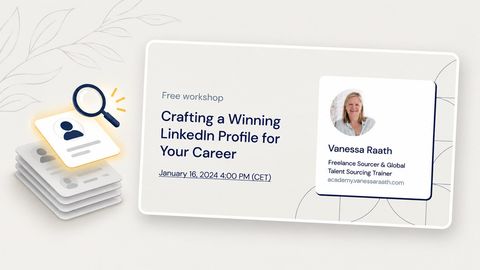
In January 2024, 9am ran a live workshop with Vanessa Raath, a South Africa-based global talent sourcing trainer who has worked for herself for years and teaches recruiters how to find people. She went through her own profile and then through participants' profiles, live. What follows is her method, updated for what LinkedIn has changed since, and separated from what nobody can verify.
Start with why a recruiter opens your profile
Her opening disclaimer reframes the whole exercise: "A lot of people are going to Google you." A recruiter or a hiring manager takes your name in quotation marks, and looks at where you show up, LinkedIn first, then everything else. So the profile has one job. It has to make the person who lands on it able to act.
"You need to tell people: this is the problem that you can solve." (Vanessa Raath)
The profile, top to bottom
The URL. Edit it to your name and surname. When someone says "we used a great freelancer called X", the search has to land on you.
Visibility. Set the public profile to visible, and choose what it shows. Vanessa keeps hers fully public because, in her words, "they cannot hire you and offer you jobs if you haven't got your public profile on."
Photo and cover. Head and shoulders, clear. A cover image that says what you do; she reviewed a UX designer whose cover said nothing about design and called it out.
The headline. Not your job title. The problem you solve, plus the words a recruiter will type. Her own reads "I help recruiters and talent sourcers to find the best talent more effectively", and she edited it live to add "all over the world" because she trains globally. For a developer she wanted the stack in the headline: Kotlin, Spring, Postgres, Docker, not "software development consultant".
"Recruiters aren't technical, so they are matching words on a job description that's been handed to them with what they're seeing on people's profiles. So the clearer that you have it, the more that you have it in front of them, the better." (Vanessa Raath)
She also wants the words a client searches for when they want a freelancer rather than an employee: "freelance", "contract", "gig". A profile that reads like an employee's will be found by people hiring employees.
Contact info. The section most profiles leave empty. She put her email in the headline itself, because "people are not always on LinkedIn that often" and an email gets answered. Two of the profiles she reviewed had no email and no website. Her verdict on one: "you are not sharing enough with me for me to be able to get hold of you."
About. A short story, not a repeat of the experience list below it. Say where you want people to go next: your portfolio, your case studies, your booking page. She had run a client's About through ChatGPT with the instruction to rewrite in the first person for recruiters, and her caveat is the useful part: read what it wrote before you publish it.
Experience, education, skills. Fill it. Short courses count, because keywords count. Skills go up to 50; use them, especially if you want to be found by LinkedIn Recruiter, which she says is heavily skills-based. Link each job to the company page so the logo shows; if a former client has no page, the text is still fine.
Featured. Pin the podcast you were on, the case study, the talk. It stays on top.
Recommendations. Her strongest lever. She has more than 550, and when a referral arrives she does not sell; she sends the link.
"I'm not trying to sell my skills as a freelancer by saying trust me, I'm really good. I have 550 recommendations which people can see. How do you get them? You've got to ask. Some will, some won't." (Vanessa Raath)
Connections. Above 500, LinkedIn shows "500+". Below it, a recruiter reads the exact number. She also draws a line between connections and followers: connect with people who will interact with your work, let the rest follow.
The Services page
Since the workshop, LinkedIn has folded its creator tools into every profile. The Creator Mode toggle Vanessa recommended was retired in February 2024: the Follow button and post analytics are now on every profile, the About section moved back up, and the profile hashtags disappeared. Nothing to switch on any more.
What is worth switching on is the Services page, which she pointed to on her own profile ("make sure it's there, so it's in front of people"). As described by Waalaxy (a vendor, since LinkedIn's help pages block automated reading): you open it from your profile under "For businesses", pick up to ten services from roughly 250 categories, write a 500-character description, set a rate range, and the location comes from your profile. It is free and LinkedIn takes no commission. The vendor's line that "more than 2 million professionals" already use it is the vendor's, not LinkedIn's.
The Services page is the only LinkedIn surface that does what a platform profile does: a client searches for a skill and finds you without you having posted that day. Treat the 500 characters like a headline, not a biography, and put the rate range in.
Posting: what she does, and what nobody can prove
Vanessa posts three times a week, Monday, Wednesday, Friday, and spends the days between replying to comments on her own posts, because comments are where the reach comes from in her experience. She checks the last 90 days of post analytics to see what worked, keeps a pen next to the keyboard for ideas, and has found that a photo with her own face in it outperforms everything else. Reposting other people's content, she says, does less than writing your own.
That is a practitioner's routine, and it earns her work. Her reason for keeping it up is the honest one:
"Would you rather get on a phone and cold call, or would you rather just be attracting work to you on LinkedIn? I haven't had a cold call for business for five years, and for me that is my marketing." (Vanessa Raath)
What we will not print: any claim about how the 2026 algorithm weighs dwell time, external links or carousels. Those numbers circulate in vendor blogs without a LinkedIn source, and LinkedIn has published none. Nor is there a current LinkedIn figure for members in Germany, Austria or Switzerland; the only official number is "more than 1 billion members" worldwide. Anyone quoting you a DACH count is quoting a paid database or an old blog.
The practical reading: posting keeps you in a recruiter's memory ("I saw Andre post this morning, let me get in touch"), and it is not the mechanism that makes you findable. The Services page and the keywords are. If writing three posts a week is a pain, build the findable profile first and post when you have something to say.
Where the whole channel fits next to platforms, referrals and your own site, and why LinkedIn alone is a thin strategy, is in forget LinkedIn, build a network. The rules for the message you send once a profile brings you a name are in cold outreach in DACH.
What to do on Monday
- Open your profile in a private browser window, as a stranger. Can they email you within ten seconds? If not, fix contact info and put the email where they will see it.
- Rewrite the headline as the problem you solve plus your five most searched keywords, including "freelance".
- Set up the Services page: ten services, 500 characters, rate range.
- Ask three past clients for a recommendation this week, with a two-line note on what to mention.
- Mirror the same headline and rate on your 9am profile, where the companies come to the search rather than to your feed; our guide to the freelancer profile covers what hiring managers read there first.
Quotes lightly cleaned from automatic captions. This article is based on the 9am workshop "Crafting a Winning LinkedIn Profile" with Vanessa Raath, January 2024; watch the full recording above.