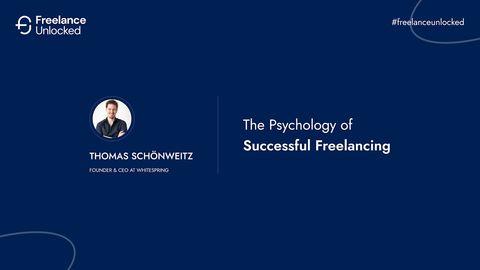

Halfway through the last session of Freelance Unlocked 2025, Thomas Schönweitz asked a room full of freelancers to raise a hand if they'd ever felt close to burnout, then told everyone to keep their hands up and look around. Hands everywhere. "A, this is not good. B, you're not alone," he said. That double message was the whole talk in miniature: your struggles are common, and they're fixable once you understand the mechanics. You've heard the standard freelance advice (network more, market yourself, raise your rates). Schönweitz asks a different question: what actually happens in your brain when a client says no, or when Sunday night starts feeling like Monday morning?
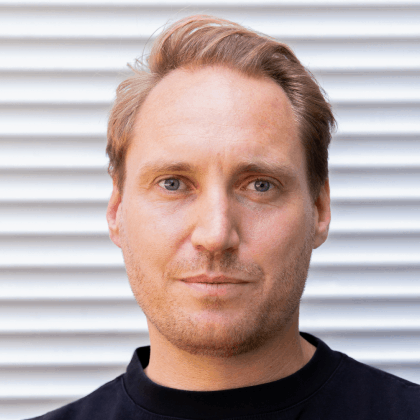
Thomas Schönweitz is a psychologist and the founder of whitespring, with a background in design thinking and 20 years of working with teams. His session closed day two of Freelance Unlocked 2025 with five psychological problems every freelancer runs into, plus eleven strategies for handling them, "because we can't fix things, but if we know the mechanics, we can develop strategies to deal with it."
Why a client's "no" hits you personally
Schönweitz's most useful diagnosis is what he calls the self-worth roller coaster. The mechanism:
"We connect our personal, psychological and emotional value to the capabilities we have, to our skills, and by extension to the products and the services that we render."
That wiring is human, not a personal weakness. Research on contingencies of self-worth (Crocker & Wolfe, Psychological Review, 2001) shows that people stake their self-esteem on outcomes in specific domains, and when those domains take a hit, self-esteem drops with them. For a freelancer, the domain is the work itself. So when a client shrugs and says "I don't really like it," it doesn't register as feedback on a deliverable. It registers as a verdict on you.
Now add financial dependence. If that client is one of three instead of one of twenty, Schönweitz says, "this will spiral you": rejection lowers self-worth, lower self-worth drains motivation, and money fear amplifies everything until you're lying awake convinced no one will ever hire you again.
The deeper frame he offers is self-determination theory, Deci and Ryan's model of what humans need to function well: autonomy, competence, and relatedness. Freelancers score high on autonomy; it's usually why we left employment. But the competence signal, the feeling that your work lands and matters, is outsourced to whichever client happens to answer your emails this month. And relatedness is often the first casualty of working alone. Two of the three pillars of wellbeing are structurally wobbly in freelance life. That's the job's architecture, not a character flaw, and architecture can be rebuilt.
Specialize, for your brain as much as your positioning
Every positioning consultant will tell you to niche down for marketing reasons. Schönweitz makes a colder, more interesting argument: specialization is a psychological stabilizer. Do ten different things and your feedback arrives scattered and unrepeatable; you never compound skill, so you never compound the good feeling that comes with it. Do one thing and every project sharpens the same edge. "If you get better at what you're doing, you will also feel better about yourself," he says. Specialization takes the competence signal back from your clients so you can generate it yourself.
His caveat is refreshingly unsanctimonious:
"You can kind of still do everything, just don't advertise everything. If somebody offers you shitloads of money to do something else, you might take the money. Just don't tell anyone."
He anchors this in Larry Greiner's classic model of organizational growth phases, first published in Harvard Business Review: creativity, direction, delegation, coordination, collaboration. The freelancer's version of Greiner's first crisis is creativity without direction. Endless ideas, no focus, nothing that scales. Getting out of what Schönweitz calls "the creativity dilemma" (deciding what you're known for) is the psychological precondition for growth, whether you eventually scale with people, with AI, or not at all.
Boundaries are a neurological need, not an admin task
Show of hands, Schönweitz asked: who works from home? Who answers email on the weekend? Nearly everyone. "Very, very problematic," he said, "because the stress in your brain doesn't stop. The fatigue keeps going. You cannot let go."
His countermeasures are unglamorous and specific:
- Time-block like it's a contract. Schönweitz keeps a hard lunch blocker in his calendar and takes no appointments before 9:30 on Tuesdays and Thursdays, his training days. Not preferences. Rules.
- Build physical boundaries. If you still work out of your bedroom post-Covid, find a co-working space, a separate room, anything with a door. "Have the possibility to close the door on your work. Don't work from the TV you watch shows on at night."
- Tell clients the rules that already exist in your head. His sharpest line on client management: "Everybody has rules in their head that they haven't told their client, that you could tomorrow." Frame them positively ("I'm available on these channels, during these times") rather than as a list of prohibitions. Then keep them: "Can I call you back Monday morning?", not "in 20 minutes" at 8 p.m.
- Reframe "no" as strategy, not rejection. Clients aren't the only ones who get to say it. "Accept that you have control, and no can be a protection mechanism for you as well." The client who vanished for six months and now wants it yesterday? You're allowed to decline.
On digital habits, Schönweitz recommends a detox: phone out of the bedroom, an analog alarm clock, noticing whether you doom-scroll the first and last minutes of your day. One honest note: the popular "dopamine detox" framing he touches on is looser than the neuroscience. Abstaining doesn't literally reset your dopamine system the way social media claims. But the practical core is sound and matches his own stated principle: "You want to be in control. You don't want external factors to control you."
Money anxiety needs a system, not more willpower
Financial uncertainty is the second-biggest stressor on Schönweitz's list, and the data says the anxiety is rational: in freelancermap's Freelancer-Kompass, Germany's largest freelancer market study, 52% of DACH freelancers name uncertain project pipelines as their biggest risk. The same study finds 84% would still choose self-employment again. The autonomy is worth it; the anxiety just needs managing.
Schönweitz's fixes are mechanical, which is exactly the point. A system carries the anxiety so your prefrontal cortex doesn't have to.
- A separate tax account. He keeps one bank account that only the tax office's money touches. No number of your own yet? Park 50% of every gross invoice there. When the Finanzamt demands back-payment plus prepayment ("really quickly, really big numbers"), you're covered instead of spiraling.
- Quote in modules, not days. Clients ask for day rates; give one verbally if you must, but structure the written quote as modules of work. Same total, different psychology. You can also invoice each module when it's done, independent of hours logged. "A very comfortable way to get into a value-based pricing approach."
- Learn your seasonality. You won't be evenly busy twelve months a year. Map your ups and downs over time and plan for them like every other business does.
The 8-minute call: loneliness, trusted advisors, and the burnout line
Problem number one on Schönweitz's list wasn't money. It was loneliness, and it goes beyond the empty apartment: "It can also be an emotional loneliness where you don't feel understood... You don't have a confidant. You don't have anybody to bounce with. You might have 50 employees and still feel this."
His answer runs on two tracks. With clients, climb the trusted advisor ladder: from "fetch me these shoes in 42" (pure execution) to "I want to go hiking, what do I need?" to the top rung, where a CEO calls and says "we need to do something with our teams, what should we do?" At that level you're a confidant, not a vendor. Relationships get long-term and your role expands.
With peers, build what he calls the 8-minute ritual: people you can call where "do you have 8 minutes?" is code for I need to vent, don't fix it, just listen. Eight minutes is roughly how long he reckons it takes to rant yourself back to calm. Have those people. Be one of those people. (A rule of thumb, not a lab finding, but the underlying need for relatedness is as evidence-backed as psychology gets.)
And know where self-help stops. Schönweitz gave three burnout warning signs: chronic fatigue despite adequate rest, a subtle shift in attitude toward work you used to enjoy, and rising cynicism about clients and projects ("well, they have a shitty logo anyway"). These map almost exactly onto the WHO's official ICD-11 definition of burnout: energy depletion, mental distance or cynicism, and reduced professional efficacy. His instruction was blunt: if the cynical jokes have become a regular feature, "go talk to a professional. It's for your own good."
Your takeaways
- Decouple worth from work: notice when a client's "no" starts a spiral. The mechanism is contingent self-worth, not evidence about your value.
- Specialize publicly, stay flexible privately: be known for one thing; take the odd off-brand paycheck quietly.
- Write down your unspoken rules for availability and channels, frame them as an offer, and send them to clients this week.
- Open a tax account and move 50% of every gross invoice into it until you know your real number.
- Quote in modules, invoice on completion, and let value-based pricing sneak in through the structure.
- Recruit your 8-minute people, and if fatigue, joylessness, and cynicism show up together, get professional support.
None of this requires transformation by Monday. Schönweitz's closing standard is deliberately low: "If you improve from 5 to 5.1, great. You've moved forward. That's perfectly fine. Just keep at it. It's not a race."
Want more of this, live, with a room full of people who get it? Watch the full session above, and grab your spot at the next Freelance Unlocked.
Freelance Unlocked is co-organized by 9am together with Uplink and freelancermap. This article is based on Thomas Schönweitz's session at Freelance Unlocked 2025. Watch the full talk above, and join us at the next edition: freelanceunlocked.com.