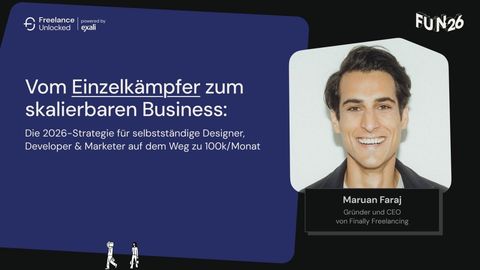

100,000 euros of revenue a month as a self-employed professional. Numbers like that usually show up in ads, not on conference stages. At Freelance Unlocked 2026, it was the title of Maruan Faraj's session, which makes it worth taking apart properly: what sits behind the number, what mechanics get you there, and where the limits are.
For context: Maruan is founder and CEO of Finally Freelancing, a coaching company that helps self-employed people build exactly this kind of business. The 100k examples are his clients, and the figures are their own reports. He is upfront that the showcases are the exception, not the average: the return of an offer, he insists, gets calculated "on average," not on the best showcase client. So the interesting question isn't whether the number is real for someone. It's what mechanic sits behind it.
Quotes translated from German.
The market data explains why the question matters. According to freelancermap's Freelancer-Kompass 2026, the average freelancer in the DACH market bills 6,653 euros of project revenue a month, down 17.1% year on year, at a stable hourly rate of 103 euros. Revenue isn't falling because rates dropped, but because fewer billable hours come in. Which is Maruan's opening argument: sell only time and you have a hard ceiling and no control over your pipeline.
The combination lock: three numbers, no hack
Anyone waiting for the one weird trick was disappointed by minute three:
"There is no single strategy. It's actually three things. Like a combination lock, one right digit isn't enough. All three digits have to be in place for the lock to open." (Maruan Faraj)
The three digits: an offer with sharp positioning, predictable lead generation, and a sales system. Miss one and growth stays random. It also explains why the same tactic works for one person and fails for another. One of his clients had sent 300 to 400 LinkedIn messages without a single reply. After repositioning the offer and rewriting the message: 29 pitches, three first calls, one closed deal. Same channel, different lock.
Digit 1: sell the dish, not the ingredients
Maruan went freelance in 2014 with the classic everything-shop: WordPress, conversion optimization, UX design, corporate identity. His formative lesson was a UI concept for a coworking app, four hours of work at 80 euros an hour. The client shopped around and picked a design student who did the same thing for 30. His diagnosis: sell individual ingredients and you get compared like a tomato at a market stall, and someone is always cheaper. "In a fine-dining restaurant I don't pay for the sum of the ingredients. I pay for the dish."
So he built a dish: conversion optimization for online shops with at least a million euros in revenue. Suddenly projects came in at 10,000 to 15,000 euros, sometimes at effective hourly rates around 500 euros. Same skills, different offer, different target group.
Three practical rules fall out of the story:
- Build on your strongest ingredient. His filter is unsentimental: open your invoicing tool. What did clients pay you most for over the last 12 to 24 months? That's market feedback, not gut feeling.
- Change the client, not the service. His example: social media management for local restaurants tops out at 500 to 1,000 euros a month, because the restaurant barely earns more itself. The same service for a client where one extra customer covers your fee is easily worth 2,000. Same work, different value created.
- Do the client's math for them. His benchmark: over twelve months, the offer should return about five times its price in extra revenue or savings, on average. Only then does it become an easy yes.
Then there's client value. Half a million a year from 2,000-euro projects takes 250 clients. At a client value of 50,000 euros, ten are enough. Maruan calls it the difference between hunting mice and hunting antelope: a mouse won't keep you fed and is still exhausting to catch.
High package prices, though, need trust that a cold prospect doesn't have yet. His bridge is the foot-in-the-door offer: a workshop, an initial audit, a tightly scoped starter project deliberately built so the follow-up offer clicks into place. The psychology behind it is well documented: Freedman and Fraser showed back in 1966 that people agree to a large request far more often when a small one came first. His metric: at least one out of every three entry projects must convert into a follow-up engagement, otherwise the design is off.
Digit 2: visibility that produces conversations on schedule
He illustrates the second digit with his worst holiday memory: family weekend at the Baltic Sea, a WordPress client emails a security warning, and a ten-minute plugin update becomes a two-hour bug hunt while his family watches the sunset. In the end he was angry at himself, not the client: he hadn't dared to say he was on holiday, afraid the client would go elsewhere.
"The greatest freedom in self-employment comes from knowing where your next client is coming from." (Maruan Faraj)
His take on the content question is refreshingly unromantic: "It's not about content. I don't care about content. It's about visibility." Visibility where your target clients are, not where your peers are. Developers impressing other developers on GitHub don't have a skill problem, in his words. They have a visibility problem.
Visibility alone is only half the digit, though. Post and wait, and you harvest what he calls the tip of the lead pyramid: every now and then someone reaches out on their own. Feels great, isn't plannable. It becomes plannable when you actively turn warm reach into conversations, at his target rate of three to five prospect calls a week, with a rule of thumb of one deal per five conversations.
Digit 3: sales is a skill, not a personality type
The third digit dismantles three excuses he hears daily. "My clients just buy" (in truth, the person who referred you did the selling). "Good work sells itself" (the iPhone is excellent and Apple still spends heavily on sales and marketing). And "I'm just not a sales person." His answer to the last one: you're competing with other developers and designers, not with insurance brokers. And the learning curves differ: the last 10% of your craft costs years, the first 80% of selling comes fast and pays straight into your business.
His frame for sales conversations is the doctor frame: the client is the patient, you ask the diagnostic questions, they don't write the prescription. As a three-step process:
- First call: Does this person need help? Can and do I want to help? Is it relevant soon, and can they afford it? Qualify before you invest. Maruan once gave a solar startup a free full-day workshop and got offered 800 to 1,500 euros plus "payment in network access." Twenty minutes of qualifying would have saved the day.
- Analysis call: Where is the client, where do they want to go, why, and what has sunk their previous attempts? The call doesn't end with "I'll send you a proposal" but with a booked date for the concept call. "Time kills all deals," so the sooner the better.
- Concept call: You play the client's situation back to them (the "are you reading my diary?" effect), establish your authority in 60 seconds, split the project into strategy and execution, and untangle every open question before the price lands. He refuses to send proposals asynchronously, because you can't read a reaction you can't see.
What's behind the 100k number (and what isn't)
Now the headline. The 100,000 euros show up twice in the talk. First as client awards from his own program: a client who, by her account, went from 7,000 to 100,000 euros in monthly revenue, and a developer with an even higher award. Second as offer architecture: his client Daniel sells AI process audits to mid-sized companies, entering through a 2,000 to 3,000 euro workshop, with a main offer around 8,000 euros a month, a 100,000-euro ticket over a year. Five such clients make half a million in annual revenue.
Three things to keep in mind when reading that number. First: these are revenues, not profits, and they're the best cases from over 1,300 clients, not the median, which he says himself. Second: the figures are the clients' own reports, as showcase numbers usually are, so treat them as what is possible, not as a forecast. Third: at that scale you're no longer a freelancer in the classic sense. You're building a company, with a sales process, entry products and often staff or a productized service. That's what Maruan means when he says:
"Being an entrepreneur doesn't mean having employees. Being an entrepreneur means being able to control and plan this." (Maruan Faraj)
How rare that control is shows in the KfW Gründungsmonitor 2026: 86% of German business founders start solo, and only about a quarter ever create jobs. Most stay structural solo fighters.
Whether you want a coach for that path is a matter of taste and situation: some people move faster with structure and someone holding them accountable, others prefer to build the system themselves. The mechanic is the same either way.
What you can take from the talk: check your invoicing tool for your strongest ingredient. Formulate an outcome offer for a target group where your result is worth a multiple of your fee. Build an entry offer with the follow-up designed in. Count conversations per week, not impressions. Whether the end result reads 100k a month depends on market, niche and stamina. But the talk lays out a coherent mechanic for predictable five-figure months.
The first step toward visibility is free, by the way: create your profile on 9am so the right clients can find you while you work on your combination lock.
Freelance Unlocked is co-organized by 9am together with Uplink and freelancermap. This article is based on Maruan Faraj's session at Freelance Unlocked 2026. Watch the full talk above, and join us at the next edition: freelanceunlocked.com.