
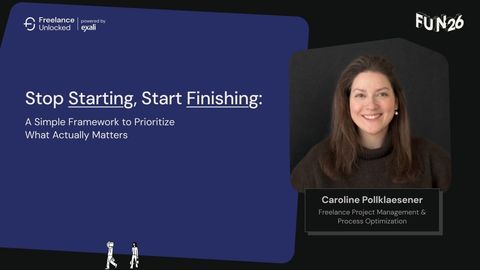

"I've got three client projects, invoices to chase, new clients to acquire, taxes to file, and I kind of want to redo my website. Where on earth should I start?"
Caroline Pollklaesener hears some version of that question constantly. Her Freelance Unlocked 2026 talk opened with it, and with a show of hands that told the whole story: almost everyone in the room writes to-do lists, almost everyone feels dread looking at them, and almost everyone has ended a ten-hour workday knowing they were productive for maybe two of those hours.
Caroline Pollklaesener is a freelance project manager and process expert from Hamburg. Before going independent about two years ago, she worked through six or seven companies of wildly different sizes and studied in Germany, Italy, Denmark, Canada and the UK. Her summary: "I saw dysfunction in many languages." She's the person companies call when nobody can see through the processes anymore, and her prioritization framework grew out of exactly that work.
Your calendar lies to you
Caroline walked through a Tuesday most freelancers will recognize. On the calendar: two client meetings, one at 10, one at 3, and glorious open space in between. In reality: email, Slack and Instagram over breakfast, then the latest client crisis, then the client weekly, then a break to recover from the weekly. You finally sit down for the project outline that could win you your next contract, an invoice arrives, and you spend 30 minutes in accounting. A developer needs feedback "right away". A load of laundry happens for no reason. At 4:30 you remember it's posting day on LinkedIn. Suddenly it's 5:30 and gym time.
Client work got done. The thing that secures your next month didn't move a centimeter.
The killer isn't laziness, it's switching. Caroline cited a figure from another FUN26 talk: roughly 23 minutes to regain focus after an interruption. That number is UC Irvine researcher Gloria Mark's widely quoted estimate, and her study of interrupted work adds the fine print: people compensate for interruptions by working faster, and pay for it with significantly higher stress, frustration and effort. The APA's summary of task-switching research points the same direction: every switch costs time and accuracy, and small switches add up fast.
As an employee, that's annoying. As a freelancer, it's existential. "You can only depend on yourself. If you don't work, then no one does," Caroline said. Nobody tells you what's important. Deciding that is your job now, and when everything sits on one undifferentiated list, everything feels equally urgent, so you graze.
The three buckets
Her fix starts with structure. Sort everything you have to do into three buckets, in strict priority order.
Bucket 1: Revenue and growth. Everything that makes money now or brings the next client. Client projects and their deadlines. Writing invoices, and chasing them, because an empty bank account caused by a client's slow accounting is still your problem. Acquisition and your lead funnel live here too, and this is where freelancers slip: you get absorbed in billable work, the project ends, and you're standing there asking what's next. Caroline admitted she's done it herself, repeatedly.
Bucket 2: Maintenance. What keeps the machine running without directly generating revenue: accounting, taxes, admin, setting up your CRM or database. Her nickname for the bucket is "what does not upset finance". One warning here: deadlines override everything. The tax office won't remind you before the 9th, but it will absolutely send a late notice with fees after it. Work with deadlines, not against them, and plan them in advance so they never sneak up on you.
Bucket 3: The annoying rest. The "I don't want to do this" pile. The workflow that's bugged you for weeks, the Notion cleanup, the email signature, the winter coat that's needed dry cleaning since, in her case, roughly June. Private errands go in here too; the pile doesn't discriminate.
The trap is that most people start in bucket 3, because those tasks are bite-sized and satisfying to cross off. "This doesn't bring you forward," Caroline warned. And there's a lesson hidden in that comfort: if the annoying stuff is easy to start and your revenue work isn't, your revenue tasks are cut too big. Break them into pieces you can actually finish.
From brain dump to highlighter
The weekly routine that makes the buckets work takes maybe twenty minutes:
- Brain dump everything. Your written to-do list is only a fraction of what's actually circling your head. Get all of it out on paper. The relief is immediate.
- Sort into the three buckets, with headspace. Not on Wednesday evening between a client call and a networking event. Caroline does it Monday morning with a coffee, before work starts, and gladly gets up earlier for it because it sorts the entire week.
- Write the lists down once. She keeps three physical lists on her desk so she never re-decides priorities on the fly. Re-sorting every time you open your list is its own form of brain fog.
- Highlight what's next. Take an actual highlighter and mark the one or two things per list that must happen today. When a distraction shows up, it now feels like a distraction, not a welcome escape.
- Apply the two-minute rule. Borrowed from David Allen's Getting Things Done: anything under two minutes, do immediately. Everything else goes on the list.
Then revisit. Your to-do list from two weeks ago shouldn't be your to-do list today. Caroline clears and re-sorts hers every one and a half to two weeks; daily felt like overkill, weekly didn't stick.
"It's not about doing more. It's about knowing what to do next and working on the stuff that actually matters." (Caroline Pollklaesener)
Five habits that make the week calmer
The buckets tell you what to do. Five habits from the talk make doing it less exhausting:
- Reduce mental friction. Lists ready on the desk, workspace set up, sorting done in advance. If step one of working is figuring out what work is, you won't start.
- Limit distractions for real. Do-not-disturb on, notifications silenced. Caroline has put her phone on the charger in the next room to finish things. It works.
- Batch similar tasks. She does the month's entire accounting in two hours on the 5th or 6th and refuses to think about it otherwise. Batching turns many expensive context switches into one.
- Find your patterns. Maybe you do your best work in the morning. Maybe one client reliably drains you. Patterns you know about are patterns you can plan around instead of fight.
- Plan ahead for recurring work. The newsletter that "sneaks up" on you every two weeks is fully predictable. Put it in the calendar before it becomes an emergency.
In the Q&A, someone confessed to 40 abandoned to-do lists in their notes app. Caroline's advice: start from the newest one and ignore the archaeology, then keep the current list on paper on your desk where it can catch you mid-distraction. Digital lists in Notion or Jira earn their place when clients or collaborators need visibility; on your own, the paper version is harder to lose behind 14 browser tabs. If you're comparing task and workflow tools anyway, the 9am Freelancer Toolbox has a curated shelf of them. And when someone asked how to find time for learning new tools at all, her answer was pure bucket 2: it's maintenance, so schedule a protected deep-work block for it, phone in the other room.
Her closing line is the one to pin above your desk: "Your to-do list will never, ever be empty, but now you know where to start." Finishing, it turns out, is mostly a sorting problem. And if the thing you keep not-finishing is your own visibility, that's a bucket 1 task you can close today: create your free profile on 9am and let the next project come to you while you work.
Freelance Unlocked is co-organized by 9am together with Uplink and freelancermap. This article is based on Caroline Pollklaesener's session at Freelance Unlocked 2026. Watch the full talk above, and join us at the next edition: freelanceunlocked.com.