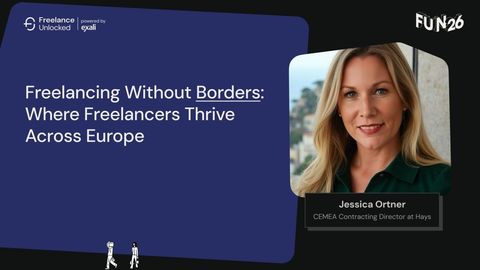
There is no best country for freelancing in Europe, and anyone selling you a top-10 list hasn't done the math. That was the opening disclaimer Jessica Ortner gave at Freelance Unlocked 2026: if you walked in with the Booking.com app open, ready to pick your new base by the end of the session, you'd leave disappointed. What she offered instead is more useful, a framework you can run for your own profession, your own rates, and your own life.
Jessica has the data to back the caution. She has worked in staffing for over 20 years, most of it at Hays, the global recruitment group, where she is Contracting Director for Central and Eastern Europe, the Middle East and Africa. She also runs the freelancer community of her alma mater, the WHU. Her core observation from both roles: your profession may stay the same, but the moment you cross a border, freelancing becomes a completely different reality.
Santa Claus, the original cross-border freelancer
Her example for what "cross-border" actually means: Santa Claus. "One day a year, he travels around the globe, delivers his services to different clients with totally different expectations. They even name him differently." The other 364 days, she suspects, he does the paperwork for the mess he created.
The serious version: you're a cross-border freelancer when the answers to "where do I live", "where do I work" and "where do I pay taxes" are not the same country. By that definition, few people qualify. When Jessica asked the Berlin audience who earns more than 20% of their revenue cross-border, only a scattering of hands went up, which matches the research: digital nomads are still a minority among freelancers. Her bet is that this changes over the next 5 to 10 years, as hybrid work erodes the last reasons to insist on a local contractor in the office four days a week.
Until then, her advice is an equation. Score every country on three factors, weighted your way: opportunity, legitimacy, and ease.
Opportunity: size, sort, and price of the cake
Opportunity breaks into three questions Jessica sums up as the size of the cake, the sort of the cake, and the price of the cake.
Size and sort: the four biggest contracting professions across Europe are tech, engineering, professional services, and life science, but their weight differs enormously by country, and a big economy does not automatically mean a big freelance market. Staffing-market size doesn't track GDP. The Netherlands, with its famously flexible workforce, has a far larger staffing market relative to its economy than Germany does, she noted, and that maturity shapes everything: how clients perceive freelancers, and how politics regulates or supports them. So research your own niche in the target country, down to your specific role rather than the generic label "tech".
Price: for tech roles, the Hays Tech Talent Explorer is a free tool that compares average contracting day rates and their ranges country by country, along with the projected AI impact per role. Jessica's added twist is to check future demand alongside today's: "If you want to change your profession, change it to something that exists in 5 or 15 years from now, or is even growing." For a broader look at what independents charge across the continent, see our data roundup on freelance rates in Europe in 2026.
Legitimacy: the legal hand and the tax hand
Legitimacy is the unglamorous middle of the equation, and the part Jessica says freelancers most often underestimate. It has two hands: the legal one (which country's law governs your contract, and where you can be held liable for your work after a project ends, a real issue in engineering and life science) and the tax one (income tax, VAT, what you can deduct, and who gets to question your status).
Four questions determine your footprint:
- Where do I physically work, over a real period of time, not a workation week?
- Where is my client, or more precisely, which jurisdiction is written into the contract I sign?
- Where is my business registered? Working from Spain through a German GmbH has consequences.
- Where does the money flow? Modern payment providers are convenient, but if your money routes through a third country, that can matter too.
Her rule of thumb: if the first three answers don't align, assume complexity. And the balance of power between tax and legal authorities varies wildly. In the UK, contractor status is policed by the tax authority through the off-payroll working rules known as IR35; for medium and large clients, it's the client, not you, who determines your employment status for tax.
"The moment you go to Belgium, no one knows what IR35 is. They don't even care. It's a totally different legislation." (Jessica Ortner)
Germany has its own famous construct, Scheinselbststaendigkeit, which even Jessica introduced with an apologetic pause before attempting the word. The criteria are notoriously blurry; if your work is Germany-based, our free false self-employment self-check shows you in a few minutes where your setup stands. The Netherlands sits at the other extreme: your status as a zzp contractor is assessed against criteria the government itself publishes, and since 1 January 2025 the Dutch tax authority actively enforces the DBA rules against false self-employment. Clearer, but with teeth.
"Don't optimize only for flexibility. Optimize for compliance. The more flexible your setup is, the more structured your compliance needs to be, because risk travels with you." (Jessica Ortner)
Practically, that means choosing your engagement model deliberately. A direct contract keeps the whole margin but also the whole risk; an intermediary, an agency of record, or an employer of record typically costs something in the range of 5 to 10% for the compliance part, which Jessica frames as the price of "safe nights". Build a small advisory ecosystem (tax advisor, basic legal literacy), and be transparent with your clients: they face the same compliance questions internally and will value a contractor who handles them proactively.
Ease: the soft factor that decides whether you stay
The third factor is the one spreadsheets miss. Ease covers culture, structure, stability, and lifestyle.
For culture, Jessica points to Hofstede's six cultural dimensions and the free country-comparison tools built on them, especially useful before working into Asian markets. For structural and economic questions, she recommends checking how easy it is to register and run a business; the World Bank's classic Ease of Doing Business ranking she referenced has since been retired and replaced by the Business Ready (B-READY) report, which compares business environments across economies. Currency stability belongs here too: getting paid in a volatile currency can quietly reshape your income.
Her cautionary example is Dubai. Attractive taxes, attractive day rates, and, as she noted on stage, newly flexible freelance visa options. "At the same time, they have a war next door. So I don't know if you want to be there currently." That doesn't mean avoiding Dubai. It means pricing predictability into the return, a lesson anyone who optimized purely for the tax rate has just relearned.
And lifestyle is legitimately part of the equation: distance from home, cost of living, whether you can thrive in the weather. Soft, but it decides whether you last.
So where does the vibe feel right?
Pressed by the moderator for names anyway, Jessica gave her personal read of the map. The Nordics, the Netherlands and Belgium have freelancing in their roots, with mature markets and broad acceptance of independent work. Iberia and Italy are currently growing while Germany stagnates, with plenty of projects but noticeably lower day rates. For English-only freelancers, Poland, the Czech Republic and Romania are easy terrain, while France and Germany will still ask whether the candidate speaks the local language. All of this is her on-stage assessment, not a ranking; your equation may weigh it differently.
Her closing was a community pitch rather than a country tip: the complexity itself is why so few hands went up, and it will take freelancers organizing together, alongside platforms and staffing firms, to push politics and tax systems toward making cross-border work easier. If the DACH market stays part of your footprint while you run your own equation, create a free profile on 9am so companies here can find you wherever you happen to be working from.
Freelance Unlocked is co-organized by 9am together with Uplink and freelancermap. This article is based on Jessica Ortner's session at Freelance Unlocked 2026. Watch the full talk above, and join us at the next edition: freelanceunlocked.com.