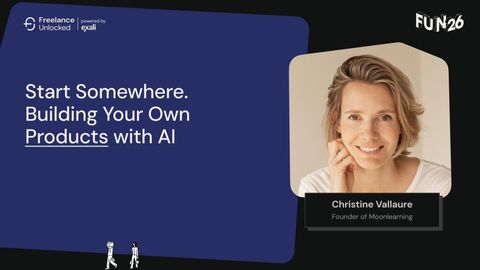

Christine Vallaure opened her Freelance Unlocked 2026 session with an unusual request: please don't feel inspired. Last year, the Moonlearning founder showed how she builds digital products as a company of one, and the inbox full of "so inspiring!" emails that followed apparently annoyed her. "I don't want you to be inspired. I want you to get into the making. I want you to get building."
Then she delivered 35 minutes on exactly how, aimed at freelancers who, in her words, wake up and choose between doomscrolling war, climate change, or AI eating their job.
The job market is being squeezed, not deleted
Christine is a product designer, so she started with the fear and the numbers behind it. The World Economic Forum's Future of Jobs Report projects 170 million jobs created and 92 million displaced by 2030. Net result: 78 million more jobs. The problem is not the total. It's the shape.
Her image for it: the job market is a can, and AI is Hulk squeezing it. The contents splash out at both ends, toward deeply human work (nurses, teachers, electricians, anyone who has to be physically present) and toward deep technical skills. The broad middle, where most knowledge workers sit, is under pressure. In her own field, AI eats the job ladder from the bottom: junior designers and entry-level production roles go first. The middle layer of real expertise, which is where most freelancers live, stays. What changes is what sits on top of it.
That top layer is not coding. She was emphatic about this all session. It's AI literacy: a hat you put on your existing core skill. "The hat needs somewhere to sit. You need a skill underneath to point the AI at." And the hat only works if you actually engage: she compared it to her seven joyless years of school French, which stopped at "je m'appelle," versus friends who went on exchange and fell in love with the language. Teams that tell her "we don't like AI, just show us enough so we don't fall behind" learn about as much as she did in French class.
Understand the model, ignore the hat parade
Before any tool demos, Christine drew the landscape, because overwhelm comes from not knowing what you're looking at. The generative AI we all argue about is the loudest part of the field, not the biggest. On the same foundations run specialized scientific models most people never touch. Her test: everyone in the room knew ChatGPT; about seven people knew AlphaFold, the protein-structure model whose creators won the 2024 Nobel Prize in Chemistry. "We have the theater where we're all operating the whole day. But the progress, we're giving very little thought. And that's actually the very good news."
Her sorting principle for the noisy consumer layer: there is a company (with an agenda), a model (the brain), and a tool (a hat on that brain). ChatGPT is not the model; it's a hat. Lovable builds on the same models. Every shiny new tool next week runs on a model you already know. "You should only wear the hats you need." Once that clicks, the weekly tool panic loses its grip.
Three ways in: vibing, pairing, agents
Christine organized the practical landscape into three pillars, each with a different depth of involvement.
Vibe coding (Lovable, Bolt, Replit): you describe what you want in plain language and the tool builds front end, back end, and database. Her demo was a brief generator for freelancers: clients paste their messy request email, out comes a structured brief with deliverables and a downloadable PDF, saving rounds of back and forth. She built it from a description, added editing and a login by chatting, and published it with one click. Other examples: an Alpine-crossing route matcher built in about three hours, and a finance tracker that categorizes pasted bank statements without any personal data, complete with a savings-potential button her family didn't appreciate.
The caveats were just as concrete. You can't control the design; the same prompt produces different results, and as a designer that drove her up the wall until she flipped her mindset. And she put up a slide for one of the conference organizers who believes otherwise: "You are not going to build Salesforce with Lovable." Complex products, sensitive data, shipping to real users without the background: wrong tool. Fun projects, prototypes, internal helpers, pitch ideas: perfect. For client-facing internal tools she pointed to secure-environment variants that wire into Slack and Google Drive.
AI pairing (Cursor, Windsurf, Copilot, "these days I'd say go into Claude Code right away"): the same principle, but you sit closer to the actual code and learn its structures instead of building in a black box. Her rule of thumb for both pillars: treat the AI like an intern. Would you ship its work unless someone looked at it?
Agentic AI is her favorite, and the part her feed is full of: AI that takes a goal and works out the steps, with "little hands" that reach into your folders and other apps. Her setup is a small named team: Quinn the lead, Jordan for business, Jamie as her writing voice, Alex the designer. Paste in a client email and Jordan checks it against her rates and scope, flags what to consider, and drafts a reply. She adds the human touch and hits send herself; no automated emails, no inbox access. The whole team is defined in a plain text file the AI reads on startup. "It's literally just a file describing what I want to do." Connections to other tools run through MCP, which she described as a USB-C cable: her agents read her Figma file and build components from her design, because she refuses to let AI generate the design itself.
Her favorite example of core-plus-hat came from a university workshop the day before: a psychology lecturer realized agents could role-play patients so students can practice therapy conversations safely. Built in minutes, valuable because the lecturer brought the clinical knowledge. "These tools are to elevate your work, not to replace your work. They become good when you bring the skill."
Why this matters for DACH freelancers specifically
The business case landed near the end. German Mittelstand companies are all facing this transition, and Christine's pitch is that they don't want a shiny consultancy for it:
"They don't want some fancy consultancy coming in. They want you. You who knows their business, who's been working with them. If you as a freelancer bring that knowledge to them and help them in that transition, that is really valuable." (Christine Vallaure)
The market data backs the instinct: Upwork's Future Workforce Index 2026 finds freelancers who use AI earn 34% more per hour, with the premium concentrated in work that combines AI with domain expertise and judgment rather than raw output.
She was equally honest about the texture of the work. The smooth videos are edited: "I've cut out 20 minutes of stuff that fails all the time. They hallucinate. They break. You burn tokens. It's the wild wild west. You got to jump in and just tinker with it." Her closing warning was about who gets to shape the products being built right now. The window is open but not forever, "like deck chairs in Mallorca," and the current builder landscape looks like the same people who built the last decade of startups. She'd rather see nurses, energy experts, and designers claiming a chair.
So start somewhere. Pick one annoyance in your own back office, describe it to a vibe-coding tool tonight, and see what comes back. And if the product you build first is your own freelance business, put it where clients can find it: create your free profile on 9am.
Freelance Unlocked is co-organized by 9am together with Uplink and freelancermap. This article is based on Christine Vallaure's session at Freelance Unlocked 2026. Watch the full talk above, and join us at the next edition: freelanceunlocked.com.