
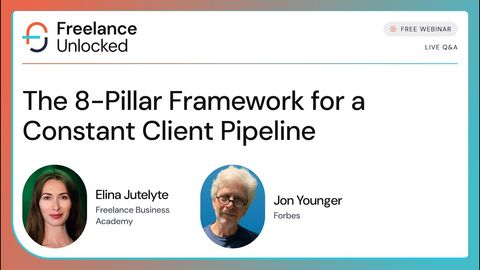

Elina Jutelyte signed solid client contracts on day one of her freelance career. She wondered why anyone found client acquisition hard. Two years later, every one of those contracts was cancelled at once, and she stood in the market with zero pipeline. That shock became an eight-year research project: talking to freelancers, coaches and experts to answer one question. How do you make sure the next client is already lined up before the current project ends?
She brought her answers to the 9am webinar "How to Ensure a Constant Customer Pipeline as a Freelancer", hosted by Marc Clemens, CEO of 9am. Alongside her: Jon Younger, the Forbes author often called the godfather of the freelance revolution, who has probably interviewed more freelancers and freelance platforms than anyone alive. Jutelyte has freelanced for over a decade, founded the Freelance Business Community and runs Freelance Business Month, now in its seventh edition.
The session also produced one of the more charming moments in webinar history. A few minutes into her talk, Jutelyte's connection froze. She kept presenting, to herself, for 25 minutes, while Marc and Jon improvised live on the same topic. She took it with humor ("I actually delivered a presentation for myself") and later re-recorded her full talk as a standalone video, which you'll find further down. So you get both: the live conversation and the complete framework.
Your conversion rate is decided before the first conversation
Jutelyte opened with a spreadsheet, not a sales script. Work out how many billable hours you have, how much revenue you need, what project sizes you sell, and you end up at the column that matters: conversations. How many conversations does it take to win one project?
Her numbers span a brutal range. With no prior relationship and weak positioning, roughly 2% of conversations convert. You'd need around 200 conversations to land a handful of projects. With strong positioning and recognized expertise, conversion can reach 60%, which means eight good conversations can fill your year.
"If you only need eight conversations a year to fix your projects, it's much easier if you know who to reach out to and what to sell to them," Jutelyte said. Pipeline conversion, in her words, "depends on your proximity to customers."
Younger put the same idea in relationship terms: "You can't establish trust at the end of a gig. You've got to establish trust before it starts." If 2% of cold conversations go somewhere, a little trust built in advance might double or triple that. He also had a warning for anyone tempted by the make-money-while-you-sleep ads Jutelyte had just shown on screen: that's dreaming big without dreaming real. "You need a system. You need a set of steps that takes you from A to wherever it is you're going."
Match your prospecting rhythm to your runway
While Jutelyte fought her router, Marc picked up the piece most freelancers get wrong: timing. The right channel depends on how far you are from your next gap.
Far from the gap, you're in passive mode. Visibility, inbound, LinkedIn presence, SEO, keeping the machine running. Around 8-10 weeks before you need a project, you switch: activate your profiles, set yourself to available on platforms, adjust your title, tell your old network you're open. From the first reactivation email to the first call alone, expect two to three weeks. Then comes active outbound and, if it gets tight, the final push. Ideally you never reach the stage where rate flexibility is the only lever left.
Platforms demand their own tactics right now. Where a project used to draw 20-30 applicants, Marc sees 100-130 today. "You need to be the absolute first to apply. If I'm the hiring manager, I will only check the first 10 or 15 people," he said. Speed and keyword match decide whether you exist in that channel at all.
How much time should pipeline work take? Younger didn't hesitate: "Simple. 50/50. You need to spend half of your time securing your future and the other half delivering on your present. If you're not spending 50% of your time on securing your future, you have less future to be secure."
Half sounds extreme, and Jutelyte runs a softer version: Fridays for marketing, Mondays for admin, client work in between. The point both agree on is that strategic work needs fixed, recurring slots. It never happens as a leftover.
On referrals, Younger reached back a few millennia: "It's better to hunt in packs." A small group of freelancers who pass each other leads and open doors beats any solo effort. His rule is to give more than he gets, and: "Don't be greedy." A lead that fits a trusted colleague better than you is still worth something if you hand it over well.
Research backs him up twice over. A study of roughly 10,000 bank customers by Schmitt, Skiera and Van den Bulte, summarized in Harvard Business Review, found referred customers churned about 18% less and had 16% higher lifetime value than customers won through marketing. And a 2022 Science study by Rajkumar and colleagues, based on experiments with 20 million LinkedIn users, showed that moderately weak ties, the former colleagues and loose acquaintances you rarely talk to, drive more job mobility than strong ties. Your next project likely sits at the edge of your network, and it behaves better once it arrives.
Elina's full presentation: the 8P positioning system
Here's the complete talk Jutelyte re-recorded after the webinar, whiteboard and all.
She starts with the trap: freelancers hear "positioning" and think it means picking a niche and an ideal customer profile. That advice points inward, at yourself. Real positioning, following Al Ries, is what you do to the mind of the prospect, and that requires interaction with actual customers. Her image for the difference is a mysterious shop on a busy street. No sign, no window display, sealed glass, door open. A few curious people wander in and discover it sells stones. "Lots of freelancers are acting exactly like that. They open the shop and they think customers will come." The niche-and-ICP layer is the tip of the iceberg. Under the waterline sit eight Ps.
Product. Your service, defined as a solution to a client problem plus an outcome. "Not copywriting, not software development. Solution to a customer problem." And there are only two outcomes clients reliably care about: "One, you help them to earn more. And two, you help them to save more." Lead with those and, she guarantees, you have their attention.
People. Your ideal customers, yes, but also your network ("The network is everything. People with huge networks have more success, and it's actually scientifically proven") and one soft skill: communication. A German developer targeting French clients in German only won't get far, however sharp the offer.
Place. Where your people hang out. LinkedIn is the default answer, but she's seen freelancers win consistently through communities, co-working spaces and accelerators. Own one place and you get recognized there, and eight conversations a year suddenly become findable.
Promotion. Building your personal brand, which stops being scary once product and people are defined. "The moment you define a product and the people you target, you know what to talk about and where to talk about it, and you can't stop talking about it."
Physical evidence. Social proof and trust signals: testimonials, case studies, portfolio, your website. "It's when customers sell for you, almost." Jutelyte spent years not collecting proof of her results and calls it her most expensive mistake.
Process. Work delivery, business admin, and your own frameworks and IP. Small repeatable methods you can name and monetize; that's how consultants end up with books and courses. Process failures hurt too: the fastest-growing company in Belgium once sent her an inquiry through her website form, into a mailbox she didn't check. She found it three months later. "This is how your process can let you down on your positioning."
Performance. Two angles: quality of work and personal satisfaction. Poor quality means no repeat clients, and repeat clients bring the bulk of your revenue. Low satisfaction means burnout, and then the rest of the system collapses with you.
Price. Deliberately last. "Most freelancers compete on price only. And why does it happen? Because all the rest is absent." Get the other seven working and the logic flips: you deliver a concrete outcome, so you can charge for the outcome. That's the actual path from hourly rates to value pricing, and it can't be shortcut by raising your rate overnight.
Her closing answer to the pipeline question is almost anticlimactic: build meaningful connections that bring value to you and to your customer. Everything else in the system exists to make those connections convert.
Your weekly pipeline checklist
- Block two fixed slots for pipeline work and treat them like client meetings.
- Have five real conversations with prospects, partners or past clients.
- Check every lead inbox: website forms, platform messages, LinkedIn requests.
- Follow up on anything quiet for more than a week, including clients you declined.
- Ask one client for a testimonial, a case study or an introduction.
- Pass one opportunity or useful contact to another freelancer.
- Publish one piece of evidence: a post, a result, a lesson from a project.
- Check your runway: if a gap is 8-10 weeks out, switch to active mode now.
Total time: a few hours. Cost of skipping it for three months: Jutelyte already told you that story.
A big thank you to Elina Jutelyte, Jon Younger and Marc Clemens for an honest session, technical drama included. More live webinars and events are listed on 9am's events page. And if you want projects finding you in the meantime, create your free 9am profile and put your positioning where clients are already looking.
This article is based on 9am's webinar "How to Ensure a Constant Customer Pipeline as a Freelancer" and Elina Jutelyte's follow-up recording of her full presentation. Watch both above.