

Buried in the U.S. Census Bureau's nonemployer statistics, the data on businesses that run no payroll and employ nobody, Elaine Pofeldt found something the business press had ignored: across almost every industry, one-person businesses were crossing one million dollars in revenue. Nobody had written the manual for them. So she did.
Elaine Pofeldt is an independent journalist, ghostwriter and former senior editor at Fortune Small Business, freelancing since 2007 and raising four children along the way. Her case studies, first collected in her Forbes column, became The Million-Dollar, One-Person Business (Random House, 2018) and the sequel Tiny Business, Big Money (2022), for which she and her daughters crunched seven batches of government data to find the industries where tiny teams earn the most. The number two industry for businesses under five employees, in case you're wondering: butter creameries. Number one was riverboat casinos, which she declines to recommend.
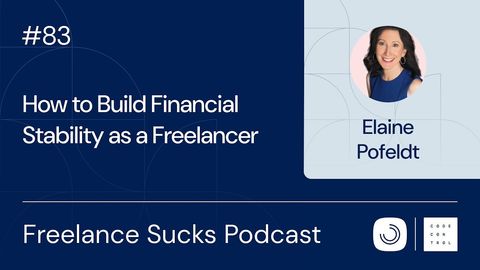
Elaine joined Yurii for both 9am podcasts, Episode 83. On Freelance Thrive, she explained what the freelancers who reach seven figures do differently. On Freelance Sucks, she talked about the part that makes it hard: uncertainty, clients who go dark, and the financial fear that pushes freelancers into bad decisions.
One meaningful thing every workday
Ask Elaine what separates successful solopreneurs from the ones who stall, and her first answer has nothing to do with talent or niches. It's consistency. Many people call themselves solopreneurs, she says, but make a half-hearted effort and don't show up for their business every day.
"You don't need to sit there toiling away for ten hours a day, but you do need to do one meaningful thing every workday to keep moving forward. It sounds simple, and it is simple. But it isn't easy." (Elaine Pofeldt)
The second differentiator is a thick skin. The people who reach one million put things out into the world constantly, an offer, a course, an article idea, and let a hundred rejections bounce off. "One person's rejection is just that: one person's rejection. They're not the ultimate judge and jury on your ideas." The freelancers who make it treat a no as one name checked off a list of a hundred, pace themselves emotionally, and see themselves as lifetime entrepreneurs, so a bad day is a blip, not a verdict.
And how do you know your consistency is pointed in the right direction? Peer learning, the backbone of both her books. Find five people with similar lives and constraints who are slightly ahead of you, study what kinds of projects they actually do, and ask whether you're doing the same type of work or clinging to a category they've already outgrown. Maybe you're writing articles while the people ahead of you moved to white papers. Then learn the new skill, usually from a friendly competitor. "The next time, they'll be calling you."
Your savings account is a negotiating position
The bridge between the two episodes is one idea: money buys you the ability to behave like a professional.
"The basis of a successful freelance business is your own personal finances. You need the freedom to walk away." (Elaine Pofeldt)
Her formula is concrete. Live about 20 percent below your means. Keep enough savings to survive a couple of months if you lose a major client. Diversify your client base so no single name controls your income, and keep developing your pipeline even when you're busy. Without that cushion, every difficult conversation is contaminated by fear. "If you're in scarcity and your family won't eat because you said no to a client, you're going to say yes. And then you hurt your own reputation, because you said yes to something you can't do or don't want your name on."
For anyone not there yet, she prescribes a 30-day push: prioritize revenue and savings every single day until at least one month of rent and food money sits in the bank. And she asks freelancers to do the thing creatives resist most, get interested in their own numbers. Keep proper books, know where you stand, "be the CFO of your own life. Spend five minutes a day on it and you'll be in a different state of mind when you talk to clients." She outsources her own bookkeeping for a couple of hundred dollars a month, having accepted she will never love double-entry accounting; the alternative was slogging through QuickBooks on beautiful spring days.
The advice travels well. In the German-speaking market, the Freelancer-Kompass 2024 found 58 percent of freelancers naming project acquisition their biggest problem, the exact feast-or-famine pressure Elaine's buffer is built to absorb.
Swim toward the light
The Freelance Sucks half of the conversation starts with the challenge Elaine considers universal: uncertainty. The world changes fast, so the businesses that hire freelancers change fast, and you have to meet that on your bad days as well as your good ones. Her stabilizers: financial reserves, modest living compared to your corporate friends at least for a while, and a support network, whether that's freelancer friends you call about a strange client situation or podcasts that keep you inspired. "You cannot do it alone, or you'll peter out over time."
Then there are the clients who go dark mid-project. You're working away, the communication stops, and you don't know if they're going bankrupt or just busy. Elaine's answer is trained intuition: pattern matching. Notice the early signals, the company entering an acquisition, the mysteriously changed tone, and address things directly and diplomatically before they fester. Early in her career she'd call a freelancer friend to sanity-check her read on a client. Sometimes it was just her mood. Often it wasn't, and she learned to trust her gut, because you don't want to keep pouring work into a project for a client who has quietly become insolvent.
Some clients aren't unstable, just unhealthy: erratic, up and down, impolite. Elaine stopped working with them, not by firing anyone, but by simply never pitching them again and doubling down on compatible people.
"My motto in my business is swim toward the light. Am I swimming toward people who bring light into my life, toward projects and activities that bring light? There's a lot of darkness in the world, but I don't have to build my business around it." (Elaine Pofeldt)
Attracting ideal clients is half the job, she says. The other half is being able to say no to the non-ideal ones, which loops straight back to the savings account.
Escaping the hourly rate, step by step
Yurii asked the question every service freelancer eventually faces: how do you move from trading hours for money to scalable income? Elaine refuses to sell it as an overnight trick. "There are a lot of people out there saying don't trade time for dollars. But if your industry runs on hourly rates, it's hard to escape that."
Her sequence starts unfashionably: do the work and become genuinely proficient, because "you have no bargaining power if you're still learning on your client's dime." Her own apprenticeship was seven years of newspaper jobs, three stories a day, knocking on doors after tragedies and learning to interview with empathy under deadline. That skill, built long ago, is what lets her charge well today.
Then build authority and signal it. Share knowledge publicly the way Yurii's book posts caught her attention in the first place; a well-curated list told her he was knowledgeable before they ever spoke. Once clients come to you for judgment and expertise rather than task execution, switch to value-based pricing: a flat fee, say 3,000 dollars for a white paper, where the client gets the document plus your advice on sources, data and what made previous papers succeed.
The last multiplier is efficiency. Elaine uses ChatGPT and Gemini to clean up and summarize weeks of interview notes, and Fathom to record client conversations, 50 calls with a single book client, each searchable. The white paper that took a week might take a day, at the same flat fee, with the saved hours going into the creative work the client actually pays for. Tools like these are exactly what the Freelancer Toolbox rounds up if you want to build a similar stack. She delegates the rest: bookkeeping, research, an agent for book negotiations, her kids on web, social media and spreadsheets. Her books condense this into four questions worth asking about every recurring task: What can I eliminate? What can I outsource? What can I put on the back burner? What can I say no to?
Starting from zero? Here's her runway plan
For beginners, Elaine's advice from the Sucks episode is a three-part running start. First, give yourself runway: you might get no business for the first three to six months, and one LinkedIn post won't do it, "you might have to put up 50 before anyone knows you're a freelancer." Second, chase quick wins, even imperfect ones, because cash flowing in brings energy, and volunteering for a local business beats an empty answer when a prospect asks what you've been working on lately. They're asking what you've done, not what you were paid for. Third, get out of the house, physically or on Zoom: show your face at events, ask one question, follow up with the host on LinkedIn.
Her one regret, looking back at her own start in 2007, when she was calculating the price per diaper between assignments: she would have saved more first. "No matter how creative and non-financial you are, you still need to master the financial side. It is a business. If you don't master that, you won't have the other things you want."
What to do with this
- Do one meaningful thing for your business every workday. Consistency beats intensity.
- Treat rejection as arithmetic: one no is one name off a list of a hundred.
- Live roughly 20 percent below your means and bank a couple of months of runway. That cushion is what lets you say no.
- Spend five minutes a day as CFO of your own life. Outsource the bookkeeping if you hate it.
- Watch for client warning signals early, and stop pitching the clients who drain you. Swim toward the light.
- Master your craft first, then sell judgment at flat fees instead of hours.
- Find five peers slightly ahead of you and learn what they actually sell.
Elaine built a business that fed four kids and produced two books on a schedule that started at 5 a.m. while the children slept. The mechanics are copyable. If you're building your own version in the DACH market, create a free profile on 9am and get in front of companies that hire freelancers directly. Then listen to both episodes above; her stories carry the detail no summary can.
This article is based on Elaine Pofeldt's conversations with Yurii on the Freelance Sucks and Freelance Thrive podcasts by 9am. Both episodes are embedded above.