No study exists that measures how much a case study moves a client's hiring decision, so do not trust anyone who quotes you a percentage. What holds up is the structure: the client's problem in the client's words, what you actually did, and the result as a number. Most freelance portfolios fail at the last part and read as a task list. If a client will not let you use their name, describe them by industry, size and region and keep proof on file. Three fill-in templates below.
A freelance portfolio usually reads like this: built the website, wrote the copy, set up the CRM. That is a list of things you touched. It tells a buyer nothing about what changed for the company that paid you.
One piece of honesty first. We went looking for research on what clients read before hiring a freelancer, and how much a case study shifts the decision. It does not exist in citable form. Upwork's research hub and the usual "freelancing statistics" roundups measure market size and earnings, not buyer behaviour. If you have seen a confident "78% of clients check your portfolio first" going around, nobody we could find has measured it. So: the structure experienced freelancers use, and why.
The three-part spine
The problem, in the client's terms. Not "the client needed a React developer." That is your language. "Onboarding took eleven days and 30% of new users dropped out" is theirs, and it is the sentence their boss said out loud in a meeting.
What you did, briefly. Two or three sentences. Method, constraints, the decision you would defend. Enough that a technical reader believes you, short enough that a non-technical one keeps going.
The result, as a number. Revenue, hours, conversion, error rate, time to market, headcount not hired. No number available? Give a before-and-after in plain language and say why.
That spine is standard practice, not proprietary research. It works because of what the reader is actually doing: deciding whether their problem is one you have solved before.
The number is the whole argument
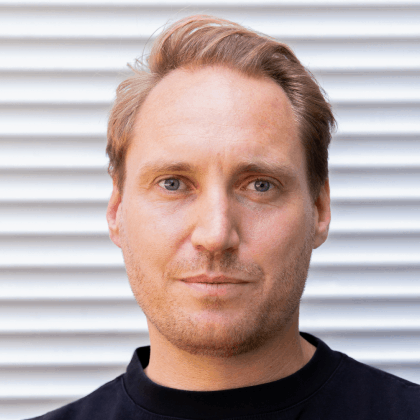
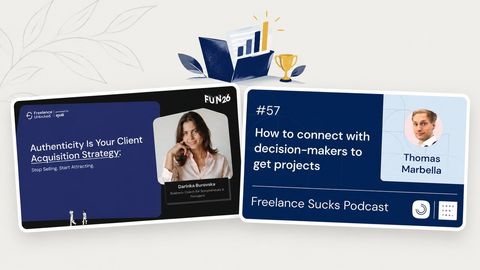
Thomas Marbella has been a freelance app developer for over 15 years and runs OneCode. On the Freelance Sucks podcast he described the moment a price stops being negotiated.
"I was offered a job for, I don't know, 50 grand a month for a tech due diligence and I was like, that's a lot of money. And they were like, yeah, but if everything goes well, you save us up to a quarter or half a million euros." (Thomas Marbella)
Nobody argued about the fee, because it sat next to a bigger number. That is what a case study does: it puts your price beside the number it produced last time, before anyone asks what you charge. His diagnosis of why most developers never get there:
"I know many developers out there only thinking their code and stack. That's fine, but try to think of a win-win situation, the actual value you can provide." (Thomas Marbella)
He proved it live once: he liked the Chrono24 app, wrote to them about their cross-platform choice, argued with their CTO for half an hour over whether it felt native, and came out with a conversation about joining their team. "If you can actually provide value, you're good to go," as he put it.
Write about the client, not about yourself
Darinka Burovska coaches solopreneurs and founders. Her Freelance Unlocked session was about what happens to client conversations when you stop optimising them. She told of a founder who wanted help scaling a company that was nowhere near ready. She said so, lost the deal, and got three of his founders as clients instead.
"I didn't see him as a deal and try to sell him something. I was honest, I saw him as a human being and I shared honestly what I saw." (Darinka Burovska)
"You don't see the client in front of you as a deal or as a revenue number. You see them as a human being going through the same challenges, the same path as you are." (Darinka Burovska)
That is the editing test. Count the sentences whose subject is "I" or "we". If it is most of them, you have written a resume entry. The subject of a case study is the client and their problem. You appear as the thing that changed.
When the client says no
Plenty of contracts, and plenty of nervous clients, will not let you use a name. That changes the header, not the case study.
- Describe instead of naming. "A 40-person logistics company in DACH" carries almost all the signal the logo did, and it is honest.
- Use ratios instead of absolutes when the absolute would identify them. "Cut support tickets by a third" is safe where "from 900 to 600 a month" is not.
- Keep the proof on file. A redacted screenshot, a written confirmation, a dashboard export with names blacked out. You never publish it. You send it once, to the prospect who asks.
- Ask at signature, not at the end. One sentence in the contract: the contractor may describe the project anonymously in their portfolio. Most clients sign it without comment. Our guide to what belongs in a freelance contract has the rest.
Vanessa D'Souza, a learning experience designer in Berlin, has the habit that makes this easy later.
"I take a lot of screenshots. If I get some really good compliments along the way, I take screenshots. I save those voice notes. I go back to them and I say, okay, I'm worth it, I know what I'm doing, and this is proof." (Vanessa D'Souza)
She asks up front instead of at the awkward end: "talk about it at the beginning of the project, I would love to collect your testimonials at the end, this is how it works."
Three templates
Fill each with one real project. Keep them ugly and specific rather than polished and vague.
1. The full case study, for your own site
[Result in one line, with the number.] Client: [industry, size, region]. Role: [what you were hired as]. Period: [months]. The situation. [Two sentences in the client's language: what was broken, what it cost, why now.] What I did. [Three sentences: approach, one constraint, one decision you would defend.] The result. [Number, measurement window, method. What came next: extension, referral, second project.] "[One line from the client, if you have one.]"
2. The anonymised version, when the name is off limits
[Result in one line, as a ratio rather than an absolute.] A [size] [industry] company in [region]. Named client on request. The situation. [Two sentences. Enough to recognise the type, not the company.] What I did. [Three sentences.] The result. [Ratio, measurement window. Proof on request.]
3. The short version, for LinkedIn and your profile
[Client type] had [problem, one number]. In [timeframe] I [what you did, six words]. [Result, one number]. Happy to walk through how, if you have the same problem.
German versions
[Ergebnis in einer Zeile, mit der Zahl.] Kunde: [Branche, Größe, Region]. Rolle: [wofür du engagiert warst]. Zeitraum: [Monate]. Ausgangslage. [Zwei Sätze in der Sprache des Kunden: was lief nicht, was kostete es, warum jetzt.] Was ich gemacht habe. [Drei Sätze: Vorgehen, eine Einschränkung, eine Entscheidung, die du verteidigst.] Ergebnis. [Zahl, Messzeitraum, Methode. Was danach kam: Verlängerung, Empfehlung, Folgeprojekt.] „[Ein Satz vom Kunden, falls du einen hast.]"
[Ergebnis in einer Zeile, als Verhältnis statt absoluter Zahl.] Ein [Größe] Unternehmen aus [Branche] in [Region]. Kundenname auf Anfrage. Ausgangslage. [Zwei Sätze. Der Typ erkennbar, die Firma nicht.] Was ich gemacht habe. [Drei Sätze.] Ergebnis. [Verhältnis, Messzeitraum. Nachweis auf Anfrage.]
[Kundentyp] hatte [Problem, eine Zahl]. In [Zeitraum] habe ich [was du getan hast, sechs Wörter]. [Ergebnis, eine Zahl]. Wenn du dasselbe Problem hast, erzähle ich gern, wie.
Where the case study goes
Your own page. The full version, one per service you sell. The only place you control the layout, and the link you send with a proposal.
LinkedIn. The short version as a post, not a PDF nobody opens. One project, one number, one offer to explain it. Our piece on personal branding for freelancers covers the rhythm.
Your 9am profile. Worth being precise here, because it is our own product. 9am describes the profile publicly as "the perfect business card that sells and can be used anywhere", "built specifically with the needs of hiring managers in mind", and as a profile "created and updated automatically". The pages describe no dedicated case-study field, so treat the profile as what hiring managers read first and your case-study link as what it carries. Our guide to the freelancer profile says the same: link a separate portfolio page, or attach samples as PDFs.
And know which projects you collect proof for. If your positioning is still moving, your case studies point in three directions and none of them lands.
What to do on Monday
- Count the "I" sentences in your portfolio. If most of them start with you, rewrite the first case study with the client as the subject.
- Go find one number. Take your best project of the past year, email the person who ran it, ask what changed. The answer is your headline.
- Add the portfolio permission clause to your contract template. It costs nothing now and everything to ask for later.
- Start the screenshot folder. Every compliment, every voice note, every "this saved us" in a Slack thread, from today.
- Publish one short version this week. Template 3, one project, on LinkedIn and on your profile.
None of it pays off if the people with that exact problem never see it. A free 9am profile puts it in front of companies across DACH hiring freelancers right now, with the long version linked.
Quotes lightly cleaned from automatic captions.
Freelance Unlocked is co-organized by 9am together with Uplink and freelancermap. This article draws on the sessions of Darinka Burovska and Vanessa D'Souza at Freelance Unlocked 2026 and the Freelance Sucks podcast episode with Thomas Marbella. Watch and listen above, and join us at the next edition: freelanceunlocked.com.