
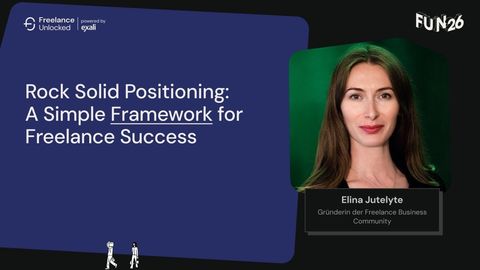

Elina Jutelyte once announced to a client, after 20 years in the industry, that her next proposal would be value-based. The client agreed to look at it, read it, and asked one question: "How many hours are in it?"
The story got worse. As they discussed the details, she explained she'd hire a team to reach his goals. His response: great, let's hire those people together. He took the plan, hired the people, and never signed her proposal. "I cried in the pillow," she told the Freelance Unlocked 2026 audience. Then she cried to a business coach, who asked a few questions and delivered the diagnosis: "Elina, you're trying to position yourself as a consultant, but what you described is not really being a consultant."
That gap, between how you position yourself and how the customer actually sees you, became her research project. Elina Jutelyte has run her freelance business for a decade, founded the Freelance Business Community and has spent eight years talking to freelancers about what shapes their market position. Regular readers may remember her from our article on keeping your customer pipeline full, where she first walked through her 8P system. Her FUN26 talk is the sharpened sequel: the pipeline work gets you through this quarter, positioning is what eventually makes the pipeline fill itself. This time she focused on the diagnosis: where exactly your positioning breaks down, and what to fix first.
Positioning is what happens in the customer's head
Most freelancers treat positioning as a writing exercise. Pick a niche, define an ideal customer, polish the LinkedIn headline. Elina pulled up real examples of "positioning advice" from LinkedIn and called it what it is: "It's not a positioning exercise. It's copywriting."
The original idea was stricter. Al Ries, who ran a New York ad agency, noticed in the late 1960s that advertising had stopped working; there was too much noise even then. His answer, published in 1972 as The Positioning Era Cometh, was that creativity alone was no longer enough. Brands needed a fixed point, a rock, in the prospect's mind. Positioning is not what you say about yourself. It's what you do to the mind of the prospect. Elina's aside from the stage: if Ries thought 1972 was noisy, "I can't imagine what he would say today."
Perception, she explained, forms along four lines: what people predict from you, what they feel in contact with you, what they notice and what they remember. You influence all four, or the market fills the gaps for you, as her value-based proposal story proves. To that client, she was an hourly resource. No proposal template could override that.
The deeper problem: almost all positioning advice was written for companies with marketing departments and product lines. Applied to a one-person business, it turns into the eternal "find your niche" loop. She meets freelancers who have been in a niche for years and still ask her how to niche. The niche was never the issue. The system underneath was missing.
The 8Ps: a system, not a statement
Her framework takes the classic service marketing mix, the 7Ps developed by Booms and Bitner, and rebuilds it for independent professionals, adding an eighth: performance. Picture an iceberg. Above the water sit the two Ps everyone works on: product (your service) and people (your ideal customer). Below the waterline sit the six that actually decide how you're perceived:
- Place: the rooms, platforms and communities where your customers already are
- Promotion: how visibly and consistently you show up
- Physical evidence: case studies, testimonials, anything that proves your work
- Process: how you deliver, communicate and run your business
- Performance: the quality you deliver, actually measured, not assumed
- Price: what you charge, grounded in a financial plan and market intelligence
The point is not the list. It's the connections. In her workshops she runs an eight-by-eight matrix showing how each element feeds the others: product shapes people, place shapes people, process props up price. "You can't take one out of the equation," she said. Remove physical evidence and the flywheel jams: without proof of good work, promotion sounds like empty claims and premium pricing sounds like a joke.
That's why isolated tactics disappoint. Freelancers who compete on price aren't failing at pricing. They've left six Ps unmanaged, so price is the only signal the customer can read. According to freelancermap's Freelancer-Kompass, client acquisition is the hurdle DACH freelancers name most often, and this is usually where the missing system first hurts.
"76% of freelancers are doubting their prices. For me the pricing issue is not a pricing problem, it's a positioning problem." (Elina Jutelyte)
The 76% comes from her community's own research. Read the sentence again with the iceberg in mind: doubt about price is what an unbuilt system feels like from the inside.
What the well-positioned do differently
Elina mapped the visible habits of highly recognized solopreneurs, the Justin Welshes and Chris Dos of the world, onto the 8Ps. Not to copy their playbooks, but to show the system running:
They sell transformation, not deliverables. Everyone repeats this advice; few pull it off, because transformation comes from knowing customer pains, and pains only surface in conversations. Most freelancers simply don't have enough of them.
They build networks strategically. Deliberately connecting with people a level above their current circle, and connecting others with each other.
They get into the right rooms. Her favorite example is a communication coach she met seven years ago, then a magician with 3,000 Instagram followers. He kept speaking at conferences for event planners, a room made entirely of potential buyers, who then booked him for their own stages. Today he has around 10 million followers across social media.
They show trust signals from the right people. Look at whose testimonials they feature: peers at or above their level. Proof borrows status.
They develop their own IP. Frameworks, methods, certifications, books. "All of them wrote a book," she noted, adding you don't need to write one this week; you need something identifiable that competitors can't offer. Her own 8P framework is exactly that.
They demand premium prices last. The price only holds because everything else carries it.
Your positioning fixes for this week
Elina was explicit that positioning is a long-term strategy, not a quick fix. But she closed with actions that start now:
- Run a project audit. List every project: service delivered, industry, client persona, what you were paid, how they found you, what you liked. Then look for patterns. This is the most powerful exercise on the list, and the cheapest.
- Craft one offer from the pattern, then contact 25 people who match that ideal customer. Not to sell. To validate: what have they tried, what's missing, what did they pay? "That's the time to move beyond your family members," she joked. This is market intelligence you can't download.
- Create physical evidence. Write at least one case study yourself: problem, approach, result. Even under an NDA you can usually describe the pain and the outcome without naming the client, a question the audience pressed her on in the Q&A. And start a social proof database, one file collecting every testimonial and piece of praise.
- Install one quality check. Announce it at contract stage ("in three months I'll send you a short survey"), then execute. Or send past clients a two-line email asking for honest feedback while you refine your business.
- Rebuild your price from data. Market intelligence from customers instead of downloaded benchmark reports, a value impact bank documenting the problems you solve and what they cost when unsolved, and a financial plan that makes your minimum price a number, not a guess.
One warning from the Q&A deserves its own line. Testing several positionings at once mostly produces contradiction: LinkedIn says one thing, the CV another, the website a third. "It instantly breaks the trust," she said. Validate one position for three or four months before switching.
Consistency, in the end, is the whole trick. Every P either reinforces your rock or chips away at it. If you want one place where your positioning is easy to keep consistent, set up your free 9am profile: one page where your offer, your evidence and your rate tell the same story to the clients already searching.
Freelance Unlocked is co-organized by 9am together with Uplink and freelancermap. This article is based on Elina Jutelyte's session at Freelance Unlocked 2026. Watch the full talk above, and join us at the next edition: freelanceunlocked.com.