
The GDPR has no exemption for one-person businesses. You are a controller for your own client list, website and invoices, and a processor whenever you handle a client's personal data on the client's instructions. Then Art. 28 requires a written processing agreement (AVV), best signed before the first data arrives. You also keep the Art. 30 record, because routine customer data cancels the 250-employee relief. We found no recent German fine for a missing AVV; the likelier cost is a client who asks for proof.
"I'm a one-person business, the GDPR doesn't apply to me" is the most expensive sentence in freelancing admin. The text of the law contradicts it, and clients stopped accepting it long ago.
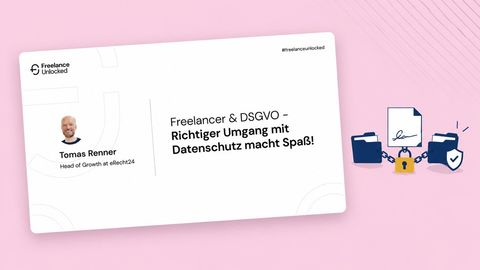
Tomas Renner, a lawyer by training and Head of Growth at eRecht24, put one line first in his talk at Freelance Unlocked 2024:
"We have to handle our clients' data, and as freelancers also our clients' clients' data, with care, regardless of laws and regulations, simply because that is good for how we treat each other in the digital world." (Tomas Renner)
▶ Watch on YouTube His employer sells data protection software, so we take mindset and method from the talk and every legal statement from the sources linked below.
Which role you play
Art. 4 Nr. 7 and 8 GDPR define the controller (Verantwortlicher), who decides "über die Zwecke und Mittel der Verarbeitung", and the processor (Auftragsverarbeiter), who processes "im Auftrag des Verantwortlichen". Both definitions include natural persons, so a Freiberufler is covered. The household exemption in Art. 2 (2) c reaches only purely personal or family activity.
The EDPB's 2021 guidelines (read via a law-firm summary) give the test: the controller decides purposes and essential means, meaning which data, how long, about whom. A processor may pick non-essential means such as software. The German authorities' Kurzpapier Nr. 13 lists typical Auftragsverarbeitung (hosting, cloud, data entry, backup, IT maintenance with data access) and typical non-cases such as Steuerberater and Rechtsanwälte. It dates from January 2018 and is marked under revision.
Our mapping, not a quote from either body: a developer with production access, a marketer inside a client's CRM, a virtual assistant running a client's inbox and a freelancer doing backups are processors for that work. A coach with their own client files is a controller. Renner calls processor "der Normalfall" for most freelancers; it depends on who sets the purpose, and one project can hold both roles.
The AVV: when it is mandatory, what it must say
Whenever you are the processor, Art. 28 (3) requires a contract that sets subject matter, duration, purpose, data types and categories of people, and binds you to:
- process only on the client's documented instructions;
- keep everyone who touches the data to confidentiality;
- apply the security measures of Art. 32;
- follow the sub-processor rules;
- help with data-subject requests, breach notification and impact assessments;
- delete or return all data at the end, at the client's choice;
- prove compliance, allow audits and warn if an instruction breaks the law.
The form is writing, "was auch in einem elektronischen Format erfolgen kann" (Art. 28 (9)). A signed PDF or a click-accepted agreement works; a handshake does not.
Most clients send their own template or the Commission's standard clauses, Decision (EU) 2021/915, which state that they meet Art. 28 (3) and (4). Check three places:
- Annex II (description of processing): does it match your actual work?
- Annex III (technical and organisational measures): do you really run these, such as disk encryption and screen locks?
- The sub-processor list: every tool you use on the client's data must be on it or approved. An unlisted tool breaches Art. 28 (2) and (4).
Renner's rule: sign on both sides, then start working. His second point is the chain: you need an AVV with each provider that touches the client's data, "even if you sit next to me in Berlin". File it beside your freelance contract; our contract checklist and the IP clause guide cover the rest of the paper.
Your records and your website
The Art. 30 record. Controllers list purposes, data categories, recipients, transfers and deletion periods; processors keep one per client (Art. 30). Art. 30 (5) exempts firms under 250 employees, but not where processing is "nicht nur gelegentlich". The authorities' Kurzpapier Nr. 1 (December 2018) reads that as regular customer or employee data. A client list, invoices or a newsletter put you in.
Renner's method is a spreadsheet, one row per place where client data lives: website host, e-mail provider, CRM, cloud storage, laptop, phone, paper notes. By his claim it has "maximal 100 Zeilen" and takes "einen Tag, dann ist das Ding gegessen". His damage-control argument holds up: after a breach, a freelancer with 120 clients and no inventory must write to all 120; with one, to the five whose data were affected.
Website. A contact form or server logs trigger the privacy notice of Art. 13. The Impressum follows § 5 DDG, in force since 14 May 2024. Cookies and similar tools need consent under § 25 TDDDG unless "unbedingt erforderlich" for a service the visitor asked for.
Breaches. A controller reports to the authority "unverzüglich und möglichst binnen 72 Stunden" (Art. 33 (1)); a processor tells the controller "unverzüglich" (Art. 33 (2)). Set up the reporting line to each client now.
DPO. § 38 BDSG requires one from 20 people constantly handling personal data, so a solo freelancer normally needs none.
US tools: Data Privacy Framework, October 2026
Transfers to a US company certified under the framework need no further mechanism; others need the 2021/914 clauses and a transfer assessment. The General Court dismissed the challenge on 3 September 2025 (T-553/23); the appeal C-703/25 P was lodged on 31 October 2025 and we found no hearing date. The framework stays in force. On 31 July 2026 the EDPB asked the Commission to review whether a US Supreme Court ruling affects the FTC's independence as an enforcer (IAPP). Check each tool's certification on the official list, and keep fallback clauses in your AVV.
What a one-person business actually risks
Ceilings: EUR 10 million or 2 % of turnover for duties such as Art. 28, 30, 32 and 33; EUR 20 million or 4 % for core principles (Art. 83). That is the worst case. The CMS enforcement report itself notes "a large number of comparatively small fines" against individuals and small entities.
German authorities publish by state. Baden-Württemberg's 2025 report counts 7,673 complaints and 101 fines totalling about EUR 308,850, roughly EUR 3,060 each by our arithmetic. Brandenburg reports 25 fines against 9 parties, about EUR 109,000; its small-business examples involve cameras. We found no German fine from 2025 or 2026 for a missing AVV or record against a sole trader. The often-quoted EUR 5,000 Hamburg case of 2018 is listed as later withdrawn. No national total exists, so do not extrapolate.
The risk is different: a complaint, a breach that exposes missing paperwork, or a client audit that finds no AVV. What you lose is the contract.
Do not wait for relief. The Commission's Omnibus IV proposal would rewrite the Art. 30 exemption, and a provisional agreement came on 9 June 2026, but it is not in force. The wider Digital Omnibus had no Council mandate on 24 September 2026.
What to do on Monday
- Spend one day on the inventory: a row per tool, with purpose, data, access and where its AVV is filed.
- Ask each client who sets the purpose. If they do, you are the processor: request the AVV before the next data transfer.
- Check Annexes II and III and the sub-processor list of each AVV against what you really do and run.
- Get an AVV from each provider that touches client data, and check the DPF listing for US providers.
- Lock the basics: encrypted disk, phone lock, a breach-reporting line to every client, a current privacy notice and Impressum.
For tool choice, our CRM comparison is a starting point, and a free 9am profile puts you in front of DACH clients who will sooner or later send you an AVV.
This article is general information for practitioners and does not replace legal advice.
Freelance Unlocked is co-organized by 9am together with Uplink and freelancermap. This article is based on Tomas Renner's session at Freelance Unlocked 2024. Watch the full talk above, and join us at the next edition: freelanceunlocked.com.