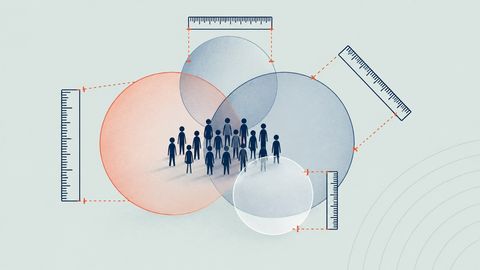
There is no count of freelancers in Germany, because the word has no legal definition. There are four counts of neighbouring groups, none interchangeable. Destatis counts 3.6 million self-employed people in mid-2026, about half of them solo. The Mikrozensus puts solo self-employment at roughly 1.85 million in 2024. The BFB counts 1.49 million Freiberufler at the start of 2025. KfW counts 690,000 new founders in 2025, 70 % of them on the side. The "1.5 million freelancers" you read everywhere is the Freiberufler number with a different label. Quote the definition and the date, or not at all.
Ask five people how many freelancers Germany has and you will hear 1.5 million, 4 million, "almost 5 million", and two shrugs. All of the numbers exist somewhere. None of them measures the same thing. This piece lays them out with the definition and the date attached, says which ones can be compared, and gives you a short rule for quoting them without embarrassing yourself in a pitch deck.
If you need the definitions first, what is a freelancer in Germany explains why the Finanzamt, the Rentenversicherung and the statisticians each use a different word.
The population statistics
These come from Destatis and its household surveys. They count people, not registrations, and they are the only figures here you can put next to each other.
3.6 million self-employed, Q2 2026. Destatis counted 3.6 million self-employed people including helping family members in the second quarter of 2026, per its press release of 18 August 2026. That is 58,000 fewer than a year earlier, a drop of 1.6 %, inside a total of 45.7 million employed people. This is the ceiling: every freelancer is in here, along with every dentist with a practice, every farmer and every founder with 40 staff.
About 1.85 million solo self-employed, 2024. The Mikrozensus, compiled by sozialpolitik-aktuell from Destatis data, puts self-employed people without employees at roughly 1.85 million in 2024, preliminary, about half of the 3.7 million self-employed that year. This is the closest thing to "freelancers" the official statistics offer: one person, no staff. It still includes the solo kiosk owner and the solo farmer.
3.5 % of the workforce, 2025. Destatis's own solo self-employment indicator says 3.5 % of employed people aged 15 to 64 were solo self-employed in 2025, 3.8 % of men and 3.1 % of women. The share rose until about 2005 and has drifted down since. Two details are worth more than the headline: the share is 5.2 % among 55 to 64-year-olds and 1.1 % among 15 to 24-year-olds. Solo self-employment in Germany is a late-career move, and our piece on freelancing after 50 shows what that looks like in the DACH surveys.
The direction of the trend since the mid-2000s is confirmed; a clean year-by-year series is not, because Destatis changed methods more than once and says so. Treat "slowly declining" as solid and any precise 2015-to-2026 curve as somebody's reconstruction.
The administrative counts
These count registrations or tax classifications, which is why they cannot be added to the figures above.
1,492,000 Freiberufler, 1 January 2025. The Bundesverband der Freien Berufe, via the Institut für Freie Berufe, counts self-employed members of the liberal professions under § 18 EStG: doctors, lawyers, architects, engineers, journalists, translators, artists, teachers and the rest of the catalogue. The count was 1,492,000 at the start of 2025, up 0.47 % from 1,485,000 a year earlier, as reported by the BFB's Baden-Württemberg association in November 2025. A freelance developer classified as Gewerbetreibender is not in this number. A dentist with six employees is. It is a tax-status count, and it is where "1.5 million" comes from. The status itself is explained in Freiberufler or Gewerbe.
About 110,000 new Freiberufler in 2025. IfM Bonn, working from the tax administrations' data, reports roughly 110,000 freiberufliche Existenzgründungen in 2025 out of about 395,000 business start-ups in total, in its release of 20 April 2026. IfM adds a caveat worth repeating: 13 tax administrations changed their evaluation practice, so the figure is probably slightly inflated. Secondary reports round it to 111,000 and a 17 % rise; we print IfM's own wording.
The founder survey
690,000 founders in 2025, 70 % on the side. The KfW Gründungsmonitor 2026, published 19 May 2026, counts people who started any self-employed activity in 2025: 690,000, up from 585,000 in 2024. The rise came almost entirely from side founders: 483,000 Nebenerwerb start-ups after 382,000 the year before, against 206,000 full-time. That is a flow, not a stock. It tells you how many people entered, not how many are there, and it includes everyone from the weekend photographer to the GmbH founder. Our write-up of the side-hustle republic has the detail.
One correction to a number floating around internal decks: there is no "8 % full-time" figure in the KfW release. The split is 30 % full-time, 70 % side.
The platform and survey numbers
These are self-reported and unaudited. Useful for scale, useless for population claims.
freelancermap: "over 280,000 registered freelancers". That is the wording on the platform's homepage on 28 September 2026, next to "more than 117,600 active freelancers". The page does not define either term. Registered means an account was created at some point; active is whatever the platform counts as active. Other platforms publish Europe-wide totals that are not Germany figures at all. Our platform comparison treats these as marketing numbers, which is what they are.
Freelancer-Kompass 2026: who answers. The survey had 5,412 respondents, 84 % full-time freelancers, 9 % part-time, 10 % entrepreneurs with staff, average age 45. Those are sample shares, not population shares. The same goes for every gender split you see quoted from freelancer surveys; we look at what the samples do and do not say in the freelance gender gap in 2026.
"Almost 5 million freelancers." An industry association's press release with this headline circulates widely. We could not read it: the page refused every request, so its definition, date and method are unknown to us. We do not use the figure, and you should not either until you have read what it counts.
Tracing "1.5 million"
In May 2026 Thomas Maas, freelancermap's CEO, wrote in t3n that "über 1,5 Millionen Solo-Selbstständige arbeiten heute in Deutschland", attributed to IfM Bonn, with no reference date. The sentence is a good example of how the numbers blur. 1.5 million is the Freiberufler count (1.49 million, a tax status that includes employers). "Solo-Selbstständige" is the Destatis category (about 1.85 million, no employees, any tax status). Neither is "freelancers". The article's argument, that this group has no register and no lobby, stands. The number underneath it is two different numbers.
The gap nobody has filled: IT freelancers
There is no current, primary headcount of IT freelancers in Germany. The figures that circulate trace back to industry estimates from 2010 and 2011, or to a 2023 category of technical and scientific Freiberufler that is much broader than IT. Bitkom's 2026 labour-market work covers employed IT staff and vacancies, not freelancers. If someone tells you how many IT freelancers Germany has in 2026, ask for the source. There is a decent chance it is fifteen years old.
How to quote these numbers correctly
Rule 1. Name the population: self-employed, solo self-employed, Freiberufler, founders, platform users. Rule 2. Name the date and the source, because the vintages differ by two years. Rule 3. Never add or compare across the two groups above: population statistics on one side, administrative and platform counts on the other. Rule 4. "Freelancers" is a label you add to one of these, and you say which. The honest sentence is: "Germany has about 1.85 million solo self-employed people (Destatis, 2024), of whom around 1.5 million are Freiberufler by tax status (BFB, 2025)." Not: "Germany has 1.5 million freelancers."
What to do on Monday
- Fix the number in your deck or profile. If it says "1.5 million freelancers", change it to one of the sentences above with the source and year.
- Pick the figure that matches your argument. Selling to companies? The 3.6 million and the 1.6 % decline say the pool is shrinking while demand is not. Talking to politicians? The 483,000 side founders say where the growth is.
- Ask for the definition whenever someone quotes "almost 5 million" or an IT-freelancer headcount. If they cannot give one, drop the number.
- Diary the vintages. Destatis publishes quarterly, KfW in May, IfM in spring, the BFB count in November. Update once a year, not from memory.
- If you are one of the 483,000 who started on the side last year, our checklist for becoming a freelancer covers the steps that turn a Nebenerwerb into a business.
Whichever number you use, the people in it are competing for the same projects. A free 9am profile puts you in front of companies across DACH that hire freelancers, and the platform's search runs across more than 100 job boards, so you see the demand side of these statistics in one place.