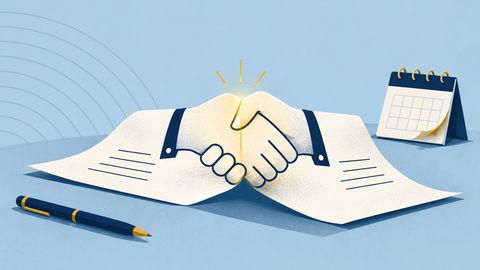


Negotiation research says a precise price like €4,850 beats a round one like €5,000: round offers get countered by $4,235 on average, precise ones by only $3,197, and read as more informed. The catch is a ceiling, extreme precision down to the cent reads as incompetence to experts, so round to the nearest €10 or €50 and back it with one line of reasoning. This matters more this year since the average German freelance rate held at €103 and 62% are not planning to raise it. Quote precisely, defend the number, and put your payment terms in the same document.
Two freelancers quote for the same project. One writes €5,000. The other writes €4,850. Thirteen years of negotiation experiments say the second one usually walks away with more money, and gets pushed back on less.
That is a strange thing to be true, and it is one of the few pricing findings that survives replication.
It matters more than usual this year. In the Freelancer-Kompass 2026, the average German hourly rate came in at €103 against €104 the year before, the first time the number failed to rise since the survey started. Of the 5,412 people surveyed, 62% said they do not intend to raise their rates, and 9% plan to lower them. Satisfaction with income fell from 66% to 55%.
The standard response is to go recalculate your rate. Worth doing, and we have a full guide to that calculation. But the calculation happens at your desk. The money is decided in the sentence where you say the number out loud, and almost nobody prepares for that part.
What a precise number does to the person reading it
The clearest evidence comes from Malia Mason and colleagues at Columbia Business School, published in the Journal of Experimental Social Psychology. In their main experiment, 130 pairs of people negotiated live. Half opened with a round number, half with a precise one.
People who received a round offer countered by moving an average of $4,235. People who received a precise offer moved $3,197. That is roughly a quarter less push-back, from a single formatting decision. Final agreements followed: $2,963 of movement after a round opener, $2,256 after a precise one.
A third study explains why. Precise offers were rated as more reasoned and informed. The number itself carries a message about how well you know your own business.
David Loschelder's group at Leuphana found the same thing with much larger sums. In a negotiation over a chemical plant, sellers opened at €5 million, €5,818,600 or €5,818,614.76. The precise openers ended up ahead, even though their opening numbers were less ambitious than the round ones. They also conceded less as the conversation went on, and correctly predicted in advance that they would not have to.
Think about what €5,000 actually communicates. It says: I picked a number that sounded about right. A client who hears a placeholder treats it like a placeholder, and negotiates against the round figure rather than against your reasoning. €4,850 says something different. It says there was a calculation, and if you push it, I can show you the calculation.
The point where precision starts working against you
There is a ceiling, and it is well documented. Loschelder, Malte Friese, Michael Schaerer and Adam Galinsky ran five experiments with 1,320 participants across real estate, jewelry, cars and HR negotiations, mixing amateurs and professionals. For amateurs, more precision kept helping. For experts, the effect turned into an inverted U: past a certain point, extreme precision backfired, because experts read it as a sign that the other side does not really know what they are doing.
So the useful rule is narrow. Quote to the nearest €10 or €50, not to the cent. €4,850 works. €4,847.63 makes you look like someone who has confused a spreadsheet with a price, especially in front of a procurement lead who buys this kind of work every week.
And precision only holds up if there is something underneath it. If the client asks how you got to €4,850 and the honest answer is that you thought €5,000 looked greedy, you have bought yourself one round of advantage and then lost the room.
The offer decides more than the technique
Thomas Marbella spent seven and a half years going from solo Android developer to running OneCode, a team of around 13. His Freelance Unlocked session was mostly arithmetic: what an employee costs, what they bill, where the margin sits. He calculates around 1,600 billable hours at an average of €85, which is roughly €136,000 of revenue against about €90,000 in cost, and he tracks the mix across people because some projects sit at €70 an hour and others at €120.
Ask him what actually moves the numbers and it is not the phrasing of the quote.
"You don't need amazing sales skills to do acquisition. If you have a good offer, can sell a little, and your conversion works, it will be fine. The other way round, a bad offer doesn't move at all in the market." (Thomas Marbella)
He is blunt about how fast the market can revalue what you sell. Five years ago he could put himself on projects as an Android developer doing architecture and clean code for €100 to €120 an hour. "You don't get that at all today," he says. What changed was not his negotiation skill. It was what the offer was worth.
"The hardest part is finding a good offer. If I'm selling an AI transformation expert, I write to 50 people and I have new clients." (Thomas Marbella)
That is the honest hierarchy. Positioning first, then the number, then the way you write the number. Precision is the cheapest of the three to fix, which is why it is worth fixing, but it will not rescue an offer nobody wants. Thomas's own version of value-first positioning is in his earlier session on giving decision makers something before you pitch.
He also has the single best rule for the moment after the client pushes back on your price.
"Nothing as an entrepreneur is so important that you have to decide it within 24 hours. You can always sleep on it, or sleep on it twice. If you notice you're emotional, please don't make a decision." (Thomas Marbella)
Most discounts are not negotiated. They are conceded, in the twenty minutes after an email lands, by someone who felt caught out. A quote you spent an afternoon calculating deserves more than a same-day reflex.
Why this feels so uncomfortable in the first place
Stefania Volpe is a product manager at freelancermap and helps run the surveys behind those €103. Asked on the 9am podcast what freelancers most dislike about the job, she does not say difficult clients.
"All the topics associated with money, it's always a bit painful for freelancers. The whole setting-rate thing can be annoying, at least at the beginning, when you're new in the business and you don't really know how it works." (Stefania Volpe)
Her first piece of advice to anyone starting is about that discomfort rather than about spreadsheets: do not underestimate yourself, and do not set a lower hourly rate than the one your experience and your industry would carry. It sounds soft until you put it next to the arithmetic. The hours you spend chasing a project are unpaid. Price that work badly and you have paid twice for the same client: once in unbilled acquisition time, once in the discount. Her full session on client acquisition and hourly rates is worth the fifteen minutes.
Saying the number without flinching
Eileen Liebig built her first company out of a single conversation. She was a dancer, booked to supply performers for a corporate Christmas party, when the client asked whether she could also supply service staff. She had none. She said yes anyway. He mentioned the catering company wanted €19 an hour per person. She heard herself answer that this was daylight robbery, hers cost €18.50, and he took the deal on the spot.
She spent the following weeks finding actual staff, which is not the part of the story to copy. The part to copy is that a specific number came out of her mouth with no hedging around it, in a situation where most people would have said "I'd have to check".
Her session was about training that reflex rather than being born with it.
"Being strong isn't brave. Being afraid and acting anyway is brave." (Eileen Liebig)
Her exercise is deliberately small: put yourself into one uncomfortable situation every day, and specifically go collect a rejection. Say the thing that might get a no. For a freelancer, the natural version is the quote you think is slightly too high. Send it. The information you get back is worth more than the project you were going to underprice anyway.
Put the payment terms in the quote too
One number in the Intrum European Payment Report 2026 should change how you write proposals. Across 8,385 businesses in 20 European countries, 50% now ask their own customers to pay in advance, up from 46% a year earlier. Around 12% of all revenue is paid late, and the gap between agreed terms and actual payment stretched from 16 days in 2023 to 20 days.
Prepayment is no longer an odd request from a nervous freelancer. It is what half of your clients are doing to their clients. Write the deposit, the milestone and the payment window into the same document as the price, in the same precise style, and it reads as standard practice rather than as suspicion.
What to do on Monday
- Recalculate your floor, then stop quoting round numbers. Take your real cost per billable day, add your margin, and let the result stay ugly. Round to the nearest €10 or €50 and no further.
- Write one sentence of reasoning under the price. Days, rate, scope. It costs you a line and it turns the precision into something you can defend.
- Put terms next to the number. Deposit percentage, milestone dates, payment window. Half of European businesses already demand prepayment, so you are asking for the normal thing.
- Never answer a price push on the same day. Acknowledge it, sleep on it, reply in the morning with numbers instead of nerves.
- Collect one rejection this week. Quote the number you think is slightly too high to a client you can afford to lose. Do it before you need the money, not after.
Precision is not a trick to make cheap work look expensive. It is what a well-run business sounds like when it puts a price on paper. If you want more of those conversations to start with the client already interested, create a free profile on 9am and let companies in DACH come to you with the brief instead of the budget.
Freelance Unlocked is co-organized by 9am together with Uplink and freelancermap. This article draws on the sessions of Thomas Marbella and Eileen Liebig at Freelance Unlocked 2026 and the Freelance Sucks podcast episode with Stefania Volpe. Watch and listen above, and join us at the next edition: freelanceunlocked.com.