
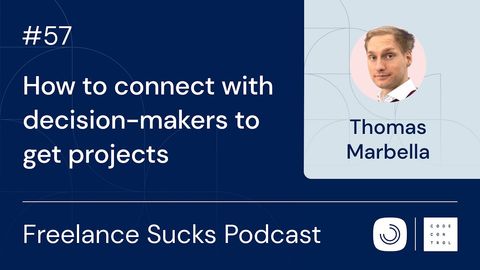

Last Christmas, Thomas Marbella copied one short message into 700 WhatsApp chats: Merry Christmas. Two hours of copy and paste. Months later, two of those contacts wrote back with the words every freelancer wants to read: "Long time no see, I may have a project for you." That ratio sounds bad until you compare it with the usual alternative, which is silence.
Thomas sat down with Yuri twice on the 9am podcasts. On Freelance Sucks, he talked about the ugly side of winning projects: recruiters draining rates, projects frozen week by week, and a client who vanished owing him around 70,000 euros. On Freelance Thrive, he laid out what actually works for him now. Together, the two conversations form a complete playbook.
A quick intro: Thomas is a freelance app developer with more than 15 years of experience and clients like Spotify, Visa and Porsche in his portfolio. He spent a decade employed at large corporates, including Porsche and Mercedes, before going independent. Today he runs One Code, an agency with 15 developers that passes projects on to 10 to 20 freelancers, and he mentors developers who want to go freelance through his Rich Dev Poor Dev program.
Why finding projects got hard
Two years ago, handing your CV to a recruiter was enough. An offer arrived within a month or two. That market is gone. "Since 2023 some things on the market changed," Thomas says. "The market has less demand and it's actually hard to get projects. It's not impossible."
He's far from alone in feeling this. In the Freelancer-Kompass 2024, freelancermap's survey of the German market, 58 percent of freelancers named winning new projects as their biggest problem, well ahead of everything else on the list.
Thomas used to rely on recruiters for about half his projects. The back and forth, the squeezed rates, the last-minute rejections wore him down, so he decided to learn acquisition himself. His first attempt was the one everybody tries: "Everybody told me it's about a network, so I tried to add as many people as possible on LinkedIn. I added around 4,000 people in two years and trust me, it's not that."
What separates freelancers who stay booked from those who don't is a repeatable system. Most people have nothing of the sort. "I call this marketing hoping," Thomas says. "If you have at least some sort of system, you're ahead of everybody else."
Give value before you ask for anything
Thomas's system starts with a rule that sounds soft but runs on hard numbers: help people before you need them. "It's always important to actually give value," he says. "If you help 10 different people, at least five, six, seven, eight will come back to you, even after years."
In practice it looks like this. He picks a target group, say CTOs and engineering managers, and sends a short message with something useful inside: a performance trick he found, a bug in their app, a UX flaw worth fixing. No pitch attached. "I do this with 100 people easily. At least 20 of them will respond and at least five of them will actually like that." The payoff comes later. "You give them value, so this will be stuck in their brain. Once they do have an opportunity, they will say, hey Thomas, you gave me value like a month ago, I may have a project before we put it public, are you free?"
Last year he invited 200 people for lunch or dinner. A 20-euro lunch in Berlin turned into calls years later from people who suddenly needed three Android developers. The Christmas message to 700 contacts came from the same logic: stay lightly present in a lot of heads.
Research backs the approach. A 2022 study in Science by Rajkumar and colleagues ran experiments on 20 million LinkedIn users and found that weaker ties, the people you barely know, produced more job moves than close contacts, with moderately weak ties working best. Your next project probably won't come from your best friend. It'll come from someone you had lunch with three years ago.
One warning, learned the hard way: "Don't be salesy. That's what I did wrong for so long, because people don't like to be sold something. Be genuinely interested, because people smell the difference."
Reach the person who can say yes
Giving value works best when it lands on a desk with budget authority. Thomas goes straight to decision-makers, and he's picky about which ones. A CTO at Porsche will never see your message. A CTO at a startup is still reachable.
His funnel is unglamorous math. Write to 50 or 100 people, doable in an hour or two. Around 30 percent reply. Those replies turn into maybe 10 conversations, two or three video calls, and, if you're good, one closed deal.
Personalization decides the reply rate. The scaled version: scrape LinkedIn job posts, find companies hiring a permanent developer, and offer to bridge the three to six months the search will take. The specific version is stronger. Thomas likes watches, so he wrote to the team behind the Chrono24 app with an observation about their cross-platform setup. That message turned into a half-hour technical argument, then into "we need somebody like you," and eventually into a 150-euro-per-hour engagement a CTO personally pushed through despite the official budget.
This matches what sales research has said for years. In Harvard Business Review, Toman, Adamson and Gomez found that B2B buyers are overwhelmed by their own buying process, and that sellers win by making the purchase easier rather than by pitching harder. A freelancer who shows up with a diagnosed problem and a ready solution is doing exactly that.
Two more levers. First, urgency: Thomas spoke with three CTOs in one month who all admitted their pains weren't urgent enough to get money from the CFO. So find the pain they legally or commercially must fix. His example: the accessibility requirements hitting consumer-facing software in 2025. Second, positioning. "I always said, hey, I'm an Android freelancer for architecture and clean code. That's nice, I'm very good, but nobody cared." Meanwhile a colleague who does React design systems only for automotive gets constant inquiries, and a Shopify performance specialist he met earns 300k a year in a niche most people would laugh at.
Protect yourself when deals stall
The Freelance Sucks half of the conversation is about what happens after the pipeline looks full. Projects get postponed week by week. One large engagement, already staffed with four developers, was frozen after three months of "next week, promise."
His fix is a hard grace period. "Two weeks max. If they don't figure out the start for the project, I say screw it." Then a backup plan for both sides: he moves to another project and offers the client a freelancer he trusts, maybe five percent cheaper. "Usually they don't care if you do the job. They care if someone skilled does the job." The relationship survives; his calendar doesn't sit empty.
The deepest scar came earlier. His very first client kept promising payment until the debt reached about 70,000 euros, then disappeared, owing 1.4 million to some 20 creditors. Thomas went back to a permanent job at Mercedes, rebuilt his finances, and returned to freelancing three years later with new rules: work with companies that have money, and cut off any client two weeks after the first late payment.
What to do with this
- Build your network before you need it. Ideally half a year before going freelance, aim for 20 to 30 genuinely valuable contacts.
- Add five to ten relevant people on LinkedIn daily, with real interest and zero pitch. Expect roughly one valuable relationship per 100 contacts.
- Lead every cold message with something useful: a bug, a tip, an observation about their product.
- Target reachable decision-makers and treat outreach as a funnel: 100 messages, 30 replies, a few calls, one deal.
- Pick a niche. A sharp positioning beats a long skill list.
- Frame your rate against the money you save or earn the client, not against other freelancers' rates.
- Give stalled projects a two-week grace period, then move on with a backup plan for you and the client.
- Get a tax advisor. And at the first late payment from a client, set a deadline and stick to it.
None of this needs talent. It needs 10 minutes a day and the patience to let lunches from three years ago pay off. Start today: send one useful message to one person who could hire you. Then listen to both episodes above, because Thomas's stories carry details no summary can.
This article is based on Thomas Marbella's conversations with Yuri on the Freelance Sucks and Freelance Thrive podcasts by 9am. Both episodes are embedded above.