
Somewhere on your feed right now, a successful freelancer is telling you exactly how they did it. Post daily. Pick one niche. Do the dancing video. And if their formula worked for them, it should work for you, right?
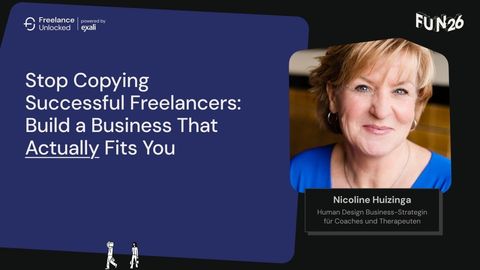
Nicoline Huizinga spent over 30 years in the coaching industry watching people follow that logic straight into exhaustion. Her talk at Freelance Unlocked 2026 makes the opposite case: the formula isn't the problem. The fit is. A strategy built by someone wired completely differently from you will drain you even when you execute it perfectly.
Nicoline is a Dutch business strategist and author of four books who works with coaches and therapists, splitting her life between the Netherlands and Spain. She opened with the belief she considers the biggest myth in freelancing: the harder you work, the more you earn.
The myth that keeps freelancers on the hamster wheel
It sounds logical. More hours, more output, more money. Except that's not how most freelancers experience it. Working harder leads to burnout, kills creativity and wrecks the focus you actually bill for. The health research is blunt on the extreme end: a WHO/ILO study linked working 55 or more hours a week to roughly 745,000 deaths a year from stroke and heart disease. Overwork is a risk factor, not a business plan.
The trap has a structural cause. The moment you go freelance, you stop having one job. "We become marketers, we become bookkeepers, we become CEOs, we become finance managers," Nicoline told the room. When she asked who loves marketing, barely a hand went up.
Her Instagram confession made the point better than any framework could. She watched the pointing-and-dancing videos every marketer seems to make, and felt the pull: I need to record these. She hates making them. Other people told her, you're an entrepreneur, why aren't you doing that kind of content? That gap, between what works for someone else and what you can sustain, is where freelancers quietly burn out.
Why success formulas don't transfer
There's a second reason copying fails, and it has nothing to do with energy. The formulas themselves are less solid than they look. Phil Rosenzweig's The Halo Effect dismantled a whole genre of business advice by showing that when we study winners after the fact, we attribute their success to whatever they happened to do, and ignore everyone who did the same things and failed. The freelance guru economy runs on exactly this delusion. "I posted every day for a year and now I earn six figures" tells you what one person did, not what caused what.
So you're copying a recipe that may not even have worked for the reasons its author believes, and executing it with a completely different temperament. No wonder it feels like forcing.
Nicoline's image for that forcing: squeezing into jeans that aren't your size. She asked who had ever taken on a project that paid well but wasn't really their thing. Nearly every hand went up, and most people admitted the results were mediocre. You can force your way through a wrong-fit project. You can't force your way through a wrong-fit business for years.
Know your wiring before you pick your strategy
Her tool for figuring out fit is human design, a personality system that builds a profile from your date, time and place of birth. She's upfront that it mixes modern astrology with other traditions, and that analytical minds tend to bristle at that. You don't have to buy the cosmology to use the underlying move: get an honest picture of how you work best, then build the business around it instead of against it.
What struck her after years of using it with clients is the reaction people have. "The first word is relief," she said. Oh, I'm not weird. This is how I am. "And the second word is permission." Permission to stop running someone else's playbook.
The system's energy types read like a catalog of freelancer strategies that work for some and wreck others:
- Generators (about 37% of people) run on doing what lights them up. Their energy is the trademark clients remember. Their rule: if a project pays well but doesn't light you up, dare to say no.
- Manifesting generators are the multi-passionate ones. The standard advice to pick one narrow niche is poison for them. They need an overarching umbrella they're known for, with real variety underneath, or their creativity dies of boredom.
- Projectors (about 20%) are guides and advisors, built for short sprints and rest, not marathons. Trying to out-hustle a generator exhausts them. Nicoline's advice: be the lighthouse. Broadcast what you do and let the right clients come to you, ideally with a passive income stream to smooth the energy dips.
- Manifestors (about 9%) are visionaries who initiate and move fast, often before anyone understands what they're doing. Their job is to inform people of the vision and start running, not to wait for permission.
- Reflectors (1%) sense when something is off in a room long before others see it. That sensitivity gets dismissed in corporate settings, and it's precisely what makes them valuable.
Treat the labels as loosely as you like. The practical question underneath survives any amount of skepticism: does your current strategy match how you actually generate energy, or does it match what looked impressive on someone else's profile?
The little voice that sets your prices
The deepest part of the talk had nothing to do with types. Whatever you believe about yourself drives your strategy, and your strategy drives your results. If the voice in your head says you don't know enough, you'll study forever, overdeliver and hesitate at exactly the wrong moment: when you say your price.
Nicoline acted out the difference on stage. The same six-month coaching package, once mumbled with a downward glance, once stated with pride. Clients feel the difference even when the words are identical.
"People are great at reading and feeling our energy. And even though we think we're not doing it, we do it, because a confused mind doesn't buy." (Nicoline Huizinga)
If that voice is running the show, she warned, "you're working 24/7 for an hourly fee that is way too low."
The voice itself is almost universal. A systematic review in the Journal of General Internal Medicine found impostor feelings affecting up to 82% of people across the studies examined. You're not broken; you're normal. Which is exactly why "just be more confident" is useless advice, and why Nicoline's reframe is more workable: keep learning because you love it, not because you're not enough yet. Her own line for the room stuck with me: "You are an expert in an average room." More on these mental traps in our guide to the psychology of successful freelancing.
One question to ask before your next yes
Nicoline left the audience with a single filter for the coming week. Before you accept a project, launch a channel or copy anyone's tactic, ask: does it feel right, or does it look right?
"Looks right" has the logical arguments. Good money, good logo, adds to the CV, everyone says you should. "Feels right" is the one you'll still be able to do with full energy in year three. The dancing video looks right. For her, it will never feel right, and her business grew when she stopped pretending otherwise.
That's the anti-guru position in one sentence. Study successful freelancers for ideas, not for instructions. Then build the version only you can run: your energy, your kind of clients, your kind of marketing. If part of that is putting your profile where projects find you instead of chasing them, create a free profile on 9am and let your work be visible while you do the work only you can do.
Freelance Unlocked is co-organized by 9am together with Uplink and freelancermap. This article is based on Nicoline Huizinga's session at Freelance Unlocked 2026. Watch the full talk above, and join us at the next edition: freelanceunlocked.com.