
An uncomfortable statistic for anyone sitting on a business idea: in Germany, roughly half of adults say fear of failure would stop them from starting a business, while only about 41% believe they have the skills to do it. Objectively, German freelancers and founders are among the best-trained professionals in Europe. The bottleneck is rarely competence. It's what happens between the ears.
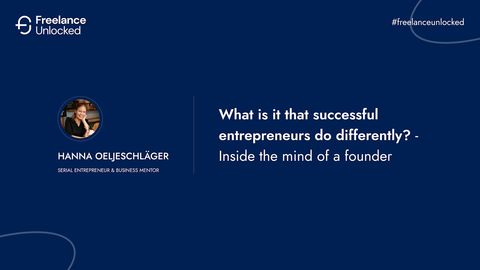
That gap, between what people can do and what they believe they can do, was the subject of Hanna Oeljeschläger's bonus session at Freelance Unlocked 2025.
Oeljeschläger has been an entrepreneur since 2016, moving from tech consultancy in Ireland to Berlin and Munich, where she built a six-figure tech startup before turning to coaching founders. Her talk distills what she's seen across "so many startups, so many founders, so many people from different industries" into seven patterns, and pointedly skips the one everyone expects. "The first trait, which might surprise some people, is not product-market fit," she says. "It's not the big idea or the business genius."
Belief comes before strategy, and the research mostly agrees
Her first pattern is blunt: you have to believe success is possible for you, not for founders in general.
"If you don't trust yourself, who will? Nobody else will believe it. Nobody else can follow you if you don't believe it's possible." (Hanna Oeljeschläger)
This sounds like motivational wallpaper until you notice it's one of the most-studied constructs in entrepreneurship research. Psychologists call it entrepreneurial self-efficacy, and a systematic review by Newman and colleagues in the Journal of Vocational Behavior traces decades of evidence linking it to entrepreneurial intentions and action. Honest caveat: the same review calls for better measurement and notes that researchers haven't fully explored whether too much self-efficacy backfires. Belief is a precondition, not a guarantee.
What makes her version useful is that she treats belief as buildable, not innate. Two levers: surround yourself with people "who might be two steps ahead of you" (not ten, that's demoralizing), and invest in your skills, because competence compounds into confidence and "your clients will feel that you're actually capable." For most freelancers she meets, skills aren't the issue: "The main problem is going to be in your own head."
The German context makes this concrete. The GEM national report for Germany found early-stage entrepreneurial activity climbing to 9.8% in 2024, a real surge, yet 49% of respondents still name fear of failure as a barrier. Activity is rising despite the mindset, not because it's been fixed.
Fix the why, flex the how
Her second and fourth patterns work as a pair: have a strong why, and stay radically open about the how. The why can't be "make a lot of money": that, she jokes, might get you to five figures if you're lucky. It's your "internal GPS," the thing you return to when family asks whether you're sure about this.
The how is a different animal:
"Opportunity rarely knocks. It whispers." (Hanna Oeljeschläger)
(She illustrates this with an anecdote from The Secret, not a book we'd cite as evidence. Strip away the packaging, though, and her actual claim holds up in serious research.) Saras Sarasvathy's landmark study of expert entrepreneurs, published in the Academy of Management Review, found that experienced founders don't start with a fixed goal and reverse-engineer the path. They start with their means (who they are, what they know, whom they know) and treat surprises as raw material rather than derailments. Sarasvathy's own line could subtitle this part of the talk: "To the extent that we can control the future, we do not need to predict it."
Her field version of effectuation: "If your how needs to change, let it. Your why should not change." Ship an MVP early, listen hard to market feedback, change the target group or the offer if you must. Just don't confuse a pivot in method with a crisis of purpose.
Risk is required, especially here
The pattern she says most reliably separates entrepreneurs who last from those who quit within two years: willingness to take risks.
"Risks are not reckless. They are required. Risk-taking is essential, especially also in Germany. This cannot be stressed enough." (Hanna Oeljeschläger)
The "especially in Germany" lands because the numbers back it. The KfW Gründungsmonitor 2025 counted 585,000 people starting businesses in Germany in 2024. It also found that roughly 36% of those actively planning a founding abandon the plan each year. A large share of German entrepreneurship dies in the planning stage, before the market ever gets a vote.
Note what she is not saying. Required risk isn't reckless risk: she's watched startups scale into the US too fast and go broke within a year. Her calibrations: take risks the size of an MVP, not a New York office; find a counterweight, ideally a co-founder or network whose strengths oppose yours ("if one person is the controller, really good with numbers, the other should be more marketing, creative driven"); reframe setbacks as tuition. This maps almost exactly onto Sarasvathy's "affordable loss" principle: expert entrepreneurs decide what they can afford to lose, then act, rather than betting everything on a projected return.
And when the risk doesn't pay off?
"Failure isn't an opposite of success. It's a vital ingredient." (Hanna Oeljeschläger)
Failure, in her framing, is information. Is the market ready? Is the target group wrong? Was the product misunderstood? The question is never "should I quit?" but "what's the lesson here?"
Action is the filter
Her closing pattern is the least glamorous and the most decisive. After the books, the masterclasses, the feedback rounds:
"Then you're already better than 90% of the startups if you just take the action, because most people won't ever do it." (Hanna Oeljeschläger)
Whatever the true percentage, the KfW abandonment data says the direction is right: the graveyard of German entrepreneurship is full of well-researched plans that never met a customer. Go to market before it's perfect. Adjust on the go.
The takeaways, compressed
- Write down your December vision. Oeljeschläger opens the talk with it for a reason: if you can't imagine the successful year, you won't build it.
- Audit your circle. Find people two steps ahead: a community, mentor, or coach with shared values. "Your network is your net worth," she says, "and this isn't just a catchy phrase." It saves time, money, and stress, particularly around German bureaucracy.
- Separate why from how. Put the why somewhere you'll see it. Hold every pivot against it.
- Size your risks as affordable losses. MVP-sized bets, then iterate on market feedback. No empire moves on year-one confidence.
- Reframe one recent failure this week. Write down what it taught you about market, audience, or positioning, then act on it.
- Ship something imperfect this month. Action is the sorting mechanism.
None of this replaces strategy. Oeljeschläger is explicit that positioning, financials, and a solid offer are table stakes. But in a country where skills are abundant and self-belief is scarce, mindset is where the work pays off most.
Freelance Unlocked is co-organized by 9am together with Uplink and freelancermap. This article is based on Hanna Oeljeschläger's session at Freelance Unlocked 2025. Watch the full talk above, and join us at the next edition: freelanceunlocked.com.