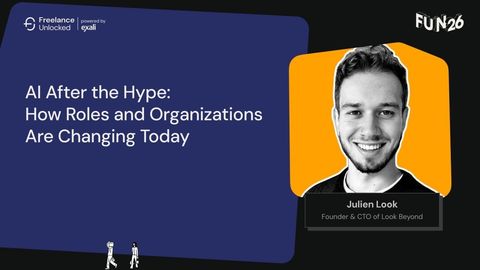

A year ago, Julien Look stood on the Freelance Unlocked stage and demoed AI workflows a freelancer could copy that afternoon: voice agents, content pipelines, lead enrichment. We covered that session in AI Workflows for Freelancers. At Freelance Unlocked 2026, the software engineer and Julien Beyond founder came back with a different problem. The tools work. The organizations don't.
His opening numbers set the tone. Around 88% of people already use AI inside their organizations, a figure that matches McKinsey's State of AI survey, which puts regular AI use at 88% of organizations. Yet only about 5% of AI projects capture real value measured in EBIT. The other 95% fail, most of them at the pilot stage. MIT's much-quoted NANDA study landed on the same split: 95% of enterprise GenAI pilots produce no measurable P&L impact.
For freelancers and consultants, that gap between adoption and value is not bad news. It's the market.
The biggest problem is not the technology
Julien ran a quick poll from the stage. Is the biggest blocker technological? A budget problem? Or change management? The room voted change management, and he agreed: "Guys, you can come to the stage already."
The failure pattern he described has little to do with model quality. People don't trust output they can't trace. He pointed to Siemens, where adoption staggered because employees simply didn't believe what the agents produced. Hallucinations and odd interpretations of company data create mistrust, and mistrust kills rollouts. His fix is unglamorous: make limitations explicit, make every step of the output traceable, and involve the people who will use the system in building it.
Then there's the leadership gap. In Germany, C-level involvement in AI initiatives sits at roughly 2%, far below the US. Executives expect a transformation done in six months; the C-suite demands results within 18 months max. Meanwhile only 23% of middle managers, the people who have to translate the vision into daily work, feel adequately prepared. Julien's conclusion cuts against every project plan you've ever written:
"Transformation is a cultural change and it's not done within one project." (Julien Look)
His practical advice for freelancers followed immediately, half joke, half business model: "Next time you're going to pitch a transformation project to your client, aim for a retention contract that goes for five years or so."
Small groups, real desire
How do you actually build adoption? Julien leaned on ADKAR, the Prosci change model, and admitted with a grin that he mainly uses the first two letters: Awareness and Desire. Both need to exist at the bottom of the organization before anyone installs anything. As a software engineer, he called introducing technical solutions too early his own biggest bad habit.
The most concrete guidance came from the audience. Julien had interviewed Antje, a transformation consultant with decades of experience, and invited her to the mic. Her numbers: groups of up to five people work best, because discussion stays open and responsibility stays high. Five is too few for the diversity a transformation needs, so she recommends seven to ten champions per group. At 150, you breed passive participants and internal resistance. Large companies should build small local groups plus one central center of excellence. And champions should be volunteers, but pre-selected ones: management picks candidates first, then asks who wants in, because not everyone who wants the title actually supports the change.
Roles are shifting faster than org charts
The middle section of the talk was about what AI does to jobs, and Julien's read is more interesting than the layoff headlines he says he despises. He opened the session mocking the pattern of firing a department, replacing it with agents, and rehiring the people when the agents underperform: "It's ridiculous. Let's talk about how to do this right."
What he sees in real teams:
- Non-developers are building software. Most people using AI coding tools now have no coding background. The barrier is gone.
- Software engineers move up the stack. The old "10x developer" talk has become "100x": engineers drive technical vision and orchestrate systems rather than typing every feature.
- Everyone ships in their own lane. Product managers ship user-facing features, designers turn wireframes into clickable apps, QA writes code.
- Teams shrink. Three people can build what once took ten. Julien doesn't read that as job loss: the backlog of failed adoption is so large that "there will be only more work created in the future for people in our position."
His European success story was Bosch, which used AI to run a massive legacy ERP migration: align on goals first, upskill the entire developer and consultant team, clean the core system, then add GenAI-driven intelligence layers. Result: about 20% developer productivity gain and a legacy monster dealt with in record time. The order matters. Alignment and upskilling came before implementation, not after.
Inside his own consultancy project, the method is called "strategy as protocol": strategy lives in one documented place, humans and AI both read it, everyone contributes against it. "Writing the documentation is key to every process that comes after."
Three questions before you pitch AI work
Julien closed with a filter for anyone selling AI transformation, and it doubles as a client qualifier:
- Who owns this? If the answer is not the executive level, rethink the engagement. Ownership by IT alone predicts failure.
- What does success look like? Ninety days works for a pilot. The real question is what the picture looks like after one year, which is also your argument for a longer contract.
- What do you actually want to change? "We want AI" is not an answer. Which bottleneck are you solving?
In the Q&A, the moderator asked how to handle clients who want AI for clearly nonsensical use cases. Julien refused the purist answer. He wouldn't walk away from a challenging client; he'd set realistic expectations, propose what's achievable, and start with something less committal so both sides learn. Asked whether he formally assesses culture before starting, he offered a tactic any freelancer can borrow: sell a one-to-three-day process assessment workshop, talk to everyone from top to bottom, then start with a micro-project in the practice area with the worst bottleneck and expand from there. Twenty people are easier to transform than two thousand.
That's the quiet theme of the whole session. The 95% failure rate isn't an argument against AI. It's a job description for the people who know how to close the gap. If you're building that kind of expertise into your freelance offer, create a free profile on 9am and make it visible to companies that are stuck at exactly this point.
Freelance Unlocked is co-organized by 9am together with Uplink and freelancermap. This article is based on Julien Look's session at Freelance Unlocked 2026. Watch the full talk above, and join us at the next edition: freelanceunlocked.com.