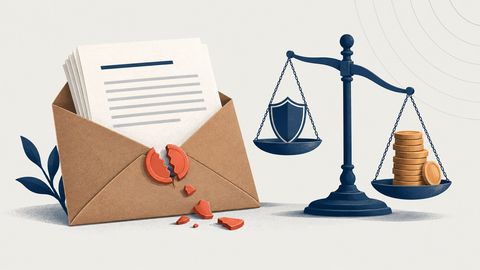
Paste ChatGPT output into a client deliverable and an awkward legal question follows: whose words are those? Your client is paying you, publishing the copy on their website, and assuming they now own it. Under US law, and very likely under German and wider European law, nobody may own it at all. Worst case, fragments of it belong to someone else entirely, someone who can come after the publisher.
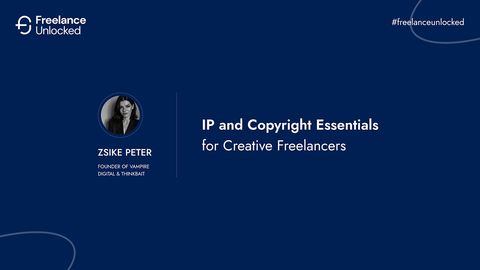
That was the core of Zsike Peter's session at Freelance Unlocked 2025. Peter is a former investigative journalist from Hungary, founder of the content agency Vampire Digital and of ThinkBait, her self-described "movement against 50 shades of beige vanilla content." She's not a lawyer, and says so on stage. But she runs an agency of ten freelancers, writes for AI researchers at Harvard and MIT, and has spent 18 months interviewing academics for a book on what AI is doing to human creativity.
You probably don't own what the machine writes
Most freelancers get Peter's first legal point backwards. OpenAI owning your output isn't the risk. The risk is that no one owns it. Or worse, that a stranger does.
"Just because OpenAI produced the copy for you doesn't mean they own it. What it does mean is you don't own it. It could be owned by another originator."
On the US side, she's on solid ground. The U.S. Copyright Office said it in its March 2023 registration guidance and confirmed it in Part 2 of its Copyright and Artificial Intelligence report in January 2025: copyright protection requires human authorship. Purely AI-generated material cannot be registered, and the 2025 report concluded that prompts alone don't make you an author. Works mixing human and AI contributions can be registered, but only for the human parts, and applicants must disclose which portions were AI-generated.
Europe reaches a similar destination by a different route. No EU statute says "AI can't be an author" in so many words. What exists is a copyright tradition built entirely around human creation. Germany's Copyright Act (UrhG) is blunt: Section 2(2) protects only "the author's own intellectual creations" (persönliche geistige Schöpfungen), and Section 7 defines the author as "the creator of the work." A language model predicting tokens is not making a personal intellectual creation, and the EU Court of Justice's long-standing standard for protection (the author's own intellectual creation reflecting free and creative choices) points the same way. Peter compressed this into a sentence DACH freelancers should memorise: authorship belongs to people, not predictive algorithms.
Why does this matter commercially? Because clients "are now blindly uploading AI copy to their websites, to their email newsletters, their social media posts, and they assume that that writing is now theirs because it's on their website, but it's not," Peter warned. An asset your client can't own is an asset any competitor can lift, word for word, with no recourse. If your deliverables are supposed to transfer usage rights (and most freelance contracts in Germany and Austria are built on exactly that, Nutzungsrechte), you may be selling rights to something that has none attached.
The liability flows in the other direction, too
Not owning your output is the mild problem. The sharper one: AI output can contain someone else's protected work, and the tool will never warn you.
"ChatGPT won't tell you: oh, by the way, this line belongs to such and such author. You won't know."
If a model reproduces a distinctive phrase, paragraph, or image element from its training data and you publish it under your name or your client's, the copyright still sits with the original creator. And infringement claims come from originators, not from AI companies. Peter's framing of the stakes was pure freelancer economics: "You might be liable if you're using AI-written copy, and you might not own what you think you do. Is this worth risking your name, your reputation, and your income?"
The courtroom drama she pointed to has moved on since the stage. Getty Images' UK case against Stability AI, over millions of images allegedly used for training, went to trial in summer 2025; in November 2025 the High Court dismissed most of Getty's copyright claims (largely because the training happened outside the UK) while giving Getty a narrow trademark win on watermarks. The Authors Guild's US lawsuit against OpenAI, on behalf of authors whose books were allegedly used for training without consent, is still pending. Nothing in that litigation wave gives an individual freelancer cover. Those disputes settle who owes what for training, not what happens to you if plagiarised text surfaces in your deliverable. That risk stays yours.
The same logic applies to visuals. Asked whether Midjourney images can be used commercially, Peter was careful: probably yes, if nothing recognisable appears (logos, protected characters, watermark ghosts), but the designers she works with "still prefer to create your own work for commercial use, to be safe," or use AI only as a starting point that gets transformed beyond recognition.
Transparency is becoming law in the EU. Plan for it now
Peter mentioned the UK's consultation on whether AI companies should be forced to disclose their training data. For freelancers in Germany and Austria, the more important fact is that the EU has already legislated. The AI Act (Regulation (EU) 2024/1689) requires providers of general-purpose AI models to put in place a policy to comply with EU copyright law (including honouring text-and-data-mining opt-outs) and to publish a sufficiently detailed summary of their training content, using the Commission's template. Those obligations became applicable in August 2025. From August 2026, transparency rules also require that AI-generated content be identifiable, with clear labelling for deepfakes and certain AI-written text intended to inform the public.
Two consequences for your business. First, Peter's licensing scenario stops being hypothetical. Once training data becomes visible, "you could license your work… here you go, OpenAI, you can use it, pay me a licensing fee." Equally, originators are likelier to discover their material inside yours. Second, disclosure norms are heading into the client relationship, and Peter's advice anticipates them:
"If AI had a role in shaping the outcome that you produce, it's better to just note that at the end of your work."
Her line for where disclosure kicks in is practical. In her agency, client interviews and strategy come first. AI is then prompted (with goals, audience, and pre-set content pillars) for top-level ideas only, and the client is told exactly that and asked to sign off before anything gets written. "You use AI as a collaborative partner rather than the originator."
The market penalty arrives before the legal one
Even if no lawyer ever knocks, Peter argues the commercial damage of AI-reliant work is already priced in. Audiences detect synthetic copy even when they can't say why: "people will read AI-written copy without knowing it's written by AI, even if it's polished by a human. They can tell that something feels off. And then you lose trust. And if you don't have trust, you don't have a business." She cites LinkedIn's own measurements: AI-written posts don't hold readers' eyes. People scroll past, and your authority scrolls away with them.
Her diagnosis of what clients actually pay freelancers for is worth pinning above your desk: "We're not just hired for output. We are hired for discernment, for taste, for knowing when the line lands and when it doesn't." That's also her answer to the "post 15 times a week with AI" gospel: better two or three high-value posts than daily fluff anyone could have prompted. The internet has been flooded with machine-generated content in just two years, she noted. Sounding like everyone else is a strategy for invisibility.
"Let AI pick up the bricks, but you build your building."
Do this, not that: AI hygiene for creative freelancers
Do:
- Rewrite substantially, always. Be your own "editor-in-chief": restructure, cut, add your experience and voice. Under US registration rules, only your human contribution is protectable anyway. Make it the bulk of the work.
- Disclose AI's role to clients at the idea/strategy stage and get sign-off before drafting. It builds trust and pre-empts the disclosure norms the EU AI Act is phasing in.
- Fix ownership in your contracts. Clarify with clients what happens to usage rights when AI is involved in a deliverable, and have a lawyer review the clause for your jurisdiction.
- Use AI for the gunk-scraping: summarising transcripts, structuring dry data, headline variations for a post you wrote. Peter's dishwasher rule: it speeds up the boring part; the thinking stays yours.
- Keep records of your process: briefs, interview notes, drafts. If ownership or originality is ever questioned, your human paper trail is your best evidence.
Don't:
- Don't copy-paste AI output into paid deliverables. You can't warrant originality you haven't verified, and you may be handing your client unprotectable (or infringing) text.
- Don't assume "no visible logo" makes an AI image safe for commercial use. Transform it substantially or create original visuals for anything brand-critical.
- Don't put barely edited AI text into a book or flagship asset you intend to own and defend.
- Don't outsource the thinking. "If you outsource your voice, you outsource your responsibility as well." And, as Peter warns, the creative muscles atrophy fast.
- Don't rely on AI detectors to police your own subcontractors or ghost-writers; they're unreliable. Judge the work the way readers do.
Know the rules, keep the pen
Peter's closing image is the one to keep: "Use AI like an architect would use a blueprint. Build a frame, but don't carve the cathedral with AI." The freelancers who thrive won't be the ones producing the most output. They'll be the ones who understand the technology, the law, and the ethics well enough to sell what machines can't: judgment, voice, and work a client can actually own. Or as she put it: don't let AI ghostwrite you out of your business.
If IP clauses, usage rights, and AI disclosure are gaps in your client contracts, this is the week to close them. And if you want to be in the room the next time an expert like Zsike Peter takes questions, come to the next Freelance Unlocked.
This article is for information only and is not legal advice.
Freelance Unlocked is co-organized by 9am together with Uplink and freelancermap. This article is based on Zsike Peter's session at Freelance Unlocked 2025. Watch the full talk above, and join us at the next edition: freelanceunlocked.com.