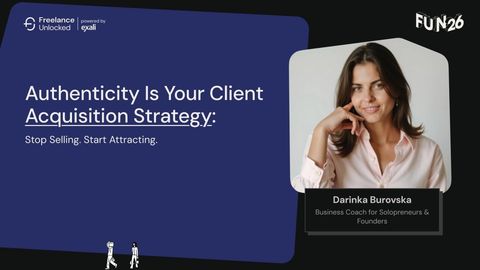

The best referral engine Darinka Burovska ever built came from a client she talked out of hiring her.
A founder approached her wanting help scaling his team, 10x by next year, all the relentless drive you'd expect. The problem: his product was nowhere near ready to scale. So instead of selling him the coaching package he asked for, she told him what she actually saw. What he needed wasn't business advice but an honest look at where that relentless drive was coming from and why it was clouding his judgment. He signed with a different coach. Then he called her.
"You know, Darinka, no one has ever said something like this to me before. Everyone just sells me the thing I asked for." (a founder, as told by Darinka Burovska)
He introduced her to three founders in his community, all of whom became clients. He introduced her to his investors and invited her to speak at community events. "All because I didn't see him as a deal," she told the audience at Freelance Unlocked 2026. "I was honest, I saw him as a human being, and I shared honestly what I saw."
Darinka Burovska is a business coach for solopreneurs and founders in Berlin, a former national-level athlete, and someone who has lived through the failure mode she describes: two burnouts inside the high-growth tech world. Her talk makes a claim most acquisition advice ignores. If your pipeline isn't working, the problem might not be your strategy. It might be the internal state you're executing it from.
That lands in a market where, according to the Freelancer-Kompass 2026, 62% of freelancers name client acquisition as their single biggest hurdle. The standard answer is more: more posting, more outreach, more follow-ups. Darinka's answer starts somewhere else entirely.
Burnout is data, not weakness
Darinka asked the room who had experienced burnout. Nearly every hand went up.
Her first reframe draws on the Harvard developmental psychologist Robert Kegan, whose research showed that adults don't stop developing; we keep changing how we make sense of ourselves and the world throughout life. Through that lens, she argues, many career crises aren't malfunctions. They're signals that your current way of operating no longer fits who you've become. (She was careful to add the caveat: an underlying mental health condition needs proper treatment, not a reframe.)
She knows the pattern from the inside. Her first burnout hit at a Series B scaleup where she was getting everything she wanted externally, promotions included, while internally running on stress, brain fog and negative loops. She recovered, changed nothing fundamental, and, in her words, "just reloaded the same operating system and pressed play." The second burnout was borderline existential, and became the transformative one.
"None of us burns out from working too hard. We burn out when we have a complete internal misalignment between our values and what our life actually is." (Darinka Burovska)
Why does this belong in an article about winning clients? Because as a solopreneur there is no corporate wall between you and the customer. You are the product, the brand and the sales team. Whatever state you're operating from leaks into every discovery call, every proposal, every follow-up. Exhausted and misaligned reads as exhausted and misaligned, no matter how polished the pitch deck.
Authenticity is not a branding exercise
The word authenticity has been worn smooth on LinkedIn, so Darinka defines it narrowly: authenticity is not a content style. It's the result of inner work, of knowing yourself well enough that you stop performing a version of you that you think clients want.
Her point about uniqueness is practical, not motivational. Your combination of perspectives, countries, hobbies, skills and the specific way your brain processes information genuinely doesn't exist twice. In acquisition terms: you already have a differentiator no competitor can copy. Most freelancers just can't access it, because it's buried under imposter syndrome, ego, fear of speaking plainly, and the constant need to prove.
Worth noting: this is not an argument for "just be yourself and change nothing." Herminia Ibarra's The Authenticity Paradox in Harvard Business Review warns that clinging to a fixed self-image can stall growth; real authenticity includes experimenting with who you're becoming. Darinka's version is compatible: the inner work she describes is exactly that kind of evolution, done deliberately.
She walked through her own excavation. After the second burnout she spent four and a half months in Thailand: yoga teacher training, a ten-day silent retreat, somatic therapy. The belief she eventually dug up traces back to a kindergarten ballet show. The sparkling dresses ran out, she got the plain one and a spot in the back row, and a five-year-old's nervous system filed the lesson: I'm not enough to deserve the beautiful thing unless I outwork everyone. That belief ran her career like a lens she didn't know she was wearing. Everyone's lens is different. The mechanism is the same.
Three shifts that change how clients experience you
Stripped of the retreat stories, her method comes down to three concrete shifts.
1. Find the lens before you fix the funnel. When your reactions are driven by old beliefs ("if I rest, I fall behind", "I must prove myself in every call"), you make fear-based decisions: underpricing, overpromising, saying yes to wrong-fit clients. Her daily tool is the lens check. When a reaction feels bigger than the situation, pause, breathe, and ask: which version of me is acting right now, and where is this coming from? Most intense reactions aren't about the current moment.
2. See clients as humans, not deals. When ego runs the show, every conversation is about you: what do I get, how do I prove myself, how do I close. Buyers can smell it, and nobody connects with taker energy. The shift is from "what do I get" to "how can I be of service", and it's precisely what happened in the founder story. She lost one sale and gained a referral network. Deep relationships, not follow-up sequences, are what keep pipelines full over years; the mechanics of that are in our guide to keeping your customer pipeline full.
3. Give your best, then let go of the outcome. This was the hardest one for her to accept: do the best discovery call you can, write the best pitch you've written, show up fully, and then detach from whether it closes. No refreshing your inbox every two hours, no panic discounts, no needy follow-ups. Outcomes depend on factors you don't control; your effort doesn't. "When you stop needing the deal," she says, "you move from desperate sales energy to grounded presence. And that is what attracts."
Her proof story: an event she organized where everything collapsed 30 minutes before doors, power cut, tech failures, materials arriving late. She welcomed guests calmly, the team sorted the room, the workshop landed. Afterwards the venue director told her: "Life is full of problems. But if I can choose, I choose to have problems with you." The CEO of another accelerator happened to overhear, and asked her to collaborate on their projects. No pipeline, no pitch, no follow-up sequence.
What this looks like on a Tuesday
Authenticity as a strategy doesn't mean abandoning structure. It means running your structure from a different state:
- Before outreach or a call, do a 30-second lens check: am I about to perform, prove, or actually help?
- In conversations, name what you honestly see, even when it costs you the sale. Referrals follow truth-tellers.
- After sending a proposal, close the loop deliberately: define the next touchpoint once, then stop monitoring.
- Each evening, note one thing you're grateful for that has nothing to do with achievement. Darinka uses this to unhook self-worth from closed deals.
- Audit where you show up. If a channel makes you perform a persona, it's costing more than it converts. That's half the argument in our piece on why networking beats LinkedIn theater.
"The next frontier for solopreneur growth is not another strategy, system or milestone," Darinka closed. "It's you." If the outer layer is what's missing, a profile that shows your actual work helps too: create one free on 9am and let the right clients find the real you.
Freelance Unlocked is co-organized by 9am together with Uplink and freelancermap. This article is based on Darinka Burovska's session at Freelance Unlocked 2026. Watch the full talk above, and join us at the next edition: freelanceunlocked.com