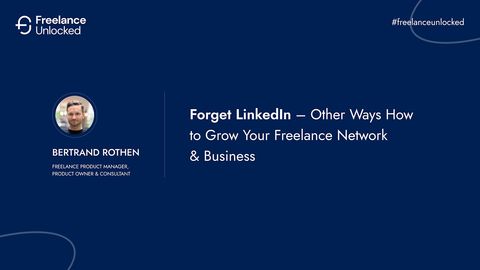

Bertrand Rothen has been freelancing for six years. In that time, exactly two clients reached out through LinkedIn, and nothing else, and turned into paid work. Two. Against thousands of hours the platform quietly absorbed.
"You could say, oh, you just suck at it," he told the audience at Freelance Unlocked 2025. "And the thing is, maybe I do. But then also I haven't heard anything wildly different from my peers on this."
That tension was the core of his talk: the platform everyone treats as mandatory versus the results almost nobody can point to. Not a rejection of LinkedIn, a cold audit of where a freelancer's networking hours actually pay off.
Rothen is a freelance product manager and consultant in the DACH market, independent since mid-2019, and, as he said on stage, he has nothing to sell here: "I'm not here to sell you a course or anything. This is not my business. My business is product management." (His pre-conference interview with 9am could be embedded here as a companion clip.)
The feed is not your sales channel
Rothen separates two products living under one blue logo. There's what he calls the "Rolodex side": the world's largest directory of professional profiles, useful for looking people up, messaging them, and collecting verifiable recommendations. And then there's the feed.
His verdict on the feed is blunt. He walked through its decline era by era: engagement-bait brain teasers, "broetry" one-line paragraphs, recycled boss-versus-leader platitudes, thirst traps with a business veneer. His test for all of it: does this convert into work for anyone?
"Unless you have a brain-teaser business, this is not going to convert to business for you at all. The engagement numbers are nice to look at, but there's no real value behind this." (Bertrand Rothen)
Then came AI. Over a year before his talk, Rothen noted, LinkedIn had already crossed the point where more long-form content was AI-generated than not. Originality.ai's ongoing study backs him up: over half of long-form posts were likely AI-generated by late 2024, past 80% by mid-2026. Whatever attention the feed still commands, you're competing with machines for it.
"If you take all this stuff that just got progressively worse and throw it in a blender," Rothen said, "what are you going to get? It's not going to be better."
LinkedIn was never built for freelancers
The sharper argument is about incentives, not content quality. More than half of LinkedIn's revenue comes from Talent Solutions, enterprise tooling for finding, hiring, and retaining employees. Marketing Solutions (ads) and Premium subscriptions make up most of the rest.
"None of this is geared towards freelancers," Rothen argued. The platform's paying customers are companies filling permanent roles. Freelancers are a side effect at best, which, he added, "gives platforms like freelancermap and 9am and Uplink a reason to exist."
He also flagged a cost most freelancers never price in: exposure. LinkedIn is "OSINT heaven and hell," he says, a public archive of who you work for, in what function, since when. Scammers once used details copied from LinkedIn to impersonate Rothen and try to reroute a client's invoice payment to their own account. Automated scanning caught the email before any money moved, but the lesson stuck.
"That was the day that I stopped sharing detailed information on what clients I worked for, at that very moment and in what function." (Bertrand Rothen)
For consultants and interim managers whose client lists are their business, that's worth sitting with. Every project announcement is also a phishing template.
A hundred people who love you
So where should the time go? Rothen's answer comes from Airbnb co-founder Brian Chesky: better to have 100 people love you than one million who sort of like you. Depth over reach. Freelance work doesn't come from an audience; it comes from specific people who remember you at a specific moment.
His own best client came from exactly this mechanism, and the story is comically undramatic. A former colleague resurfaced after nearly a decade of silence:
"He contacted me eight years later, just out of nothing. He said, 'Hey, you do freelancing now, right? I work in recruiting now and I need a freelancer.' And that was business for me, pretty good business as well." (Bertrand Rothen)
There's research behind the anecdote. A 2022 experiment published in Science, run (ironically) on 20 million LinkedIn users over five years, found that moderately weak ties, the ex-colleague or the person you met at one conference, generate more job mobility than close contacts do. Your strong ties already know everyone you know. The acquaintances are plugged into networks you can't see.
The DACH numbers point the same way. freelancermap's Freelancer-Kompass 2025 surveyed 3,210 freelancers; 64% said most of their projects arrive passively, through referrals, follow-up engagements, and staffing partners rather than cold self-promotion. When companies go looking, 57% search dedicated freelance platforms and 43% rely on recommendations; social networks come third at 39%. Referrals and platforms beat the feed on both sides of the market.
Rothen's conclusion: invest in the relationships that produce referrals, and don't confuse your fellow freelancers with the competition.
"Some of the people in this room might be your competitors, but they also can be your allies." (Bertrand Rothen)
Content, if you must (but not for everyone)
Rothen didn't tell anyone to go dark, just to right-size the effort: "I'm not saying tone it down to 0%. I'm saying tone it down to 20% if you're posting a lot."
He also pushed back on the assumption that every freelancer needs a content strategy: "Not everyone needs to produce content. If we all would produce content, who would consume it? AI, maybe. What's the point of that?"
For those who genuinely enjoy writing, he rated an own blog or newsletter, or guest posts in an established niche publication, well above feed posting. Smaller audience, but the right one: "The numbers are not as impressive, but the value is just much higher."
The one LinkedIn feature he'd double down on? Recommendations. Attached to a real, verifiable profile, they carry social proof a testimonial on your own website never can. "I've neglected this for far too long," he admitted, "but I'm going to be doing this now for every client that I work with."
Your networking system, in five moves
Rothen's advice condenses into a weekly rhythm, not a platform strategy:
- Meet two new prospects every week. A call counts. A coffee counts. So does a recruiter who posts interesting projects. The goal: be top of mind before the next project exists. Double down whenever you're actively looking.
- Work events properly. At every conference or meetup, talk to at least five new people. Not to pitch, just to stay loosely connected. The eight-years-later client starts here.
- Be a real community member, not a lurker. "I don't mean sign up and create a profile and then wait for the jobs," Rothen said. Help people. Ask for help. Follow up.
- Collect three LinkedIn recommendations per client. Ask at the end of every engagement, while the results are fresh. It's the most valuable thing the platform still does for freelancers.
- Cap the feed at 20%. If you post, share something uniquely yours, and stop watching the engagement counter. Put the reclaimed hours into moves 1–4.
The closing line is the one worth pinning above your desk:
"No one's going to inbox you saying, 'Hey, I saw your post and I want to give you a lot of money.' No one's going to do that, honestly. But if you build proper connections, you're going to be the first one that people call." (Bertrand Rothen)
Start this week: book two conversations and ask your last client for a recommendation. If you want your profile in front of companies that actually hire freelancers, create your free profile on 9am. Then meet your future referral network in person at the next Freelance Unlocked.
Freelance Unlocked is co-organized by 9am together with Uplink and freelancermap. This article is based on Bertrand Rothen's session at Freelance Unlocked 2025. Watch the full talk above, and join us at the next edition: freelanceunlocked.com.