
A routine audit can reach four years into the past. If the Deutsche Rentenversicherung decides your freelance engagement was actually employment, your client owes social security contributions for that entire period, and you might owe pension contributions yourself. Most freelancers in Germany know the word Scheinselbstständigkeit. Far fewer know how the assessment actually works, and that's exactly where the expensive mistakes happen.
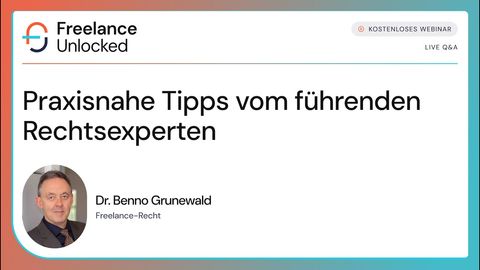
In a 9am webinar hosted by founder Marc Clemens, lawyer Dr. Benno Grunewald laid out how these cases really unfold. Grunewald has spent over 20 years defending freelancers and their clients in status disputes and is one of Germany's best-known specialists on the topic.
Nobody is permanently "falsely self-employed"
Grunewald's first point clears up a misconception that shapes the whole debate. False self-employment isn't a status you have. It's a question that hasn't been answered yet.
"Nobody is permanently falsely self-employed. That's impossible, it's nonsense," he says.
Quotes translated from German.
Every paid working relationship eventually lands in one of three boxes: genuinely self-employed, self-employed but subject to mandatory pension insurance, or dependently employed. "Falsely self-employed" just means an engagement that looks self-employed but hasn't been assessed. And the assessment is always per engagement, never per person. There is no such thing as a general certificate of self-employment in Germany. A contract that passes review today says nothing about your next project with a different client.
The law is two sentences. Everything else is case law
What does the law actually say? Astonishingly little. § 7 SGB IV defines employment as "nichtselbständige Arbeit" and names two indicators: working under instructions (Weisungen) and integration into the client's work organization (Eingliederung). That's it.
Because two sentences can't settle real disputes, courts have spent more than two decades filling the gap. Dozens of criteria have emerged. The heavyweights, according to Grunewald:
- How far the client dictates content, time, place, and manner of the work
- How deeply you're woven into the client's processes and team
- Fixed conditions like set hours or vacation arrangements
- Whose equipment you work with
- Whether you carry real entrepreneurial risk, for example through performance-based pay
No single criterion decides a case. The BMAS confirms what Grunewald stresses in the webinar: what counts is the overall picture, and if the contract says one thing while daily practice says another, practice wins. Grunewald adds a note from the trenches: "To this day I've really never had two identical cases." Court rulings help, but every engagement gets judged on its own facts.
Your client is whoever pays your invoice
Many freelancers work in a triangle: an end client wants the work, an agency or consultancy sits in between, and the freelancer contracts with the agency. Legally, the agency is your client. The end client doesn't matter for the assessment, and neither does a chain of two or three intermediaries.
This cuts both ways. Freelancers who say "I've worked for lots of companies" often mean lots of end clients through one agency. In the eyes of the Rentenversicherung, that's one client. And agencies can't hide either: if the freelancer is examined, whatever happens at the end client's office is attributed to the agency holding the contract.
Two risks, and they hit different people
Here's the part the umbrella term blurs. There are two separate risks, and they land on opposite sides of the table.
Risk one is false self-employment itself: the engagement is reclassified as employment. That risk sits 100 percent with the client. They owe the back contributions, up to four years of them, and no contract clause can shift that burden onto you. Grunewald is blunt: such clauses appear in contracts all the time and are simply unenforceable.
Risk two is yours alone. Under § 2 Satz 1 Nr. 9 SGB VI, a genuinely self-employed person who has no insurable employee and works "on a permanent basis and essentially for only one client" becomes subject to mandatory pension insurance. Passing the self-employment test doesn't end the story; the pension question comes right after it. Back payments can again cover four years.
What about the famous five-sixths rule, under which a client providing more than five sixths of your revenue counts as your only client? Grunewald's answer surprised many attendees: "It's an invention of the pension insurance." The thresholds don't appear in the law, and no court has confirmed them. The statute only says "on a permanent basis and essentially," which the legislator left deliberately open. Useful to know, though: the Rentenversicherung applies its rule of thumb anyway, treating roughly a year with one client as "permanent."
One more myth Grunewald dismantles: hiring someone doesn't fix everything. An employee earning above the Minijob threshold (603 € per month in 2026) removes the pension insurance problem. "To be completely clear: an employee does not protect you against false self-employment," he says. Those are different questions with different answers.
Why Grunewald warns against rushing into a status determination
The official route to certainty is the Statusfeststellungsverfahren, a free procedure at the Clearingstelle of the Deutsche Rentenversicherung Bund that takes about three months on average and delivers a binding decision. Sounds sensible. Grunewald sees it differently: "Personally, my experience with status determination procedures has been, to put it carefully, not good."
His pattern: parties file jointly, convinced they're a textbook case of self-employment, and receive a negative decision that triggers years of litigation. He only accompanies the procedure when a client insists on it before awarding a project.
What does he recommend instead? Two levers. First, the paperwork: skip the classic framework contract that auditors know inside out and work with purchase orders plus general terms and conditions instead. Second, and more important, the lived reality: auditors ask who gave you instructions, how you got your information, where and when you worked. If you know the criteria before a project starts, you can shape those conditions. "You can't reduce the risk to zero," Grunewald admits. "But you can reduce it considerably."
A GmbH helps too, mainly because audits target contracts with individuals, so the chance of being examined at all drops sharply. Weigh that against losing Freiberufler tax status before founding one.
Your checklist for a clean setup
Check the criteria that actually matter
- You decide how, when, and where you work, within project needs
- You stay outside the client's org chart: no internal email address as a team member, no duty to attend every internal meeting
- You use your own laptop, tools, and licenses
- You carry visible entrepreneurial risk: own insurance, own marketing, ideally performance-linked elements in your pricing
- You have more than one active client, or a concrete plan to get there
Document as you go
- Keep purchase orders, your own T&Cs, and invoices consistent with reality
- Save evidence of independence: your own project plan, rejected tasks outside scope, parallel client work
- Record who your contractual client is in each triangle setup
- Track your revenue split across clients per year, since concentration on one payer is what draws pension scrutiny
Think before you file a Statusfeststellung
- Don't start the procedure casually just for peace of mind; get legal advice on your specific setup first
- Expect it when a corporate client demands it as a condition of the contract, and prepare the practical side beforehand
- Do a dry run first: 9am's free Scheinselbstständigkeitstest mirrors the logic auditors apply and shows your risk in a few minutes
- Founders can apply for a three-year exemption from pension insurance, but as Grunewald cautions, weigh the visibility this creates
The freelancers who get through audits unscathed aren't the lucky ones. They're the ones who understood the criteria before the first invoice went out, and set up the engagement accordingly.
Want more of this? 9am runs regular webinars with experts like Dr. Grunewald on the legal and business side of freelancing in the DACH market. Join the next one, or bring your questions to the Freelance Unlocked conference.
This article is for information only and is not legal advice.
This article is based on 9am's webinar "Scheinselbstständigkeit vermeiden als Freelancer". Watch the full recording above.