The World Economic Forum expects 92 million jobs to be displaced and 170 million created by 2030: a net gain, but a swap of roughly one job in five. Cloudflare showed what the swap looks like in May 2026: more than 1,100 people out, most of them what its CEO calls "measurers", while builders and sellers stayed. For freelancers the question is not whether your job disappears but which part of your invoice does. The skill that moves you to the building side is curiosity, and the research says it is a habit you can train.
92 million jobs gone by 2030. The number opened day two of Freelance Unlocked 2026, and it is worth getting exactly right, because it is bigger and less scary than it sounds.
The source is the WEF Future of Jobs Report 2025, published in January 2025 and based on more than 1,000 employers who together employ over 14 million people in 55 economies. Their expectation for 2025 to 2030: 170 million new jobs, 92 million displaced, net plus 78 million. The churn adds up to 22% of today's jobs. One caveat the stage version dropped: the WEF attributes the change to structural transformation as a whole, technology among it but also the green transition, demographics and geopolitics. AI is the loudest driver, not the only one.
So the headline is not "one in five jobs vanishes" but "one in five jobs gets swapped". That is the useful version for freelancers, who are already the people companies call when a role changes faster than a hiring plan can.
What the swap looks like up close
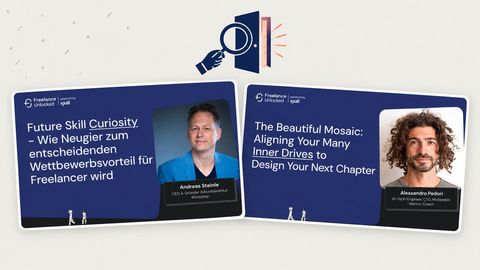
Andreas Steinle, who runs the innovation consultancy Zukunftsinstitut Workshop in Frankfurt and sits on Merck's Curiosity Council, opened his session with the feeling behind the number:
"Es gibt diese sogenannte Fobo, die fear of being obsolete. Wer hatte ich überhaupt noch gebraucht? Macht die KI meinen Job? Und ja, in vielen Bereichen macht die KI meinen Job." (Andreas Steinle)
FOBO, the fear of being obsolete. He then gave two examples, and both deserve the primary source.
Entry-level jobs. On stage the figure was "a solid 40%" fewer entry-level postings over five years. Stepstone's own labour market briefing of 24 July 2026 is more precise and less dramatic: postings for career starters bottomed out in the third quarter of 2025 at about 33% below the multi-year average, were roughly 14% above the prior-year period in the first half of 2026, and still sit around 18% below the long-term average. When Stepstone asked companies why, only 17% named AI; remote work, the weak economy and pandemic-era learning gaps share the blame. We covered the freelance side of that squeeze in The entry-level squeeze.
Cloudflare. On 7 May 2026, Matthew Prince and Michelle Zatlyn announced a reduction of more than 1,100 jobs, more than a fifth of the company, alongside the note that internal AI usage had risen more than 600% in three months. Two weeks later Prince explained the selection in a Wall Street Journal op-ed titled "How I Choose Which Cloudflare Employees to Replace with AI", reported here. He borrowed Peter Drucker's 1954 split of every company into builders, sellers and measurers, and wrote: "The vast majority of those we laid off last week were measurers." Steinle's summary from the stage:
"Die 1000, die er entlassen hat, das waren die Measurers. Das soll die KI machen." (Andreas Steinle)
One correction to the stage version: the 1,111 interns Cloudflare is hiring were announced in September 2025, eight months before the cuts, with Prince noting that "getting a job out of school has never been harder". The sequence matters less than the shape: measurement out, building in.
Which line of your invoice is measuring?
The freelance translation of Drucker's three boxes: builders make the thing, sellers bring in the client and keep them, measurers count, track, report and coordinate. Every freelancer does all three. The question is which one you are billing for.
Status reports, timesheet reconciliation, "aligning stakeholders", dashboards that summarise other people's work, testing that follows a checklist: these are measurer hours, and they are exactly the hours a client's AI agent will do first. If a third of your invoice is measurement, a third of your invoice is at risk, whatever your job title says.
That is also the opportunity. The WEF's rising-skills list starts with AI and big data, networks and cybersecurity, and technological literacy, then continues with creative thinking, resilience and flexibility, and, at number six, curiosity and lifelong learning. Steinle's bet is that the last one climbs:
"Über die Zeit wird sich Curiosity und Lifelong Learning auf Platz 1 schalten, wenn Technologie immer weiter in die Prozesse hineinsickert." (Andreas Steinle)
His argument: when you can program by describing what you want, the scarce skill is knowing what to want. That is a builder's skill, and it starts with a question.
The evidence that curiosity pays
Patrick Mussel, then at the University of Würzburg, published a study in the Journal of Organizational Behavior in 2013 that tested whether curiosity predicts job performance in a sample of 320 apprentices. It did, and it kept predicting after he controlled for general intelligence and the Big Five personality traits. Steinle cited the same researcher on stage and added that curious companies perform better financially; we could not trace that second claim to a published paper, so take it as his reading.
The uncomfortable counterpart comes from Merck's own State of Curiosity survey of 2,606 US employees in 2015: only about a fifth, 22%, described themselves as curious at work. Steinle rounded it to 20%: in an economy that competes on innovation, not enough. It is why Merck set up the Curiosity Council he belongs to, and why they broke curiosity into four measurable dimensions.
Those four are the practical part of his talk. Drive through knowledge gaps: can you stay with one problem for hours. Joy of discovery: do you cross into fields you do not know. Openness to other people's ideas: Steinle's example is that great founders steal well. And tension tolerance: can you keep asking when things are uncomfortable. His example for the first dimension was Peter Steinberger, the solo developer whose AI-agent platform, in Steinle's telling, ended up ahead of the big labs' own offerings:
"Er hat sich nicht gefragt, was ist denn das beste KI Agentensystem, sondern er hat sich gefragt, was passiert, wenn ich es einfach baue?" (Andreas Steinle)
A freelancer who lost his job to AI in 2010
Alessandro Pedori, an AI engineer and coach, has a claim to expertise almost nobody else in the room had:
"I consider myself one of the people that lost their career to AI before it was cool, like 2010." (Alessandro Pedori)
He was a technical translator when machine translation got good enough, retrained in natural language processing and has spent fifteen years inside the AI industry since, including a stint at Apple's Siri. His session was about the method he built from that: instead of one big reinvention, imagine three or four possible five-year futures, notice which parts of you veto each one, then run small experiments.
The rules of the experiment are what make it usable. "Experiments never fail. The idea is that the experiment is a question. Is it true or not?" Set a definition of success in advance, a month-long horizon, a small budget: "don't put more than a few percent of your net worth for your next month." And one permission most career advice forgets:
"Sometime we need the permission not to reinvent ourself. Like it's okay if next year I do the same thing of this year." (Alessandro Pedori)
That permission is what separates curiosity from panic. FOBO makes people change everything at once. Curiosity makes them change one thing, measure it and keep the result.
Training it
Steinle's closing instructions were concrete enough to copy. Replace brainstorming with questionstorming: 30 questions about the problem before a single solution, in silence, then read them back (we described the method in Skills on the rise 2026). Put the phone in the bag for the next talk, because self-inflicted interruptions shut down the part of the brain that processes anything new. And his least comfortable one:
"Probiert etwas aus, das ihr hasst." (Andreas Steinle)
His example was bodybuilders made to crochet, most of whom enjoyed it. You cannot know what you like until you have done it, and a freelancer whose taste stopped updating in 2019 has a service menu that stopped with it.
What to do on Monday
- Sort last month's invoices into builder, seller and measurer hours. The measurement share is the one to automate yourself, before a client does, and to replace with building.
- Write 30 questions about your best client's business. Not solutions. Questions. Send the three best ones to the client. That is a builder conversation, and it usually ends in a new brief.
- Design one four-week experiment. A new service, a new tool, a new industry. Define what "it worked" means before you start, cap the money you spend, and write down the result whether it goes up or down.
- Do one thing you dislike this week that a curious person would try. A tool, a format, a meetup outside your field. Note what you learned.
- Check your profile against the WEF list. AI and data literacy, cybersecurity basics, creative problem framing. If none of them appear, the search engines reading your profile in 2027 will not find you.
If the experiment turns up a service worth selling, put it where buyers look: create a free profile on 9am and list the thing you can build, not the thing you can count.
Freelance Unlocked is co-organized by 9am together with Uplink and freelancermap. This article draws on the sessions of Andreas Steinle and Alessandro Pedori at Freelance Unlocked 2026. Watch the full talks above, and join us at the next edition: freelanceunlocked.com.