
Employment among 22 to 25 year olds in AI-exposed jobs is 19% below their peers, driven mostly by fewer hires, not layoffs. Entry-level postings in AI-exposed fields grew 35% since 2019, but now demand senior-level skills seven times more often, and the AI-skills wage premium hit 62%. That is a real opening for experienced freelancers since smaller teams need judgment on demand, but nobody is training the seniors of 2032, and skills can erode within months of relying on AI. If you are starting out, pick a narrow, consequential field and keep doing the reps by hand.
The most quoted labour-market number of the year is about people who never got hired. In their August 2026 update, Erik Brynjolfsson, Bharat Chandar and Ruyu Chen report that employment among 22 to 25 year olds in highly AI-exposed occupations now sits about 19% below where it would be if it had tracked their peers in less-exposed work.
The detail that matters is buried one line further down. This is not a layoff story. The adjustment runs almost entirely through reduced hiring rather than through people being let go. Nobody was fired. The door was quietly closed.
For anyone who sells expertise by the day, that closed door is both an opportunity and a slow-moving problem. Worth understanding both halves before deciding which one you are in.
What the Stanford data does and does not say
The team used ADP payroll records through June 2026, which means real paychecks rather than survey answers. The shortfall was 15% at the July 2025 data cut and is 19% as of June 2026.
The direction of the effect depends on what AI does to the work. Where AI substitutes for tasks, employment falls. Where AI complements the person doing them, employment is flat or rising, and the researchers note this holds "particularly among more experienced workers". Older cohorts in the same AI-exposed occupations show no comparable gap.
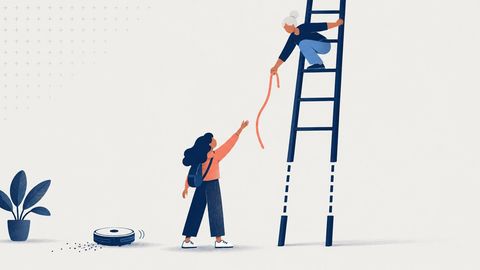
So the machine is not eating the profession. It is eating the bottom rung of the ladder, which happens to be the rung people used to climb on.
The junior job did not disappear. It changed its job description
The complement to Stanford comes from PwC's Global AI Jobs Barometer 2026, which read more than a billion job ads across 27 countries. Its finding cuts against the panic in an interesting way: entry-level postings in AI-exposed fields have actually grown 35% since 2019, while other entry-level roles shrank 10%.
The catch is what those postings ask for. Entry-level roles exposed to AI are seven times more likely to demand traditionally senior-level, human-intensive skills. Judgment, client communication, the ability to decide what is good enough to ship.
Put the two datasets side by side and the picture is coherent. Companies still want juniors. They want juniors who can do the part of the job that used to take five years to learn, because the other part is now cheap. Fewer people clear that bar, which is why hiring falls even as postings rise.
PwC adds the price signal. The wage premium for AI skills hit 62%, up from 57%. Roles the report calls "professionalised", where AI strips out routine and leaves judgment, show twice the job growth and 42% faster salary growth than "democratised" roles, where AI makes the work accessible to anyone.
Why this is a live opening for experienced freelancers
Julien Look builds AI transformation projects for companies and spent his Freelance Unlocked session on why so many of them fail. His description of what has happened inside product teams is the same story from the inside.
"We are not only seeing developers coding nowadays. That barrier is just not existing anymore." (Julien Look)
Most people now using AI coding tools, he points out, have no coding background at all. Product managers ship features. Designers ship interfaces. QA writes code. The consequence is not that engineers become useless, it is that the composition of a team changes.
"Team sizes are shrinking. You don't need a 10 people team to build SaaS products anymore. Three people might be enough. But even if teams are getting smaller, we are moving at a way faster pace and organizations are still struggling to drive this whole adoption. There will be only more work created in the future for people in our position." (Julien Look)
A smaller permanent team with more work to do is, structurally, a freelance market. Three people who ship fast need a fourth for six weeks, not a fourth on payroll. And the hiring data says the fourth person will not be a graduate.
Upwork's Future Workforce Index 2026, a survey of 2,400 US workers, shows the supply side moving the same way: the share of skilled knowledge workers doing freelance work went from 28% to 38% in a year, and 58% of full-time employees say they are considering freelancing, up from 36%. That is US data and DACH does not behave identically, but the mechanism travels.
The catch is that the demand is specifically for the thing AI does badly. Julien's own numbers on failed AI projects, which we covered in why most AI projects fail, point at change management rather than technology. That is judgment work. It is also exactly the kind of work you cannot learn by watching.
The part nobody is pricing in
Here is the slow-moving problem. If AI takes the bottom rung, where do the seniors of 2032 come from?
Dorothea Winter, a philosopher at the Humanistische Hochschule Berlin who researches AI and creativity, presented a finding at Freelance Unlocked that should worry anyone banking on their own expertise ageing well. In studies where people wrote fictional texts with and without AI support, the results split by starting level.
"The people who had less creative results before managed better results with AI. But the results were suddenly more similar to each other. Before, they had weaker results, but those were more authentic and more individual. And for those who were already producing at a high creative level, AI made almost no difference." (Dorothea Winter)
Her conclusion is that AI homogenises the creative middle. The floor rises, the ceiling stays where it is, and the distance between them collapses. For an individual that reads as a win. For a market that sells differentiation, it is the product disappearing.
Victoria Ringleb, managing director of the Alliance of German Designers, put the same observation in blunter terms from the buyer's side of the desk.
"AI gives me kitsch. That's mediocrity. What art is actually for, to make me push against it, to make me start thinking, AI can't deliver that." (Victoria Ringleb)
Winter also pointed to the sharpest available evidence that skills decay when you outsource them. A multicentre study published in The Lancet Gastroenterology & Hepatology followed 19 experienced endoscopists at four Polish centres. Their detection rate when working without AI fell from 28.4% before they had access to AI assistance to 22.4% afterwards. The authors are careful that the study is observational and other factors may have played a role. Even with that caveat, these were specialists with more than 2,000 procedures each, losing accuracy in months.
Now hold that next to the Freelancer-Kompass 2026: 85% of German freelancers use AI tools, 71% for writing, but 59% have not fully automated a single task and only 10% feel very well prepared for what is coming. Most people are using AI as a substitute for thinking in the small moments, not as a system. That is the exact usage pattern the deskilling research warns about.
If you are starting out
The market currently prices experience and does not pay for potential. That is unfair and it is also the situation.
What still works: pick a domain narrow enough that you can be genuinely good at it inside a year, and pick one where the output has consequences. Compliance, medical devices, industrial data, accessibility, tax. Work where being wrong costs money is work where somebody has to be accountable, and accountability is not something a client can prompt for.
Do the boring reps on purpose. If AI writes your first draft every time, you will not develop the judgment that lets you tell a good draft from a plausible one, and that judgment is the entire product. Winter's practical rule is to check two or three times a week whether reaching for the tool is genuinely making the work better or just making it easier.
And get in front of people. Our guide to surviving your first year freelancing has the unglamorous mechanics: reserves, pipeline, the first ten conversations. None of that changed because of AI.
If you are hiring
A short note for the companies reading this, because 9am sits on both sides of the market.
Hiring only seniors works until it doesn't. The Stanford data describes a system that is consuming a pipeline nobody is refilling. If entry-level postings now demand senior skills at entry-level pay, they will keep going unfilled, and the shortage you are managing in 2026 becomes structural in 2030.
The workable pattern is a junior plus AI plus a reviewer who is genuinely senior, with the reviewer often being external. That is where an experienced freelancer earns their rate right now: not as an extra pair of hands, but as the person who decides whether the output is right. It is also, incidentally, how the junior learns.
What to do on Monday
- Sort your offer into "professionalised" or "democratised". If a competent non-specialist with a good tool could deliver something acceptable, you are on the shrinking side. Move toward the decision, the accountability, the review.
- Name the deliverable AI cannot sign off. Write it into your profile and your proposals in one sentence. "I decide whether this ships" sells differently than "I produce this".
- Pick one skill you will keep doing manually. The one your reputation rests on. Do it without the tool often enough that you can still tell good from plausible.
- If you are new, choose consequence over comfort. A narrow field where mistakes are expensive beats a broad field where output is cheap.
- If you hire, run one junior-plus-senior-reviewer pairing this quarter. Measure it against a senior-only contract. The maths is usually closer than people assume.
The freelance opening created by the entry-level squeeze is real, and it is temporary in the way all structural gaps are temporary. It rewards the people who can show what they judge rather than what they produce. Our look at three years of AI at Freelance Unlocked tracks how fast that line has moved. If you want companies to find you on the judgment side of it, create a free profile on 9am.
Freelance Unlocked is co-organized by 9am together with Uplink and freelancermap. This article draws on the sessions of Julien Look, Victoria Ringleb and Dorothea Winter at Freelance Unlocked 2026. Watch the full talks above, and join us at the next edition: freelanceunlocked.com.