
Edelman and LinkedIn's 2025 survey of 1,934 executives found that 95% of the buyers they call hidden decision-makers are more receptive to sales outreach after strong thought leadership, and 79% are more likely to back an RFP proposal from a company that publishes consistently. A separate consultant survey, from a vendor with no published methodology, found blogging and SEO delivering only 7% of clients while referrals dominate. Both can be true. Publishing does not replace the ask. It makes the ask land.
There are two confident camps. One says content is the whole game and pitching is dead. The other says content is a hobby and referrals pay the bills. The evidence says they are measuring different moments in the same sale.
What publishing actually does to a buyer
Edelman and LinkedIn have run a B2B thought leadership study for seven years. The 2025 edition surveyed 1,934 global business executives between 17 March and 3 April 2025, with a margin of error of two percentage points. Its focus is a group Edelman coined a term for: hidden decision-makers, defined as people who are a final decision-maker in a group purchase but sit there representing a function that does not require deep knowledge of the product. Think the operations lead in a design tender.
Among that group:
- 71% agree thought leadership is more effective than conventional marketing or sales materials at demonstrating a vendor's potential value.
- 64% trust thought-leadership content more than marketing materials and product sheets when assessing capability.
- 55% use it as part of their vetting process.
- 79% say that during an RFP process, they are more likely to advocate for proposals from companies that consistently produce high-quality thought leadership.
- 41% say a C-suite executive encouraged them to consider a specific vendor after engaging with that vendor's content.
- 95% say strong thought leadership makes them more receptive to sales and marketing outreach.
Read that last one again, because it is the one people misquote. It does not say content brings you clients. It says content makes people open the door when you knock. LinkedIn co-produces the study and benefits from more people publishing there, so: sound sampling, interested sender.
The counterweight, with its own health warning
The best-known figure pointing the other way comes from Consulting Success, which sells marketing coaching to consultants. Their Marketing for Consultants Study, first published in 2022 and updated in June 2025, surveys a list they describe as over 50,000 consultants, with no sampling methodology published. Directional, not authoritative.
In it, 60% of consultants get at least 40% of their business from referrals, split between 31% who get 60 to 80% that way and 29% who get 40 to 60%. Outbound phone calls were the best non-referral channel at 16% of clients. Blogging and SEO produced 7%. Writing articles and reports produced under 1%. And 70% report zero leads per month from their own website.
Put the two sources side by side and the shape is clear. Publishing changes how you are received. Referrals and direct approaches are still where the work comes from. The mistake is treating publishing as a substitute for asking rather than as what makes asking work.
Hunt's version: stop selling, start showing
Christian Hunt sells behavioural science to compliance functions, a product he describes as one nobody wakes up wanting. His whole acquisition model is built on that constraint.
He started conventionally: fixed prices, cold outreach, every pitch. "I lost loads of deals because I was too expensive. I won loads of deals because I was too cheap." His conclusion belongs above most freelancers' desks: "a wrong yes is way more expensive than a no."
What replaced it:
"I should just stop selling and start showing. Show people what you can do. Don't sell them a product or service." (Christian Hunt)
He runs a podcast, keynotes, videos, written pieces. He does not know which companies his buyers work for, so he publishes and waits for self-selection. The sorting is deliberately two-way:
"I need to use what I put out there like a magnet. I need to attract the people that love what I do and I need to absolutely repel the people that don't." (Christian Hunt)
Two consequences follow. His funnel is small on purpose, and conversations convert, because prospects screened themselves. And he refuses pitches: "Pitching makes what I do invisible, so I just don't do it." Entering one signals that your work is comparable to everyone else's in the room, at which point price decides.
The other move worth copying is the public price anchor. Hunt sells speaking, training, consulting and coaching, and publishes prices for one of them only, the most expensive: "I only put pricing up for the speaking, and there's a variety of prices on there. The speaking, the most expensive product, has done the anchoring for me." Everything else is quoted in conversation, from a number the reader already carries.
And the name for the whole approach:
"I experiment in public. I screw up in public. R&D in public is massively underrated. You do not have to have the finished thing. You can just put the idea of it out there and people find it interesting and you'll get feedback on it." (Christian Hunt)
He is honest about what it takes to work this way. Asked from the audience whether it is a luxury, he said yes: he had tested the idea inside a large employer before going solo, and "that may be a very luxurious position." Keep that caveat when you copy the method.
Nguyen's version: publish five weeks ahead, sell before you build
Bao Hanh Nguyen took the same principle in a more industrial direction. Over 18 months building an audience around AI skills for women, she reports on stage over 7,000 LinkedIn followers, 3,000 newsletter subscribers, more than 2,000 women through her programmes and eight learning products. Her own numbers, on her own slides.
The operating detail is the useful part:
"I work on my content five weeks in advance. I always have five weeks of content ready and five newsletters queued up. I work strongly in blocks. Every week I decide what the priorities are and then I block the times in my calendar." (Bao Hanh Nguyen, translated)
Five weeks of buffer is what makes public development survive a busy delivery month. It is also why most freelancers' publishing dies in week three.
Her second habit is Hunt's R&D-in-public taken to its end: she sold the programme before it existed. Three days before launch she had 300-plus registrations and no material, then built each week during the week from participant feedback.
She is also blunt about the start. A workshop she posted on LinkedIn in 2024 got exactly two registrations in two weeks. She kept going. By March she had 1,900.
And her reason for not automating the content, which sits underneath the whole strategy:
"Your humanity is your USP, because everything will be full of AI slop. People notice immediately on LinkedIn whether that is an AI phrase or whether there is really a human behind it sharing their own experience." (Bao Hanh Nguyen, translated)
The gap you are walking into
One more number, to set expectations. The Content Marketing Institute's B2B research published on 8 October 2025, based on 1,015 B2B marketers, found that 96% of organisations create thought-leadership content, but only 11% rate their own programme advanced or leading, and 67% report that under 15% of their knowledgeable staff contribute anything. Those are marketing teams, not solo consultants, so read it as context, not benchmark.
The implication for a one-person business is favourable. Almost everyone publishes. Almost nobody publishes consistently with an actual expert's voice behind it. That is the gap you can occupy.
A 30-day starter plan
- Week 1. Write down the three situations that make a client hire someone like you. Hunt's are: something went wrong, someone is new in the job, or someone has always known things were broken. Every post you write from now on is aimed at one of those three.
- Week 2. Publish two pieces about work in progress, not finished conclusions. A decision you are chewing on, a method you are testing, a thing you got wrong. Add one public price signal, even if it is only "projects typically start at X".
- Week 3. Build the buffer. Draft five pieces in one blocked session, so week four does not depend on inspiration.
- Week 4. Make the ask. Three warm messages to people who engaged with what you published, three referral asks to past clients. This is the step that converts the receptivity Edelman measured.
The honest cost: several hours a week you are not billing, for months before anything happens. Hunt built his over years. Nguyen calls the pace hard. If you cannot protect the hours, publish less often and keep the ask, not the other way round.
What to do on Monday
- Write the three buying situations for your service on one line each. Pin them where you write.
- Publish one unfinished thing this week. A method, a decision, a mistake with what you learned.
- Put one price on a public page. Anchor with your most expensive offer, and quote the rest in conversation.
- Block two hours to draft five posts, so the next busy month does not kill the habit.
- Ask three past clients directly who else they know with the problem you just wrote about.
For the wider identity work behind all this, personal branding for freelancers is the companion piece, why freelancers should use video content covers the format that travels furthest, and what the research says about referrals and weak ties covers the channel that still closes. A free 9am profile does the other half of the job: being findable by companies who are already looking.
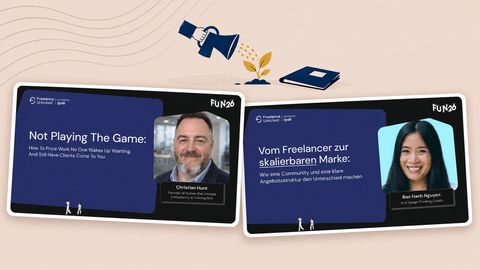
Freelance Unlocked is co-organized by 9am together with Uplink and freelancermap. This article draws on the sessions of Christian Hunt and Bao Hanh Nguyen at Freelance Unlocked 2026. Watch the full talks above, and join us at the next edition: freelanceunlocked.com.