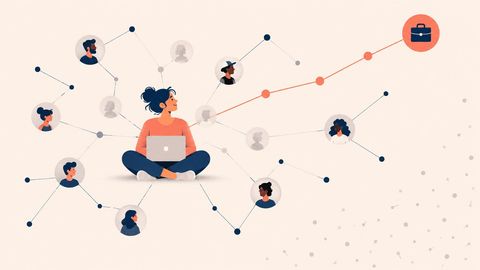
The largest causal test of the weak-ties theory, a LinkedIn experiment covering around 20 million people, found that the closer a contact is to you, the less likely they are to lead to work. The relationship is a curve, not a slope: moderately weak ties beat both close friends and strangers, with the turning point around ten mutual connections. In DACH, personal networks and referrals together bring in more projects than social media, and 55% of freelancers name new projects as the main thing their network delivers. Ask the right people, and ask before you need to.
Most networking advice tells you to nurture your closest professional relationships. The best evidence available says those are the contacts least likely to bring you work.
The experiment
In 2022, Karthik Rajkumar, Guillaume Saint-Jacques, Iavor Bojinov, Erik Brynjolfsson and Sinan Aral published a causal test of the strength of weak ties in Science. It was not a survey. LinkedIn ran multiple experiments on its People You May Know algorithm between 2015 and 2019, covering roughly 20 million users, about 2 billion new connections, more than 70 million job applications and 600,000 accepted jobs. That design lets you say something rare in social science: not that weak ties correlate with getting hired, but that they cause it.
The headline finding, as MIT summarised it: "the stronger the newly added ties were, the less likely they were to lead to a job transmission."
The part almost every retelling drops is the shape. The relationship is an inverted U. The most useful contacts are not the weakest possible ones, but, in Aral's words, "not the weakest, but slightly stronger than the weakest." The turning point sits at roughly ten mutual connections. Below that, more overlap helps. Above it, the contact starts to know the same people and the same openings you already know, and the value falls away.
One more caveat worth carrying: the effect was strongest in digital, software-intensive and remote-friendly industries, and weaker in traditional sectors. If you are a freelance developer, designer or consultant, this is your curve. If you work in a regional trade, treat it as a hint rather than a law.
Two honest limits. The study is from 2022, and we found no larger-scale replication since. And nobody has published a conversion rate for freelance referrals specifically, so if you see "referrals close at 4x the rate," that number is borrowed from general B2B sales, not measured on freelance work.
What that looks like in a DACH freelance pipeline
Numbers first, and each one keeps its year. The Freelancer-Kompass 2025, as reported by informatik-aktuell, put project acquisition at 34% via platforms and exchanges, 23% via personal networks, 14% via referrals into follow-up projects, and 7% via social media. Personal network plus referrals is 37%, ahead of platforms and five times social media.
The Freelancer-Kompass 2026, 5,412 respondents surveyed between 17 November 2025 and 8 February 2026, does not repeat that channel table, so we are not blending the two years. What it does say: client acquisition is the number one named challenge, at 62%. And 55% say the greatest value their network delivers is new projects and clients.
Platforms remain the largest single channel, and we have written about why. This piece is the counterweight, not a contradiction.
Why the network gets asked first
Dirk Franzke has spent more than a decade on the intermediary side of this market and co-founded Expert Brokers, so he sells into the channel he describes. Read him as a practitioner with an interest, and then look at what he actually describes, because it explains the survey numbers better than the survey does. A project request, he says, goes through three stages in the decision-maker's head.
"As the decision-maker I ask myself: have I had someone in the past I worked with? And if I don't have that, I go to my network and ask, do you know anyone who can solve problem XYZ? Have you had experience with someone? Only when those levers fail do I go to the provider I trust." (Dirk Franzke)
Stage one is memory. Stage two is somebody else's memory. The platform or agency is stage three, which is why it looks big in the statistics: it catches everything the first two stages missed. Being in stage two, someone else's answer to "do you know anyone", is what a referral actually is.
His advice for getting there is unglamorous and specific.
"Set up a CRM. Systematise your own network once. Look at who you used to work with, who you still know, who you play tennis with, which friends you have, which neighbours you have." (Dirk Franzke)
Tennis partners and neighbours are exactly the moderately weak ties the LinkedIn data points at. They know you well enough to vouch for you and move in circles you do not, which is the whole mechanism.
The timing mistake
Both our sources describe the same failure, from opposite sides.
Franzke's version is the email everybody has sent.
"Two weeks before the project ends, most people send some wild email around: by the way, I'm available again from the day after tomorrow, in case you have a project for me." (Dirk Franzke)
Occasionally it works. Usually it arrives while the recipient has nothing open, and you have spent your one ask at the worst possible moment. His image for the alternative is a pump: "in the end it's like a pipeline, pump, pump, pump, until the oil comes out." Keep the network running while you are billing, not when you are not.
Stefania Volpe, then a project manager at freelancermap, put the same thing in survey terms on the Freelance Sucks podcast.
"The most common complaint I hear from freelancers is project acquisition, client acquisition. We have been asking this in our freelancer surveys, and we are doing this in seven years, and the top answer is project acquisition." (Stefania Volpe)
"Many freelancers underestimate the time and effort needed to land new projects and new clients. Of course you are doing work, but you are not actively charging for this time." (Stefania Volpe)
Her rule for when to start is blunt: "if you know a project is going to end, then you should start maybe a couple of months before, looking for the next opportunities." Two months, not two weeks.
The ask that works
A referral request fails when it asks the other person to do your thinking. "Let me know if you hear of anything" is unanswerable. Make the ask small, specific, and easy to forward.
Subject: A quick favour, no rush
Hi [Name],
we worked together on [project] in [year]. I am opening up capacity from [month] and I am looking for [one sentence: exactly the kind of work and the kind of company].
If someone in your world has that problem, would you forward this? If not, no reply needed at all.
[One line of proof: the result of a comparable project, with the number.]
Thanks either way, [Name]
Four things it does. It names the person's connection to you. It defines the target so narrowly that they either think of someone in five seconds or they do not. It gives them something to forward instead of something to summarise. And it removes the obligation to answer, which is what makes people answer.
Send it to the moderately weak ties: the former colleague two jobs ago, the person you met at a conference, the client contact who has since moved companies. Not to the three people you speak to every week, who already know everything you know. That is the study's practical translation, and it is also why showing up where you are not already known pays more than posting to the same audience again. If LinkedIn is where you have been doing all of it, our contrarian take is worth ten minutes.
What to do on Monday
- List twenty moderately weak ties. Former colleagues, past client contacts, conference acquaintances. Skip your inner circle. If you and the person share fewer than about ten mutual connections, they belong on the list.
- Write the one sentence. What you do, for whom, and what problem. If you cannot say it in one line, nobody can forward it.
- Send five asks this week. Not twenty. Five, personalised, with the proof line filled in.
- Put the network into a system. A spreadsheet is enough. Name, last contact, what they do, one line of context. Franzke's CRM point does not require software.
- Book the recurring slot. Two hours every second Friday, while you are still billing. That is the pump.
If your calendar says the next project starts in three weeks and the ask has not gone out yet, a free 9am profile covers stage three while your network works on stages one and two.
Quotes by Dirk Franzke translated from German.
Freelance Unlocked is co-organized by 9am together with Uplink and freelancermap. This article draws on the session of Dirk Franzke at Freelance Unlocked 2026 and the Freelance Sucks podcast episode with Stefania Volpe. Watch and listen above, and join us at the next edition: freelanceunlocked.com.