

Three years with the same client, full capacity, no employees of your own. For an auditor from the German pension insurance (Deutsche Rentenversicherung, DRV), that one sentence is often enough: mandatory pension contributions, payable by you. Not because you're "fake" self-employed. Because of a completely different rule that most freelancers have never read.
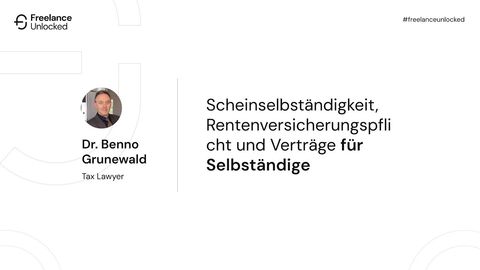
That distinction was the core of Benno Grunewald's session at Freelance Unlocked 2024. Grunewald is a lawyer and certified tax law specialist (Fachanwalt für Steuerrecht) in Bremen who has spent more than 20 years representing self-employed professionals, most of them in IT, events, and agencies. He has seen hundreds of DRV proceedings from the inside, and he opened with a warning: the terms everyone throws around are usually mixed up, and the mix-up is exactly what gets freelancers into trouble.
There are only three statuses, and "falsely self-employed" isn't one of them
"For over 20 years, a very unpleasant ghost has been haunting Germany: the ghost of false self-employment," Grunewald began. Quotes translated from German. But legally, he argued, the ghost doesn't exist as a category. If you work for money in Germany, you land in one of three boxes: employed, self-employed with no social insurance obligations (what most freelancers want), or self-employed but subject to mandatory pension insurance.
False self-employment, "Scheinselbstständigkeit", is just a label for the moment when nobody has decided yet which box applies. "No one can be permanently falsely self-employed. Saying that makes no sense at all," Grunewald said.
Why does the terminology matter? Because the two regimes behind it run on entirely different criteria:
- Social insurance status (employee vs. self-employed) is governed by § 7 SGB IV and decades of case law.
- Mandatory pension insurance for the genuinely self-employed comes from § 2 SGB VI and has its own short checklist.
Most forum advice fails, Grunewald said, because it applies the criteria of one regime to the other.
Your client is whoever pays your invoice
Before the criteria, one definition that trips people up: who is your "Auftraggeber", your client in the legal sense?
In German IT freelancing, the standard setup is a triangle. You sign with an intermediary (an agency or consultancy), the intermediary signs with the end customer, and you do the work at or for that end customer. Legally, your client is the intermediary. "You could put it even more bluntly: your client is the one who pays you," Grunewald said. The end customer has built itself a contractual firewall and stays out of any audit.
The practical consequence stings. Freelancers often tell Grunewald they've had many clients: five end customers over three years. If every one of those projects ran through the same agency, the DRV counts exactly one client. That number matters a lot in the second half of this article.
False self-employment: thin law, thick case law
What actually makes someone an employee rather than a contractor? The statute is short. § 7 SGB IV defines employment as non-independent work and names two indicators: working under instructions, and integration into the client's work organization. That's it. Germany briefly experimented with fixed statutory criteria around 2000, then scrapped them by 2003. Everything since has come from court rulings, an open-ended list that keeps growing.
Which means every case is decided on its own facts. "I've been doing this for over 20 years, and I can honestly say I've never had two identical cases," Grunewald said. Comparable, yes. Identical, no.
Two points from his practice are worth pinning:
Remote work doesn't save you. Working from your own office instead of the client's site is one criterion among many, not a fix. Auditors look at how, where, and under whose direction the work gets done.
The financial risk sits with your client, not you. If an audit reclassifies you as an employee, the client owes the back social insurance contributions, normally for up to four years. Your share: zero. Some contracts contain clauses passing that bill to the freelancer. Grunewald's advice on those clauses: "Read it, then forget it immediately." Clients can't reclaim those contributions from you.
The pension trap: genuinely self-employed and still on the hook
Now the rule that flips the risk onto you. Under § 2 sentence 1 no. 9 SGB VI, a genuinely self-employed person must pay into the statutory pension scheme if two things are true: they work essentially and on a permanent basis for only one client, and they employ no staff subject to social insurance. The DRV lists "self-employed with one client" right next to teachers, midwives, and craftspeople among the compulsorily insured.
The law never defines "essentially" or "permanent". The DRV filled the gap itself: "essentially" means more than five sixths of your revenue (about 83 percent) from one client, "permanent" means about a year. Grunewald calls that reading "completely arbitrary", and notes that no court has adopted it. Judges look at the freelancer's whole history instead: previous clients, contract lengths, how projects are cut. That's why fighting a DRV assessment often works. But the DRV audits first and applies its own yardstick, so a solo freelancer three years into a single agency relationship will almost always get flagged.
If the assessment sticks, you pay your own pension contributions, retroactively and going forward: either the full rate on your actual fee income, or a flat "Regelbeitrag" regardless of income. Grunewald put the flat rate at roughly 640 euros a month in 2024; the DRV currently lists it at 735,63 euros.
Three details from the Q&A that founders of one-person companies should note:
- A GmbH is camouflage, not armor. Auditors scanning a client's list of external contractors almost never dig into company names, so detection risk drops. But for the pension rule, a one-person GmbH with one client for three years leaves its managing shareholder liable all the same. Case law backs that.
- One real employee ends the problem. Someone earning above the mini-job threshold (538 euros a month in 2024, the limit rises over time), or two mini-jobbers who jointly clear it, and the pension obligation disappears. "Then you can work for one client for a hundred years," Grunewald said.
- Already paying in? If you contribute the maximum rate voluntarily or through the artists' social fund (KSK), there's little left for the DRV to collect.
Statusfeststellung and contracts: two warnings
Germany offers an official way to get certainty in advance: the status determination procedure (Statusfeststellungsverfahren) at the DRV's clearing office under § 7a SGB IV. Grunewald's verdict was unusually blunt: "Keep your hands off it. What comes out is usually catastrophic."
His main reason is the 2022 reform of the procedure. Since then, when work is performed in a triangle, the DRV can pull the end customer into the determination, the very party the agency setup was shielding. In Grunewald's experience that tends to end the engagement on the spot. The one comfort: the procedure never starts by itself. Only you or your contractual client can file it; a routine company audit can happen anytime, a status determination can't.
His second warning concerned the classic contract stack of framework agreement plus project-level individual contracts. The DRV increasingly reads a framework agreement as proof that both sides planned a long-term, quasi-permanent relationship, and Grunewald has met judges receptive to that argument. His alternative: replace the framework contract with your own general terms and conditions (AGB) plus a per-project order or offer. When the auditor asks for contracts, there are none, just orders and AGB, and the "permanent cooperation" argument loses its anchor. Content still matters ("I have never seen a contract I had nothing to criticize about"), and so does lived practice: the answers you and your client give on the DRV's questionnaire have to match the paperwork.
Practical takeaways
- Keep the two regimes apart. Criteria for employee status say nothing about pension liability, and vice versa. Multiple end customers behind one agency don't help you in either.
- Know your risk position: in a false self-employment case your client pays, in a pension insurance case you do.
- Watch the five-sixths line. A genuine second contractual client, or an employee above the mini-job threshold, takes you out of § 2 SGB VI territory.
- For a first orientation on your own setup, a structured self-check like scheinselbststaendigkeitstest.de is a reasonable starting point before you spend money on advice.
- A status determination makes sense only in narrow cases: before a project starts, with a written contract in place, when both sides genuinely need binding certainty and could absorb a negative answer. Filing one casually mid-engagement can now drag your end customer into the proceedings.
- Rebuild your paperwork as AGB plus orders instead of a framework agreement, and make sure day-to-day practice matches what the documents say.
None of this reduces the risk to zero. Grunewald was clear about that too. But a freelancer who knows which of the two rules applies to them is ahead of most of the market, and ahead of quite a few auditors' assumptions.
One structural fix beats all the legal tactics: don't depend on a single client. On 9am you can build a broader project pipeline across the DACH market, which is good for your business and, as it happens, for your § 2 SGB VI exposure.
This article is for general information and does not constitute legal advice. For decisions about your own setup, consult a qualified lawyer or tax advisor.
Freelance Unlocked is co-organized by 9am together with Uplink and freelancermap. This article is based on Benno Grunewald's session at Freelance Unlocked 2024. Watch the full talk above, and join us at the next edition: freelanceunlocked.com.