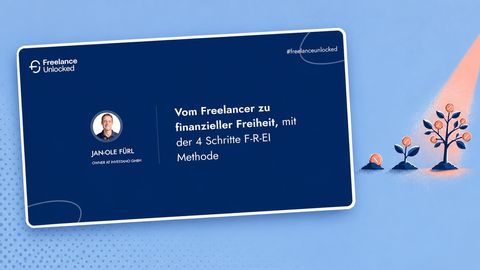
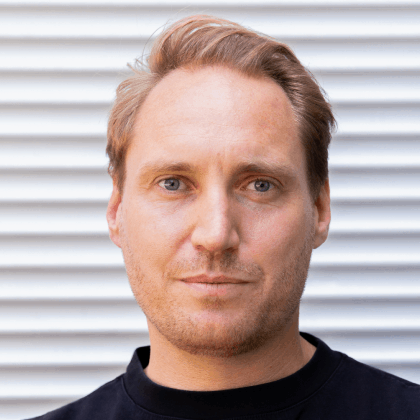
Jan-Ole Fürl freelanced in corporate IT for twenty years and twice sat in a room where a client cancelled every contractor's project overnight. His answer is a four-step system he calls F.R.E.I.: financial fundamentals, return cycles, emotion management, investment strategies. His stage numbers: 500 euros a month at a 10 percent average return grows to roughly 100,000 in ten years and about a million in thirty, with more interest than money paid in. This is a personal-finance talk, not advice. What a freelancer can do this quarter: reserves, a monthly amount, and rules written down before the next crash.
Jan-Ole Fürl remembers the smell. In 2008 he sat with thirty other freelancers in a room at Deutsche Telekom and heard that the projects were being stopped, the budget cut, and that from next week everyone would have to find something else. "I can still smell the fear sweat of my colleagues next to me," he told the Freelance Unlocked 2025 audience. In 2020 the same thing happened at an automotive group in Hamburg, even in SAP. The difference the second time: the freelancers he had been showing his investing system to over lunch breaks since 2013 were calm. Some of them saw the crash as a sale.
Jan-Ole Fürl trained as an IT systems electronics technician at Telekom, added a bachelor's and an MBA, and freelanced in corporate IT for about two decades. His key moment came in 2013 in the US, where a chance meeting with investment bankers led him into a finance community he still belongs to. Since 2024 he teaches his system through his own academy, Investano. One sentence before the method: this is personal-finance education, not financial advice, and Jan-Ole says so on stage. "I am not a financial adviser, I am not a bank adviser, I do not sell financial products."
Why freelancers need this more than employees
Jan-Ole's argument is not that freelancers earn more. It is that nobody catches them: no employer pension, no unemployment insurance by default, projects that can end on a Friday. His line comes from the banker who first explained the system to him: "There are a thousand ways to spend money, but only two ways to earn it. We work for money, everyone knows the day rate, or the money works for us."
He keeps saying "system" because his first attempt was luck: shares bought in 2008 with no real plan that tripled by 2010, then a tour of German coaching offers that taught him "if it flashes green, buy, if it lights up red, sell" does not work. The four steps replaced that.
The four steps of F.R.E.I.
F: financial fundamentals (Finanzgrundlagen). The shift from consumer to investor. Buying a share means owning a piece of a company you believe in. His favourite example: had you bought Apple shares for the price of every iPhone since 2007, he calculates, 1,579 dollars would have been worth about 150,000 in 2020 and roughly 250,000 at recent prices. "When you next stand in a long queue at Starbucks and get annoyed, ask yourself whether you can take part in the success of this company instead."
R: return cycles (Renditezyklus). Nobody has a crystal ball, he says, but four factors repeat: economic growth, inflation, what central banks do with rates, and timing. They produce four phases, upswing, boom, downturn, recession, and each has a playbook. In an upswing, commodities and shares rise and government bonds fall, so he buys shares and ETFs and treats every dip as an entry point. In a downturn, defensive sectors hold up: utilities, staples, healthcare. "We still need electricity, we still want something to eat, and we still go to the doctor." Your own day rate, he notes, follows the same cycle: high demand, higher rate, and that is inflation from the inside.
E: emotion management (Emotionsmanagement). The step that decides whether the other three work. When he bought shares in 2008 his mother "declared me completely crazy", and he admits she was right about his knowledge then. Buying when prices fall only works if you know why they fell and what a quality company is; his prompt guide is a structured way to ask an AI for that, rather than for "the five best stocks".
I: investment strategies (Investitionsstrategien). He shows three of his. The first he calls the lazy strategy: broad ETFs, checked about an hour a month, but not the MSCI World, because in his reading it carries about 70 percent US weight and "that is no longer broadly diversified". Strategy 2A is buying quality companies on dips, which requires the emotion step. Strategy 5 is dividends, which he thinks matters most for freelancers: companies paying around 4 to 5 percent, "not as high as possible, healthy", and raising it every year, so that after enough years the payout on your original stake becomes a real income. On crypto he puts 10 to 15 percent as a "performance booster, but never all in".
The numbers he uses
Two sets of numbers carry the talk. Both are his, said from the stage and not independently verified here, so read them as his framing.
The first is probability. Buy the 500 largest US companies as an ETF and hold for a day, and by his figures you have a 52 percent chance of a gain, "already better than the casino"; after five years, 88 percent; after ten or twenty, close to certain. His long-run average return is above 10 percent a year, "and the financial crisis is in there, Corona is in there".
The second is compounding:
"We start with 500 euros a month. For a freelancer I would call that a minimum. At 10 percent return, after ten years there is 100,000 on the clock. After 30 years, roughly a million. We have paid in 180,000 euros of our own capital and end up with about 860,000 euros in interest. We received far more interest than we ever paid in." (Jan-Ole Fürl)
His critique of the statutory pension follows: it passes money through one to one, with no compounding. Half of the freelancers he works with, he says, started with no capital and simply saved monthly.
The Q&A: ETFs over single stocks
Asked about sector ETFs such as robotics, his answer was a rule rather than a ticker: before any single stock, ask whether you believe this one company will beat the S&P 500. A scandal at one of 500 companies you barely notice; at your one stock it is a 20 to 40 percent drop. So spread wide, expect nothing in the next few months, and "ask yourself when a hype comes up: are the companies making money with it?" And the point that matters most for a freelancer: if you invest yourself, you can take money out when life changes. A pension product that pays out at 65 does not help you at 55.
What a freelancer can do this quarter
His system is a multi-year project. The next three months are the ground floor.
Build the reserve first. DACH freelancers hold on average 22,000 euros in reserves and spend 783 euros a month on business costs, according to the Freelancer-Kompass 2026 (1,310 respondents). If yours does not cover several months, that comes before any ETF; the 2008 and 2020 rooms were full of people without one.
Separate the tax money. What the Finanzamt will claim is not yours to invest. Our guide to how much tax to set aside in 2026 puts a number on it.
Fix the monthly amount and automate it. Jan-Ole's 500 euros is his minimum; yours is whatever survives a bad quarter, leaving the account on a fixed day. If it does not fit, the problem is upstream, in the hourly rate.
Know the vehicles. ETF savings plan, Rürup, voluntary contributions to the statutory pension, which in 2026 run from 112.16 to 1,571.70 euros a month per the Deutsche Rentenversicherung. Our overview of retirement saving options for the self-employed compares them.
Write the emotion rules now. What you do when the market drops 20 percent, in writing, while it is calm.
What to do on Monday
- Count your reserve in months. Under three, and that is the only savings goal for now.
- Open a separate account for tax and move the estimated share of every incoming invoice on the day it lands.
- Set the monthly investment amount you can hold through a bad quarter, and set up the standing order.
- Read one factsheet of the ETF you are considering and check the country weights yourself, Jan-Ole's percentage included.
- Write down your rule for the next 20 percent drop. One sentence, where you will see it when it happens.
None of it works without income to save from. A free 9am profile puts you in front of DACH companies hiring freelancers, so the next Friday cancellation is one client among several.
Quotes translated from German and lightly cleaned from automatic captions. This article describes a session on personal finance for information only and is not investment advice.
Freelance Unlocked is co-organized by 9am together with Uplink and freelancermap. This article is based on Jan-Ole Fürl's session at Freelance Unlocked 2025. Watch the full talk above, and join us at the next edition: freelanceunlocked.com.