
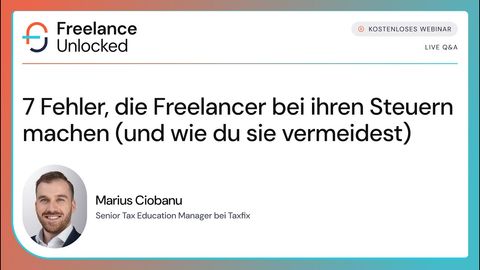

You made €40,000 in profit, spent most of it, and then the Finanzamt asks for €10,000 you no longer have. That scenario comes up almost word for word in 9am's webinar on freelancer tax mistakes, and it's avoidable. So are the other six mistakes the speakers walked through, from registering too late to ticking the wrong box on your very first tax form.
Who's talking
The webinar was hosted by 9am as part of the Freelance Unlocked series, with Marius Ciobanu and Clemens Steinmann, tax experts at Taxfix. Taxfix built one of Germany's most used tax apps and opened it up to freelancers in early 2026. The two spent about 20 minutes on the seven mistakes, then took live questions for another half hour. The practical stuff from that Q&A is further down.
Mistake 1: Not registering with the Finanzamt
Anyone who goes freelance in Germany must send the tax registration form (Fragebogen zur steuerlichen Erfassung) to their tax office within one month of starting, electronically via ELSTER. Miss that window and two things go wrong: you wait longer for the tax number you need on your invoices, and the Finanzamt may estimate your income for you.
"If you start freelancing in May but only register in September, the Finanzamt may estimate your income from May to September. Then an estimated assessment lands in your mailbox and you're staring at surprisingly high tax amounts," Marius warned.
Quotes translated from German.
An estimate is rarely in your favor. Register first, invoice second.
Mistake 2: Forgetting the trade registration
If your work counts as a trade (Gewerbe), you also register with the local trade office, which then informs the Finanzamt and the IHK. Freelancers in the liberal professions (Freiberufler) skip this step entirely, and that's exactly where people trip up: the label you give yourself isn't the one that counts.
Marius gave the example of a web designer who calls herself a Freiberuflerin while the Finanzamt classifies the work as a trade. The surprise arrives later, as a trade tax bill she never planned for. The two categories are taxed differently and reported separately in your return, so if your case isn't obvious, get it clarified early, ideally by a tax advisor.
Mistake 3: Ticking the small business box on reflex
The registration form asks whether you want the small business scheme (Kleinunternehmerregelung, section 19 of the German VAT Act). Many founders tick yes automatically, because who knows what the first year will bring. That reflex can cost real money.
Since 1 January 2025, the scheme applies if your previous year's turnover stayed at or under €25,000 and the current year stays under €100,000 (as of 2026, check the current figures). No VAT on your invoices, less paperwork. Sounds comfortable. But it also means no input VAT deduction. Marius's example: a €2,000 laptop carries €380 of VAT you could otherwise claim back. Stack up a laptop, a phone, software and a desk in year one, and the reflex tick has quietly eaten a four-figure sum.
One more thing the webinar didn't dwell on but the law is clear about: if you waive the scheme, you're bound to regular VAT taxation for five years. So decide with a forecast, not a feeling.
Mistake 4: Missing VAT return deadlines
If you charge VAT, advance VAT returns (Umsatzsteuervoranmeldungen) are due by the 10th of the month after each reporting period. "Even one day over the deadline and you can expect late fees," Marius said. His advice: build a rhythm early, before the deadlines build one for you.
How often you file depends on last year's VAT liability (all figures as of 2026):
- Over €7,500: monthly
- €2,000 to €7,500: quarterly (the standard)
- Up to €2,000: the Finanzamt can waive advance returns entirely, leaving just the annual VAT return
The webinar slide still showed the old €1,000 waiver threshold; the Growth Opportunities Act raised it to €2,000 from 2025. Also useful for founders: the rule forcing new businesses to file monthly is suspended for the 2021–2026 tax periods. From 2027 it may return, so check before you plan.
And remember what the VAT in your account actually is. "In the end I'm just the person who collects it and passes it on to the Finanzamt," Clemens said. "A bit like an employer who pays out my salary but withholds the income tax." Treat it as a pass-through item, not income.
Mistake 5: Bookkeeping in a shoebox
Every tax advisor knows the famous shoebox full of crumpled receipts. It costs you time, nerves and often money. Structured records from day one, sorted by month and digitized, mean your VAT figures are accurate, questions from the Finanzamt get answered in minutes, and nothing deductible slips through. Marius put it simply: even the case worker at the tax office is happier when clean records come in.
Mistake 6: Not claiming input VAT on founding costs
Closely related, and often missed: costs you rack up before your first invoice still count. "Even in the founding phase, when you haven't sent a single invoice or earned any revenue, you can already use those costs and claim the input VAT," Marius explained. Laptop, tools, materials, anything that helps you generate revenue later. Keep the receipts and file them.
Mistake 7: No tax reserves
The big one. As an employee, income tax leaves your paycheck before you ever see it. As a freelancer, nobody withholds anything, and the bill arrives long after the money did.
"Say you made €40,000 profit this year. You've probably spent or reinvested most of it, and there's not much left in the account. Then a €10,000 back payment comes in and the account is empty," Marius said. "Liquidity problems are not the problems you want at the start, least of all with the Finanzamt."
The fix is boring and it works: move 25–30% of every profit straight to a separate account. Income tax, trade tax, VAT, whatever comes, you can pay it without flinching.
Two things from the Q&A worth keeping
The Finanzamt picks up the phone. Clemens's experience: "They're not all bad people. You can talk to any of them, call, or write an email. You can also just say: I didn't know, what do I need to do to fix it?" An honest question doesn't make you a tax evader. Most case workers would rather help than punish.
Private vs. business use. The laptop you also watch Netflix on? Separate it as realistically as you can. Clemens's personal rule of thumb: if private use stays well under 10%, you can credibly argue the device is used predominantly for work, especially if there's a TV at home doing the Netflix duty. And predominant business use is the minimum bar to aim for.
Your prevention checklist
- Submit the Fragebogen zur steuerlichen Erfassung via ELSTER within one month of starting
- Clarify Freiberufler vs. Gewerbe before you register, not after the first tax bill
- Run the numbers on the Kleinunternehmerregelung instead of ticking it on reflex
- Put the 10th of the month in your calendar as a recurring VAT deadline
- Digitize receipts from day one, sorted by month
- Collect founding-phase receipts even before your first invoice
- Transfer 25–30% of every profit to a separate tax account immediately
Tax figures change almost every year. Before you act on any threshold in this article, check the current values on the official pages linked below.
Sorting out your taxes is one half of freelancing in Germany. The other half is a steady pipeline of good projects, and that's what 9am is for: vetted freelance projects with companies across the DACH region. Create your profile and let the next project find you.
This article is for information only and is not tax advice.
This article is based on 9am's webinar "7 Fehler, die Freelancer bei ihren Steuern machen". Watch the full recording above.