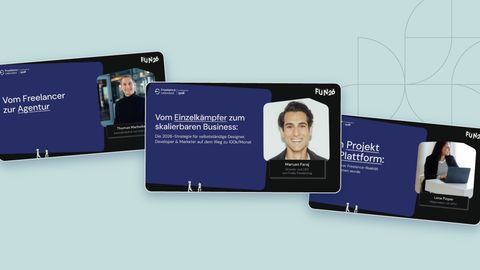

"Get out of trading time for money" is the most repeated sentence in freelancing, and it's misleading. It sounds like there's one way out, when there are at least five, and picking the wrong one just builds you a bigger, more expensive hamster wheel. At Freelance Unlocked 2026, five speakers told the same story, the leap from freelancing to something that works without their own billed hour, and gave five different answers. Together they form a decision framework.
First, why this question is on so many minds right now. According to freelancermap's Freelancer-Kompass 2026, average monthly project revenue has dropped to 6,653 euros, down 17.1%, not because rates fell (stable at 103 euros an hour) but because billable hours dried up. If you only sell time, you feel every market dip immediately. And the KfW Gründungsmonitor 2026 shows how rarely the leap actually happens: 86% of all German business founders start solo, and only about a quarter ever create jobs.
Here are the five paths, when each one fits, and what it costs according to the people who walked it.
Path 1: Stay solo, but build a company (Ricardo Brito)
The most underrated path first, because it requires zero employees. Ricardo Brito, solopreneur coach and founder of the Solo Accelerator, draws the line between cook and chef: the cook executes dishes and trades time for money, the chef decides which dish belongs on the menu in the first place, for whom and at what price. Both are honorable professions. Trouble starts when you're one while pretending to be the other.
"After 10 years, you worked in 20 different kitchens, but you still need to look for the next kitchen. A solopreneur builds a restaurant, something that compounds." (Ricardo Brito)
His point: slapping a template or a course "on top" of client work doesn't turn a freelancer into a business. Only when you define who you're cooking for (your client), what's on the menu (products from free appetizer to full tasting menu) and what your signature dish is, do you own a restaurant instead of a 20-page menu nobody dares to order from. And: stop talking about your knives. Clients buy outcomes, not tools.
Fits if you put autonomy above everything and don't want responsibility for staff. Costs: processes, systems and positioning, exactly the chef work a cook could always dodge. Ricardo's warning comes from his own years as "a cook pretending to be a chef": clients all over the place, chaotic budgets, an unhappy bank account.
Path 2: Scale solo, with a system (Maruan Faraj)
Maruan Faraj, founder of Finally Freelancing, sells the flashiest version of the leap, 100k-a-month promise included. His core image is useful all the same: the combination lock. Three digits have to be right at once or nothing opens: an offer that sells an outcome instead of individual skills, predictable lead generation instead of hope-based content, and a sales process from first call to concept call. The levers behind it: client value (ten clients at 50,000 euros instead of 250 at 2,000) and an entry offer that builds the trust a large deal needs.
"Being an entrepreneur doesn't mean having employees. Being an entrepreneur means being able to control and plan this." (Maruan Faraj, translated from German)
Fits if you're demonstrably strong in your field and willing to learn selling like a new programming language. Costs: visibility where clients are (not where your peers are), three to five prospect conversations a week, and the honesty to base your positioning on your invoicing history rather than your ego. Plus a caveat he supplies himself: his showcase numbers are the best cases from over 1,300 clients, not the average.
Path 3: The agency (Thomas Marbella)
Thomas Marbella built OneCode to 15 employees and around 3 million euros in revenue over seven years, and he delivers the numbers scaling talks usually skip. A senior developer costs just under 90,000 euros a year all-in, realistically bills 1,600 hours at an average of 85 euros, which leaves roughly 4,000 euros of profit per employee per month. You need the employee first, then the project. Reserves of 10,000 to 20,000 euros are enough to start. And until at least 20 employees, sales stays the founder's job: for him, roughly 400 to 500 LinkedIn outreaches produce one closed deal.
How Thomas builds those client relationships before anyone gets hired is something he already laid out two years ago on the 9am podcasts: give value first, then reach the decision-maker. The agency is the same logic, continued with staff.
Fits if you want responsibility for people and have an offer that multiplies across several heads. Costs: resilience, above all. In the crisis, six of his 15 people suddenly sat without a project against a monthly burn of 50,000 euros. "What makes you a managing director," he says, "is being able to sleep well when things go wrong." The reward: the company now runs with a part-time COO and a few hours of founder work a week, three-month Bali test included.
Path 4: The scalable brand (Bao Hanh Nguyen)
Bao Hanh Nguyen, an AI and design thinking coach, stood at the classic freelancer cliff edge in January 2025: her signed contract as an IT product manager was cancelled at short notice, she was ill, isolated, and already applying for permanent jobs again. Eighteen months later she has over 7,000 LinkedIn followers, 3,000 newsletter subscribers, eight learning products and a mission: bringing women to the forefront of the AI revolution.
Her path is building a brand with a value ladder: free content, a starter kit, a low-priced entry course, programs, an ongoing circle. And she consistently sold before building: three days before her first program launched she had over 300 sign-ups and no material, then built it week by week from participant feedback. Her two principles: pick one thing ("Why would anyone book a person who does three things when they can book one who does exactly one thing really well?"). And community is not a marketing channel but a business asset: referrals, market feedback, corporate leads, and clients she never has to pitch.
"In the age of AI, being human is your USP, because that's the one thing AI can't copy." (Bao Hanh Nguyen, translated from German)
Fits if you can teach, enjoy being visible and have a topic you personally stand behind. Costs: saying no. Her hardest lesson is "you have to decline": turning down lucrative client projects that build nothing of your own. Add content produced weeks ahead (five, in her case), long days, and the frustration tolerance for starts like her first workshop in 2024, which drew exactly two sign-ups. The following March, it was 1,900.
Path 5: The platform (Lena Pieper)
The longest jump: turning personal friction into a company. Lena Pieper spent over 15 years in HR, became a mother in 2019 and then went through the full program: her head-of-HR role no longer existed after parental leave, meetings landed in the afternoon, and the feedback was "well, you have different priorities now." Freelancing was the way out, "the liberation," as she calls it, until she realized that part-time plus remote was nearly unsellable in her market. Her conclusion: not an individual problem, a system problem. So she and her co-founder built UPYU (initially Freemom), a freelancing platform for people with care responsibilities.
The economics back her up: a Prognos study commissioned by Germany's Federal Ministry for Family Affairs puts the untapped potential at roughly 350,000 full-time equivalents if mothers could work the hours they actually want. Her route was anything but glossy: a Höhle der Löwen appearance filmed before the platform even launched, an investment from Tijen Onaran after a ninety-minute pitch, and then the sobering discovery that TV fame counts for little in B2B sales. "Applause doesn't buy you bread." On average it takes her eight touchpoints to turn a company into a customer. Even the name had to go: because corporates wouldn't advertise working with "Freemom," it became UPYU, same mission, better door.
Fits if you spot a pattern that affects many people and are ready to grind against timing, ghosting and existential dread for years. Costs: the most of all five. Her consolation: "What I've learned in the past four years, I didn't learn in 15 years of employment before." Today the UPYU community counts 75,000 people.
Which path is yours? Three test questions
The five stories boil down to three decision questions:
- What should scale: your knowledge, your people, or a system? Knowledge scales through products and a brand (Bao Hanh), people scale through an agency (Thomas), a system scales through a platform (Lena). If nothing should scale except your income and your control: path 1 or 2.
- Which work do you actually want to do? Every path trades craft for new work: sales calls (Maruan), people management and blended calculations (Thomas), content and community care (Bao Hanh), fundraising and B2B sales (Lena), process design for your own shop (Ricardo). If you hate the new work, no path survives contact with reality.
- How much uncertainty can your life carry right now? Ricardo's path runs alongside client work, Maruan's takes months of rebuilding, Thomas puts the reserve at 10,000 to 20,000 euros, Bao Hanh worked essentially nonstop for 18 months, Lena talks openly about existential fear. An honest answer here sorts the options faster than any business plan.
And maybe the most important insight across all five sessions: not one of these paths starts with a legal form or a logo. All five start with a positioning that promises an outcome to a clearly defined audience, and with the decision to treat acquisition and sales as a core skill. That's the common thread behind the combination lock, the outreach ratios, the value ladder, the platform pitch and the restaurant metaphor.
The first step is the same on every one of the five paths: become visible to the right clients. A free profile on 9am takes five minutes, whether it eventually grows into an agency, a brand, or a very well-run one-person restaurant.
Freelance Unlocked is co-organized by 9am together with Uplink and freelancermap. This article is based on the sessions of Maruan Faraj, Thomas Marbella, Bao Hanh Nguyen, Lena Pieper and Ricardo Brito at Freelance Unlocked 2026. Watch the full talks above, and join us at the next edition: freelanceunlocked.com.