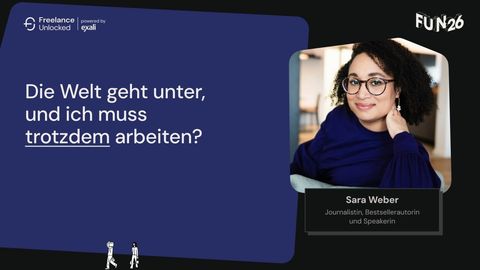
"If you're self-employed, you work yourself, constantly." The German original rhymes ("selbst und ständig"), which is why the line gets repeated like wisdom. Sara Weber hates it. It sounds like diligence and is really a shortcut to burnout.
Sara knows the territory. The journalist ran LinkedIn News for the DACH and Benelux regions until 2021, then quit and wrote down what many people only felt. Die Welt geht unter, und ich muss trotzdem arbeiten?, roughly "The world is ending, and I still have to work?", came out with Kiepenheuer & Witsch in 2023 and became a bestseller. Opening Freelance Unlocked 2026, she started with an uncomfortable observation: three and a half years later, the feeling in her book title hasn't gone away. It has gotten worse.
Close the news, open the laptop
Inflation, a weak job market, wars, a political shift to the right, the climate crisis. "In the end you think: I might as well go back to bed," Sara says. And by Monday morning at the latest, the state of the world collides with ordinary life: deadlines, care work, household admin, money worries.
The numbers back up the feeling. According to the TK stress study, nearly two in three people in Germany feel stressed at least sometimes, more than a quarter frequently. For the self-employed, the economy piles on top: when growth stalls, freelancers feel it first. On stage, Sara quotes the Freelancer-Kompass, the big DACH freelancing study: four in ten freelancers rate their stress level as high or very high, and 43% describe their income and project situation as insecure. She also went through the German government's poverty and wealth report and found the self-employed carry a higher poverty risk.
Then there's politics. Sara cites a survey in which 90% of self-employed respondents feel barely respected or not respected at all by policymakers. She's living a concrete version of it: her baby is a few months old, maternity protection for the self-employed still doesn't exist in Germany, and the artists' social insurance fund and the parental benefit office keep sending her rules that contradict each other. "A wonderfully elegant piece of arithmetic," she says, dryly.
That's the starting point of her talk, and it is deliberately not a motivational poster. Times are hard, and pretending otherwise helps nobody. But burying yourself doesn't either. The question is how to shape this situation actively instead of merely enduring it.
AI: skepticism is allowed, a personal yardstick helps
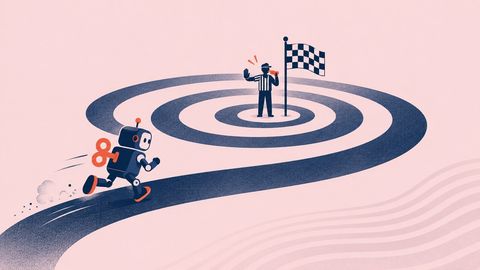
Almost half of freelancers believe AI will change their work substantially, according to the Freelancer-Kompass. Sara takes the fear underneath seriously: entire job profiles under pressure, from voice actors to ghostwriters, entry-level jobs disappearing, price pressure along the lines of "do it for 20% less or the AI will". You don't have to be embarrassed about viewing this technology skeptically, she says. Not everything demands enthusiasm.
Her counterweight is a simple personal test, which she explains in the Q&A after an audience question: is this a task I used to pay someone for, who now loses that job? Or one I would have done myself anyway, just slower? She used to spend three hours typing up her interviews by hand; now AI transcribes them. She never paid anyone for that work, and she's gained three hours. Her book editing, on the other hand, stays human, because there she can feel the difference.
The biggest lever for freelancers sits somewhere else entirely: we control our own processes. Employees get a tool handed down, fit or no fit. Freelancers can assemble their own toolkit, test things, throw them out again, and the productivity gains land in their own calendar instead of someone else's balance sheet. It doesn't have to be the big flagship models either; small, specific tools often deliver the most. For ideas, browse the Freelancer Toolbox, where we've collected tools that have proven themselves in day-to-day freelance work. And if the result is a four-day week, Sara says, you're allowed to actually take the fifth day off.
Build a crew, not a solo career
The most practical part of the talk is about other people. Sara has a small "career panel" of fellow freelancers. Once a year they sit down and do for each other what employees get in an annual review: where do you want to go, what's your plan, who kicks whom into gear and when. Through the year they check in on those goals, and the agenda goes beyond money and bookings.
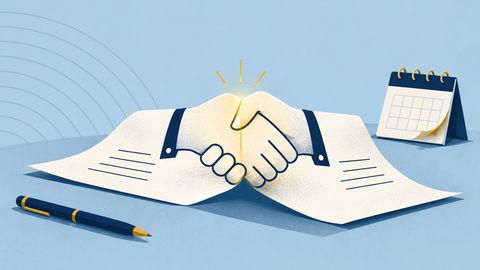
More than emotional hygiene grows out of a crew like that. You can pitch clients a complete package: one person does copy, one does development, bookable together. You can cover each other's vacations so that time off is actually off. And you can build market power. Once word gets around that a certain client pays badly or sits on invoices for months, that client eventually stops finding people. In the Q&A, Sara points to voice actors organizing against Netflix and to the 2023 US writers' strike, which ended with a collective agreement that regulates the use of AI. We'll need far more of that kind of organizing, she believes.
All of it depends on honesty. Not the fuck-up-night variety, where successful people recount old failures long after everything worked out. The uncomfortable kind: admitting things aren't going well while they aren't going well. Sara now does this openly, telling her editor that an idea was born after a sleepless night and deserves extra scrutiny. The other side of it matters too: a friend of hers wound down her freelance business after two years and is happily back in employment. Perfectly fine, says Sara. Self-employment is a chapter, not an identity, and the way back is not a defeat.
Working yourself, constantly? Please don't
Back to the saying from the top, because it's the heart of the problem:
"Nobody should work constantly, and nobody can shoulder everything alone." (Sara Weber, translated)
Working all the time works you sick. Breaks, real vacations, properly recovering when you're ill: as a freelancer, all of that costs money immediately, which is exactly why you need structures that make it possible anyway. The crew helps here too. Someone covers for you. Someone calls to check whether the laptop is back in bed with you. If you never recover, the good ideas dry up eventually, and that ends up more expensive than any time off.
Part of this, for Sara, is finding purpose outside the job. Self-efficacy is a main reason to go freelance in the first place, but if your entire self-worth hangs on client projects, you become fragile. Family, volunteering, a hobby you enjoy and are allowed to be bad at without turning it into a side business: something in your life should remind you what all the work is for. Against isolation, which 15% name as a problem in the Freelancer-Kompass, she has a simple fix: coworking with friends, at the kitchen table if need be. They don't even have to be freelancers. We've written more about why these mental patterns decide careers in the psychology of successful freelancing.
What remains
Sara saves her strongest thought for the end. This whole upheaval is not about who has the best AI tool.
"In the end, it's not some app that remains, not some tool. What remains is what's in this room: the human part." (Sara Weber, translated)
Creativity, cooperation, care, the ability to think for yourself before you let a machine do it. That's what clients remember when a project ends: the feeling of having built something genuinely good with someone. Protect that, and you own something that outlasts every crisis and every model release.
So yes, the world keeps ending a little, and the work continues anyway. But how you work is more in your hands than the morning headlines suggest. If you want to be easier to find while you're at it, create a free profile on 9am and let companies looking for exactly your skills come to you.
Freelance Unlocked is co-organized by 9am together with Uplink and freelancermap. This article is based on Sara Weber's session at Freelance Unlocked 2026. Watch the full talk above, and join us at the next edition: freelanceunlocked.com.