

Two surveys of DACH freelancers landed in the same week of March 2026 and seem to disagree. freelancermap says 62% plan no rate increase this year. freelance.de says 25% raised their rate last year, by around 14% on average, while 16% cut. Both are right: one asks about plans, the other about what happened. The people who raised did not wait for a better market. They named a precise number, announced it early, tied it to documented extra value and traded scope instead of discount. Here is that method, and a message you can send this month.
"Nobody is raising rates this year" is the accepted wisdom of the 2026 freelance market. The data says a quarter of freelancers did exactly that. The difference is not luck. It is a handful of decisions made months before the conversation.
Two studies, two questions
The Freelancer-Kompass 2026 asked 5,412 freelancers between November 2025 and February 2026 what they intend to do. 62% said they will not raise their hourly rate in 2026. 9% plan to cut. The reasons given are about demand, not price: missing orders (61%) and strong competition (31%). The average rate slipped from €104 to €103, the first year without a rise since the survey began.
The freelance.de Freelancer-Studie 2026, 3,300 respondents surveyed between 27 January and 2 March 2026, asked what people actually did. 59% left their rate unchanged. 25% raised it. 16% lowered it. And the sizes matter: the average increase was around 14%, the average cut 19%. Its average rate rose slightly, from €100.55 to €101.70.
Read together: most people froze, a minority moved, and those who moved up moved by a lot. A 14% jump is not an inflation adjustment. It is the step you take when a new contract starts, when you reposition, or when you finally correct a rate set years ago.
One caution from the same survey: 68% expect a difficult year and 26% now need more than three months to find a project. A raise works when it is prepared. If your calendar is the problem, the €103 paradox explains why price is then the second lever, not the first.
Who the 25% were
freelance.de does not publish the raise rate by segment, but its rate tables show where the room is. Experience pays less than people assume: under five years averages around €83 an hour, over twenty years around €107. A €24 spread across a career means a mid-career freelancer at €90 is not "already at the ceiling."
Sector matters more. Einkauf & Logistik averages €118.81, Coaching €116.60, IT €101.98, Marketing €86.70, Verwaltung €86.43 and Kunst & Kultur €76.89. Below your sector's average with above-average experience? This article is written for you.
Gender, for once, is not the story: 26% of women raised their rate against 24% of men, and men cut more often (17% against 14%).
The practitioner's method
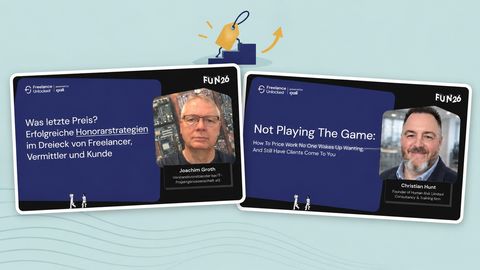
Joachim Groth has freelanced in IT for 25 years and sits on the board of the IT Projektgenossenschaft, so he knows both sides of the rate conversation. His Freelance Unlocked talk was a full negotiation playbook (summarised in our pricing strategy guide). Five of his rules apply directly to a raise.
Say a calculated number. Round numbers read as wishes.
"If I quote 100 euros, that comes across as a wish rate. 110 or 90, the same. But if I quote 103, the other side reads it as a calculated figure and is much less inclined to question it." (Joachim Groth)
The research on why precise numbers get smaller counter-offers is in our piece on the science of quoting. Joachim's version is the field test.
Publish only your remote rate. If you are looking for work, a missing rate gets you filtered out like a rate that is too high. But show the lower, remote number. The on-site premium stays off the profile and enters the conversation later.
Announce the raise halfway through, not at the extension.
"The client thinks in budgets, and because budgets are extremely tight these days, you have to announce it very early." (Joachim Groth)
If your contract ends on 30 June and the client asks today for three more months from 1 July, asking for 3% more in that moment fails. The budget is set. Say it at the midpoint instead. One variant that has worked for his cooperative: the old rate for a further six months if the client signs the extension now, the increase after that.
Justify with documented extra value, not inflation. Employees get inflation adjustments. Freelancers who ask for one get told they already earn 95 an hour. Joachim skips the argument, unless he can name a concrete cost that rose, such as hotel costs on an on-site project (heating costs, he notes, get rejected every time). What works is evidence that you delivered beyond the brief. His trick for getting it on paper: email your project lead and ask how the two of you could present the extra results to their boss. Most feel flattered and reply. That reply is your written confirmation.
When they push back, shrink the scope, not the price. Before the call, pick one nice-to-have skill from the job description that you suspect will rarely come up.
"Okay, at 89 I can't offer you that skill. That one would have to be 95." (Joachim Groth)
Said with conviction, it usually lands at 92. If 89 is truly the ceiling, sign at 89 with a clause that any extension is at 95. Most clients agree, because the extension feels far away.
Underneath all of it sits the rule he called the most important one: a reserve that covers at least six months without a project, separate from pension and insurance. Without it you cannot say no, and a raise you cannot walk away from is a request, not a price.
The public anchor
Christian Hunt runs Human Risk, a consultancy that brings behavioural science into compliance, and his pricing works from the other end. He avoids the conversation Joachim prepares for.
"I only put pricing up for the speaking, and there's a variety of prices on there. I start with the speaking and everything else I don't need to put a price on, because the speaking, the most expensive product, has done the anchoring for me. I disclose, but I don't need to disclose too much." (Christian Hunt)
Speaking is his highest-margin product, so the one price a prospect sees is the top of his range. Training and consulting are negotiated down from that anchor, not up from a day rate. He also refuses pitch processes outright:
"Pitches is a form of commoditization. Generally speaking, the biggest single determinant of whether you win a pitch or not is the price tag." (Christian Hunt)
For most freelancers the lesson is not "stop pitching." It is that your published number is an anchor whether you intend it or not. Joachim shows the remote rate to pass a filter. Christian shows the speaking fee to set the ceiling. Decide which game you are in before you type a number into your profile.
The message
Send it at the midpoint of a project, not at the extension request. Adjust the figures.
English
Subject: Planning for the next phase
Hi [Name],
we are about halfway through [project], and I wanted to raise one thing early so it does not land in your budget planning unannounced.
Alongside the agreed scope, we have also delivered [concrete extra result, e.g. the reporting layer and the two data migrations that were not in the original brief]. From the next contract period onwards, my rate for this engagement will be €[103] per hour (currently €[95]).
If it helps your planning, I am happy to fix the extension now at the current rate for another [three] months, with the new rate applying after that.
Happy to talk it through whenever suits you.
Best, [Name]
German
Betreff: Planung für die nächste Phase
Hallo [Name],
wir sind etwa zur Hälfte durch [Projekt], und ich möchte ein Thema früh ansprechen, damit es nicht unangekündigt in eurer Budgetplanung landet.
Neben dem vereinbarten Umfang haben wir zusätzlich [konkretes Ergebnis, z. B. die Reporting-Schicht und die zwei Datenmigrationen, die nicht im ursprünglichen Briefing standen] umgesetzt. Ab der nächsten Vertragsperiode liegt mein Stundensatz für dieses Projekt bei [103] € (aktuell [95] €).
Falls es eure Planung erleichtert: Wenn wir die Verlängerung jetzt festmachen, bleibe ich für weitere [drei] Monate beim aktuellen Satz, danach gilt der neue.
Wann immer es passt, besprechen wir das gern kurz.
Viele Grüße [Name]
The template does three things on purpose: a precise number, a raise attached to documented value rather than costs, and an early-bird option that turns a demand into a choice the client can win.
What to do on Monday
- Find your sector row. Compare your rate with the freelance.de averages above. If you are below with above-average experience, you have a case.
- Write down your floor. Costs, taxes, pension, a six-month reserve, divided by realistic billable hours. Know it before anyone asks.
- Turn your round rate into a calculated one. €100 becomes €103 or €97, whatever the floor plus margin actually says.
- Check the calendar of every running project. Anything past its midpoint gets the message above this week, not at the extension.
- Pick your scope card. For each project, one nice-to-have you can take off the table instead of taking euros off the rate.
None of this works without projects to raise the rate on. If the pipeline is the bottleneck, a free 9am profile puts you in front of companies across DACH hiring freelancers now, and matched projects are billable days you did not have to negotiate for.
Quotes by Joachim Groth translated from German.
Freelance Unlocked is co-organized by 9am together with Uplink and freelancermap. This article draws on the sessions of Joachim Groth and Christian Hunt at Freelance Unlocked 2026. Watch the full talks above, and join us at the next edition: freelanceunlocked.com.