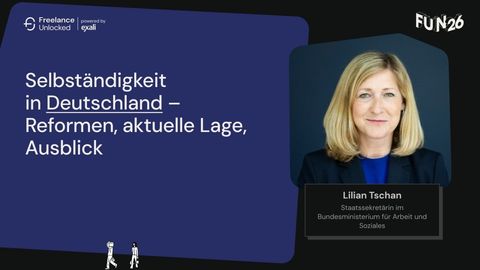
It's not every day that the number two of Germany's labor ministry faces a room full of freelancers whose trust in politics has hit a low. At Freelance Unlocked 2026, state secretary Lilian Tschan did exactly that, weeks after a draft bill from her own house had leaked and set the community on edge. Her message: the reform lands this year, and it's meant to make self-employment easier, not harder.
Lilian Tschan has been beamtete Staatssekretärin (tenured state secretary) at the Federal Ministry of Labour and Social Affairs since February 2022 and has worked at the ministry since 2018, first as head of the minister's leadership staff. Few labor and social policy reforms of recent years have bypassed her desk. Which makes it worth listening closely to what she said in Berlin, and what she didn't.
Freedom versus security: the starting point
Tschan opened with a scene from her son's daycare. During a debate about paid child sick days, one mother said:
"As a self-employed person, I'd be glad if I could take a child sick day at all." (quoted by Lilian Tschan)
For Tschan, that sentence captures the core issue: the tension between freedom and security. Around 3.5 million people in Germany are self-employed as their main occupation, more than half of them solo. They shape their own work, but when a contract falls through or they get sick, nobody steps in.
That the self-employed can handle upheaval, she illustrated with pandemic-era pivots: adventure tour operators who started with a mobile coffee cart and now run an ice cream café on the family farm; trade fair builders who develop digital learning platforms; graphic designers who spent years in ad agencies and now create AI-assisted teaching materials for schools. She also picked up the title of Sarah Weber's book from the conference program ("The world is ending and I still have to work") and extended it with a wink: AI can do everything I can, only faster and cheaper, and I still need a business model.
As the evidence base for the reform plans she pointed to the ministry's research report on the social situation of the self-employed, a representative survey of more than 2,000 self-employed people. Her summary of the findings: many stand on solid economic ground, especially those with staff of their own. For roughly one in five, though, things are markedly harder, with thin reserves and little buffer for a crisis. Solo self-employed earn considerably less on average than those with employees and are worse protected. Freelancers appear in the report as a highly qualified, specialized subgroup, once concentrated in journalism and media, today very often in IT.
Status determination: the guardrails of the reform
On the leaked draft itself, Tschan stayed silent; the paper is in government-internal coordination. Instead she laid out the guardrails her ministry is building the reform around:
- The parties' intent gets more weight. "If self-employment is expressly wanted, then the law must in principle accept and enable that."
- But not a free-for-all. Belonging to public social insurance can't be left purely to individual preference. People who think they don't need the safety net can be wrong, see the pandemic.
- Self-employment means entrepreneurial conduct, visible from the outside. Which chances and risks a statute defines as typically entrepreneurial will be "vigorously debated" in the legislative process.
- No sector-specific carve-outs. The reform is meant to apply to all professions; otherwise lawmakers would be patching it forever.
- Workable and as unbureaucratic as possible, with the associations at the table.
The timeline is ambitious: a new rulebook by the end of 2026. The pressure comes from the Federal Social Court's Herrenberg ruling, which pushed education providers and freelance teachers toward mandatory social insurance. The transition rule was extended until the end of 2027 so there's runway between the new law and its entry into force.
In the Q&A she stated the goal more plainly than almost anyone from the BMAS has before:
"Our goal is to make this distinction so clear and so simple in the future that this simply doesn't happen anymore." (Lilian Tschan on retroactive status decisions)
Asked whether "not making self-employment harder" also meant "making self-employment easier," she answered: "Absolutely, yes, without qualification." Those sentences are the benchmark the final bill will have to be measured against.
Retirement provision: the commission has delivered
On the second big topic, mandatory retirement provision, Tschan pointed to the coalition agreement: self-employed people outside any obligatory pension system are to be brought into the statutory scheme's protection, closing gaps and reducing old-age poverty. She wouldn't preempt the pension commission, whose final report was expected "in the coming days" at the time.
That report is now out. The commission indeed recommends mandatory pension insurance for future and existing self-employed, with an opt-out for those already in business. The associations tie their support to conditions, above all a contribution design that doesn't burden the self-employed more heavily than employees and employers combined.
The room's reaction was telling: when moderator Marc Clemens asked whether the statutory pension is really the right vehicle, applause broke out. Tschan defended the system: by international standards it performs well and, unlike most private contracts, also covers rehabilitation and reduced earning capacity. She conceded that the pay-as-you-go scheme has to be repositioned for demographic reality, across all three pillars.
KSK and platform work: the quieter building sites
Two points from the talk nearly slipped by but matter to many creatives and solo self-employed. First, the Künstlersozialkasse, Germany's social insurance fund for artists and writers: Tschan called it a success story whose funding needs to arrive in the digital age. Whoever profits from creative work should contribute to its protection, whether the work is exploited digitally or in analog form. Read: large platforms.
Second, the EU platform work directive, which must be transposed into German law by the end of 2026. Its core is a rebuttable presumption that eases status clarification under employment law. Tschan stressed that genuine self-employment on platforms stays possible: "It is not our goal to shut that down completely." She drew a sharp line between delivery and courier services, where solid data documents poor working conditions, and other areas where legislation will differentiate.
What to take away from the session
Reading between the lines, three things stand out. First: the ministry has publicly committed to speed, with a status reform bill due in 2026. Second: the direction is right, at least verbally, more weight for the parties' intent, clear criteria, no retroactive surprises. Third: on pensions, everything points to an obligation with room to shape it, and how much room is being decided right now.
Until then, current law applies. For what false self-employment means legally today and how to gauge your own risk, start with our guide to false self-employment in Germany, or run 9am's free false self-employment self-check to see where your current setup stands.
Want to be visible when clients look for compliant freelance setups? Create a free profile on 9am.
This article is for information only and is not legal advice.
Freelance Unlocked is co-organized by 9am together with Uplink and freelancermap. This article is based on Lilian Tschan's session at Freelance Unlocked 2026. Watch the full talk above, and join us at the next edition: freelanceunlocked.com.