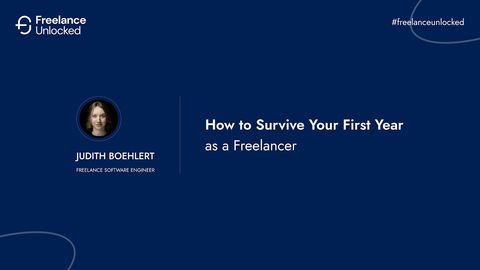

You quit the job, register the business, and wait for clients to appear. Three months later your first project ends, nothing new comes in, and you're lying awake wondering if you just made the biggest mistake of your career. That moment, not the paperwork or the pricing, is what kills most first-year freelancers. Judith Böhlert hit it right on schedule. She got through it, and at Freelance Unlocked 2025 she explained how.
Judith Böhlert is a Berlin-based frontend engineer who builds with React and TypeScript and runs her own one-woman engineering and consulting practice. After more than a decade in software development, she went independent during one of the roughest tech job markets in recent memory and made it past the one-year mark. Her session is a field report, not a motivational poster. Here's what holds up.
Know your why: freelancing is not a backup plan
Böhlert has noticed a pattern lately: people drifting toward freelancing because they can't find a permanent job. She's blunt about where that leads.
"The grass is not always greener on the other side. And chances are, if you are struggling right now to find a permanent position, probably clients won't just magically line up at your doorstep either."
The numbers back her up. Germany's KfW-Gründungsmonitor 2025 counted 585,000 new businesses started in 2024, and by KfW's long-running rule of thumb roughly a third of founders stop within the first three business years. Most quit for personal reasons (stress, family load, income dissatisfaction), not because of insolvency. The business rarely fails first. The founder does.
That's why Böhlert insists you interrogate your motivation before you register anything. Hers was freedom: she describes working from a balcony on a remote Atlantic island with "no manager, no OKR reviews, no performance reviews, no company vision meetings." But she's careful not to sell that as the universal answer:
"Freelancing is not just another mode of getting paid. It's an entirely different mode of working."
Her exercise: list your previous jobs, mark what you loved and hated, and honestly assess which of those things freelancing changes, and which it makes worse. Money alone, she warns, is a shaky sole motivator. A clear why carries you through the parts that are, in her words, guaranteed to get tough "sooner or later."
Do the math before you register
Böhlert's financial planning is unglamorous and effective: figure out what you spend, what you can realistically earn, and whether the gap is survivable.
The spending side has a trap for anyone leaving German employment: everything your employer silently co-paid is now yours alone. That means full contributions to Krankenversicherung (health insurance) and, depending on your profession, Rentenversicherung (pension). Böhlert skipped the details on stage ("the topic of social insurance for freelancers in Germany would go beyond the scope of what we can cover today and also turn this talk into a little bit more of an angry rant"), but she's emphatic that you need a plan for both before day one.
On the earning side, she rejects the cost-plus rate formulas you'll find online:
"Your clients do not care if you have a baby on the way, how high your rent is, or whether you like fine dining. All they care about is how much value you provide, and if they can get the same quality somewhere else for cheaper."
Your rate is set by the market, not your rent. For orientation: the freelancermap Freelancer-Kompass 2025, the largest freelancing survey in the DACH region, puts the average freelancer hourly rate at €104, up from €102 the year before. Averages hide enormous spread by niche and seniority, though, which is why Böhlert simply asks peers at her experience level what they charge. She's found the community surprisingly open about it. Her calibration heuristic is worth pinning above your desk:
"It's completely fine if they flinch a little bit when you tell them how much you charge. [...] But if everyone just accepts your pricing without even attempting to negotiate, you might actually be undercharging."
Then multiply honestly. You won't bill 40 hours a week, 12 months a year: sick days, holidays, bookkeeping, invoicing, acquisition, and dead time between projects are all unpaid. If projected costs exceed projected revenue, fix the plan before you launch. And check your runway: how many months could you cover with zero income? There's no magic number, but the answer determines everything else.
One German-specific cushion worth knowing: if you're receiving ALG I with at least 150 days of entitlement left, the Gründungszuschuss from the Agentur für Arbeit can fund your start. Six months of your unemployment benefit plus €300/month for social insurance, extendable by nine further months at €300/month. It's discretionary, but it can be the difference between a runway and none.
Do not mess with the Finanzamt
The biggest laugh of the session came from a slide about German tax authorities, and it carries her most repeated advice:
"Whatever you do, pretty please with a cherry on top: do not mess with the Finanzamt."
Her system is almost insultingly simple. When you register your business, the Finanzamt sends a letter stating exactly which taxes it expects from you and when: income tax for everyone, plus Umsatzsteuer (VAT) depending on your setup. Put every deadline in your calendar as a recurring event. Submit on time. Done.
And when you're lost, call them. Böhlert once phoned her Finanzamt in genuine distress because her Umsatzsteuer-Voranmeldung (advance VAT return) was due and she had no idea what to do. A clerk with a thick Berlin dialect told her to calm down and walked her through it step by step. The scary institution is staffed by humans, "and some of them are even friendly-ish."
Expect conflicting advice from everyone else, too: found a GmbH immediately versus avoid it at all costs; take every project versus niche down hard. Listen, she says, then decide for yourself.
Negotiate a no-quit period with yourself
Most first-year guides skip this part: the psychological crash is predictable. Böhlert's arrived around month three, when her first project ended and no replacement materialized.
"That moment wasn't just about not having any paid work. It really messed with my self-esteem, and imposter syndrome hit me quite hard. I was wondering if I was even cut out for this."
No new client saved her. What did was a deal she'd made with herself before starting: one full year of freelancing, no quitting allowed, no matter what. When the temptation to throw in the towel peaked, the contract wasn't up yet. So she kept going, and the work came back.
The mechanism matters. A no-quit period turns an emotional decision ("this isn't working, I'm a fraud") into a calendar decision ("I evaluate in month twelve, not month three"). Match its length to your financial runway. Since most German founders who give up do so under personal strain rather than economic collapse, pre-committing against exactly that moment may do more for you than anything else on this list.
For the roles you suddenly have to play alone ("all of a sudden I was also the marketing intern, the social media manager, the CFO, the head of sales, my own chief of staff"), she recommends an imaginary board of advisors: real mentors where you have them, admired strangers where you don't. Before firing off a passive-aggressive email about a late payment: "Just ask yourself, what would Oprah do?"
Your network is your pipeline
Client acquisition is, in Böhlert's words, "the single most important and difficult task for all freelancers." Platforms, recruiters, and cold outreach all work, but everything runs through two assets.
First, an online presence that instantly communicates what you do. For her that's LinkedIn, and sharpening it had a measurable effect: more inbound leads, and far more relevant ones, "because from looking at my profile it is immediately clear that I'm a freelancer and what exactly I can help potential clients with."
Second, and more powerful: the network you already have. Former colleagues, side-project collaborators, open-source communities, even teachers if you're fresh out of school:
"You need people who can speak to the quality of your work. You need people who will vouch for you. You need people who will mention your name in a room full of opportunities."
Her own first client came exactly this way. She announced she was open for business, a former colleague introduced her to an acquaintance who needed a freelance developer, and the pre-existing trust closed the deal. "These sort of warm introductions, where someone you know introduces you to someone they know, are solid gold." When that first invoice was paid, she nearly teared up: proof the thing she was building actually worked.
The long game is community. Her biggest fear going solo was loneliness. The opposite happened: "I never felt less lonely and more included than I do right now," thanks to Berlin's freelance scene and Friday freelance breakfasts. One random LinkedIn podcast invitation eventually became a two-season live-coding YouTube show and a major joint client project.
Your first-year checklist
- Write down your why. One paragraph. If it's only "couldn't find a job" or only "money," dig deeper before registering.
- Map your full costs: personal plus business, including every tool and subscription, and the full Krankenversicherung and pension contributions your employer used to share.
- Find your market rate by asking peers in your niche, not by cost-plus formulas. Use the DACH average of €104/hour as orientation only. Watch for the flinch.
- Budget realistic billable hours: subtract vacation, sick days, admin, acquisition, and gaps between projects.
- Check your runway. If you're coming from ALG I with 150+ days of entitlement, look into the Gründungszuschuss before you register.
- Calendar every Finanzamt deadline the day the registration letter arrives. Call them when confused, before the deadline, not after.
- Set a no-quit period matched to your runway, and decide now that month three will feel terrible.
- Announce your launch to your entire network and sharpen your online profile until a stranger understands your offer in ten seconds.
- Join a freelance community: meetups, conferences, a weekly breakfast. It's an emotional survival strategy and a pipeline in one.
Böhlert's closing image is the honest one: freelancing is a roller coaster, feast or famine. But at the high points: "I did this. I built this for myself. And I wouldn't want to trade this feeling for anything."
Ready to find your first project, or your people? Create your free profile on 9am and plug into the DACH freelance community Böhlert credits with getting her through year one.
Freelance Unlocked is co-organized by 9am together with Uplink and freelancermap. This article is based on Judith Böhlert's session at Freelance Unlocked 2025. Watch the full talk above, and join us at the next edition: freelanceunlocked.com.