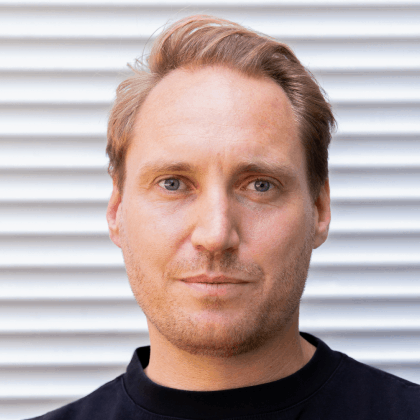

Same stage, same question, three very different years. In 2024, AI was a side note at Freelance Unlocked. Ralph Günther, founder and CEO of insurance provider exali, remembers Sascha Lobo's 2025 keynote as more or less the lone AI talk that shook him awake. Standing on the 2026 stage, he looked at the program and laughed: "It feels like 50% of the topics have something to do with AI. Or more like 80."
That shift in the program is the story. Across two editions of the conference, the freelance community's answer to AI moved from anxiety and tool demos to something much less dramatic and much more useful: operating practice. Put the 2025 and 2026 sessions side by side and you can watch it happen.
2025: naming the fear, showing the tools
The 2025 sessions split into two jobs: calm people down and show them something concrete.
Matteo Cassese did the first job by refusing to pretend everything was fine. His talk gave the feeling a name, "mal-AI-se," and a diagnosis: we were promised robots for the menial work, "instead, the robots came for the creatives. They came for the poets." When he asked who expected their job to change radically soon, most of the room raised a hand. His prescription was a crisis of meaning handled like one: slow down, find your internal motivation, treat output as the machine's job and thinking as yours. And one line that stuck: "There's no map, but there is mapmaking." We covered the full talk in From AI Malaise to Renaissance.
Zsike Peter did the guardrails. Her session on IP and copyright warned that purely AI-written work can't be copyrighted, that training-data lawsuits were piling up, and that "if you outsource your voice, you outsource your responsibility as well." Her caricature of AI-written sameness, "corporate Colin," became shorthand for the 50 shades of beige flooding every feed. The legal details are in Who Owns AI-Generated Content?
And Julien Look did the demos: voice agents answering conference questions live, a content pipeline posting to LinkedIn without manual steps, lead enrichment in Clay. What made it credible was the framing, which doubled as the community's 2025 consensus in one sentence:
"AI is not your replacement. It's going to be an extension of your core skills." (Julien Look, 2025)
Notice what all three had in common. In 2025, the question underneath every session was still whether to let this technology into your business, and how to feel about it. Reassurance was half the content. That's what changed.
2026: the same speaker, a different problem
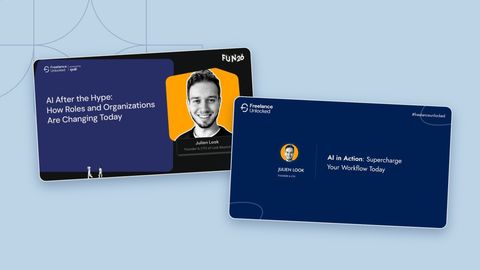
The clearest measurement of the shift is Julien Look himself, because he came back. In 2025 he showed freelancers which tools to adopt. In 2026, his session "AI After the Hype" assumed everyone had adopted them, and moved to the harder question: why organizations still fail to turn usage into value. His numbers: 88% of people use AI at work, yet only 5% of AI projects produce value you can measure in EBIT. The blocker isn't the technology, it's change management, trust, and leadership ownership.
"Transformation is a cultural change and it's not done within one project." (Julien Look, 2026)
Read those two quotes together and you have the whole arc. 2025: don't be afraid, it extends your skills. 2026: the tools were the easy part, now build the culture and the systems. Nobody on the 2026 stage argued about whether AI belongs in freelance work. Four sessions, four working practices.
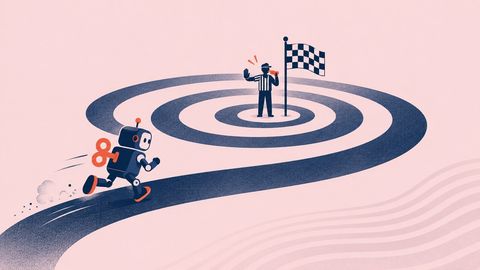
Ralph brought the operating tempo. His talk "Im Tempo der KI" was a confession as much as a keynote: after hearing Lobo in 2025, he went home and did what a German executive does, built the perfect AI strategy, presented it to his supervisory board, and watched the first two initiatives flop. What worked was an email agent that wasn't even in the plan and turned out, in his words, revolutionary for the company. His conclusion is the sentence on his opening slide: "While you plan, others are winning." Perfectionism, the trait he credits for German engineering, has become the risk itself. He now argues for speedboats over tankers, an MVP mindset, and a genuine error culture, quoting Meta's Andrew Bosworth: trying things, learning fast and iterating has become far less risky than trying to plan everything in advance. His challenge to freelancers who feel safe because the order books are full: "If you don't try things, you might not have a job in two years either. Better to fail in action than to be overtaken in passivity."
Lucas Chevillard brought the system. A year ago the email marketing and CRM freelancer delivered audits and strategy decks. Now every client call feeds an automated pipeline: transcripts get processed and routed into to-dos with deadlines, content briefs, and draft deliverable documents. Since building it he's run 57 calls through the system and harvested 159 content ideas, at roughly 5 cents of API cost per 30-minute call. Discovery-call follow-ups that took one to two hours now take ten minutes plus what he calls the secret sauce: his own judgment about direction, offer, and commitment. And the deliverable changed too. He hands clients the strategy document plus a working system their team can run without him.
Christine Vallaure brought the products. The Moonlearning founder told the room to stop feeling inspired and start building: internal tools via vibe coding, an agent team defined in a plain text file, client-facing helpers. Her frame for staying employable is a hat of AI literacy on top of your core skill, and her pitch is aimed straight at the DACH market: Mittelstand companies in transition "don't want some fancy consultancy coming in. They want you. You who knows their business."
The counterweight: what you refuse to automate
The 2026 program also kept a session that would have fit 2025's anxiety slot, except it wasn't anxious. It was precise. Victoria Ringleb, managing director of the German designers' association AGD, and philosopher Dorothea Winter asked "Kann KI Kreativität?" and answered with research instead of vibes. Dorothea cited a study on AI-assisted writing: less creative participants produced better results with AI, but their outputs converged and lost originality, while the most creative people barely benefited at all. Her thesis: AI homogenizes the creative middle. She paired it with a medical study in which doctors' colonoscopy detection accuracy dropped from 28% to 22% within three months of leaning on AI support, her warning that outsourced skills atrophy. Victoria was blunter about the aesthetic result: AI delivers kitsch, and art exists to give you something to push against. Their homework for the room: check yourself a few times a week, is this use of AI enhancement, or is it laziness?
That's not a contradiction of the builders' sessions. It's the same maturity from the other side. Zsike Peter's 2025 warning about losing your creative muscles has become, one year later, a measured research agenda and a professional responsibility question.
The data says the community read it right
The two years of stage wisdom line up with what the labor data now shows. Upwork's Future Workforce Index 2026 finds freelancers who use AI earn 34% more per hour, but the interesting part is the split underneath: earnings for complex AI-augmented work rose 45% year over year, while commoditized generative production grew 90% in volume and fell 13% in per-contract earnings. The share of skilled US knowledge workers freelancing jumped from 28% to 38% in a single year. PwC's 2026 AI Jobs Barometer shows the same divergence from the employer side: the wage premium for AI skills climbed to 62%, from 57% in 2025, and the market is splitting into judgment-heavy roles that grow and commoditized ones that don't.
Which is exactly what the stage predicted, in order. Matteo said output would stop being the differentiator. Peter said sameness would be punished. Julien said the skills would need an organization around them. The 2026 speakers showed what the organization looks like when you're a company of one.
What to take from three years in three moves
- Retire the adoption question. Nobody successful is still asking whether to use AI. The 2026 question is what system you run it in: Lucas's call pipeline, Christine's agent team, Julien's documented "strategy as protocol." Pick one process you repeat weekly and build the smallest version.
- Ship before you're ready, on purpose. Ralph's two failed initiatives cost him little; the unplanned third one changed his company. Iterations that took months now take weeks or days, which makes long planning the expensive option.
- Decide what stays human, out loud. The judgment premium in both studies is the money version of what Dorothea and Victoria argued: the value sits where you bring taste, expertise, and responsibility AI can't carry. Name those parts of your work and protect them from your own automation.
The community answered the AI question faster than most corporations did, which is fitting, since speedboats were the whole point. If you're building your own answer, put your profile where the work is: create a free account on 9am.
Freelance Unlocked is co-organized by 9am together with Uplink and freelancermap. This article is based on sessions at Freelance Unlocked 2025 and 2026. Watch the full talks above, and join us at the next edition: freelanceunlocked.com.