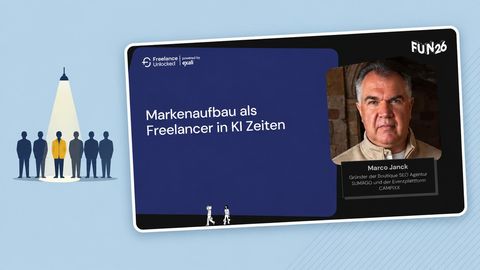

Marco Janck has spent 25 years making himself visible, first as a freelancer, then as the head of a 20-person SEO agency, now back at four people by choice. His Freelance Unlocked 2026 closing talk boils brand building in the AI era down to five habits: break the norm so people notice you, pick one shelf in the supermarket instead of carrying a tray of everything, sell security rather than hours, talk about the things nobody else talks about, and rebuild the real touchpoints that AI cannot fake. The client decides your value, not your rate card.
Marco Janck sat through a full day of AI talks before he closed it, and he opened by admitting he was confused. "I have heard nothing but KI here, AI there all day," he said, "and I ask myself: where do we actually take place in all this AI stuff with agents replacing employees?" His answer over the next 36 minutes was less about tools than about what a person can still do that a model cannot.
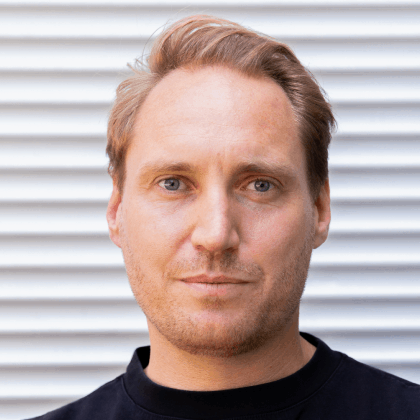
Marco Janck founded the Berlin SEO boutique SUMAGO and the conference platform CAMPIXX. Before that he was a police officer for 27 years, sold printer ink from a three-room flat when his family lost a salary, and then followed the books: "You have to scale, you have to scale." He grew the agency to 20 people, shrank it back to four after the pandemic and a serious illness, and says he has never been happier. "As a freelancer I was happiest and earned the most money."
Why search alone will not carry your brand
Marco's starting point is his own trade. Where Google's AI answer boxes appear, he says, "almost no clicks reach the clients any more". The one piece of outside data worth adding: a Pew Research Center analysis of 900 US adults in March 2025 found that people who saw an AI summary clicked a traditional result in 8 percent of visits, against 15 percent without one. No DACH figure exists, so treat it as direction, not a local number.
His conclusion is not "brand, brand, brand" as a mantra. "That I appear as a brand between six others is all nonsense," he says. "So I have to think of something new." Five things, as it turns out.
1. Break the norm, or nobody sees you
"When you break out of the norm, you become perceptible to other people. That is just how we are wired." His examples are physical: a yellow suit with a beard dyed to match, business cards that do not look like business cards, a company car in a branding that is wrong for the industry. In 2015 he stood on SEO stages in combat fatigues to represent guerrilla marketing. "If something feels like something," he says, "then it is valuable to me."
The point is not the costume. Each of these is a story you can distribute afterwards, and distribution is the part content marketers never got right: "A lot of people philosophised about content, but they never got that content onto the street."
His AI version of the rule is a joke with a serious core. Everything is built by AI now, so the art is to push back: "I still build my typos myself. If that is the differentiator of the future, that I have to make typos, hey, so what."
2. Pick one shelf in the supermarket
"It is like in a supermarket. People want orientation, and you have to see your offer the same way. You have to know which aisle you would put yourself in, so that people can go straight to you and say: okay, I will take something off this shelf."
No "Bauchladen", no tray of everything. "Show precisely, with a microscope, what you stand for." He admits he has not finished this himself: "Whoever goes to my website will see, hey, this guy knows nothing. He is focusing on touchpoint marketing because he wants to open a new world." His advice is to give yourself the quiet moment to work it out. Our piece on authenticity as a client acquisition strategy makes the same argument from a different stage.
3. Sell security, not hours
The rule with the best story. Marco spent years selling time for money, "the worst business model ever", priced against the mental grid of a civil servant: 100 euros an hour felt enormous to someone who had earned 25 as a police officer. Then, fully booked and wanting to stay in the running for a request he could not really take on, he sent a quote far outside his own grid: a 50,000 euro retainer. He expected to leave it lying there. "Ten minutes later the signed order was there, and I thought: what? Something in your grid is wrong."
"It was not in the books. The recipient, the client, makes the value, not me in my strange grid." (Marco Janck)
What the client was buying was what he had sold in uniform. "At the core I sell security, nothing else. If you have an agent programmed, it is not about programming the agent. It is that the person who programs it gives you the security that it works cleanly and does not pull you out of bed at night." The price of security "is not an hourly rate, it is how the other person perceives it."
4. Talk about what nobody talks about
Marco talks publicly about downsizing his agency, about falling ill three years ago, about political positions although "entrepreneurs should not do that". Each time, he says, the same thing happens: "When you talk openly about things nobody else talks about, you suddenly have a resonance space." You lose some people and win others.
His deal story is the small version. At a client's home, with a high-value contract on the table, the children were running wild and the client was embarrassed. Marco told him it was the same at his house. "That was the icebreaker. I got the deal on that level." Not scalable, and he is fine with that: "Do I want this purpose moment with good revenue, or scaling with naked numbers? No."
5. Rebuild the touchpoints AI cannot fake
His own unfinished homework. When the agency grew, Marco followed the advice to work on the business rather than in it, handed over responsibility, and "whoosh, all the touchpoints I had made before were gone. For years I noticed that nothing came in at the back of that chain any more." Sales people would call it lead generation. "No, I did not generate leads. I simply talked to people, and it still feels better today than anything else."
"If I shook your hand now, the contact would be completely different from me just looking in here or doing something online." (Marco Janck)
So he podcasts, he livestreams again because being addressed by name in the comments "is on a completely different level", and he goes to conferences to talk to people. Bertrand Rothen's argument for real networks over the LinkedIn feed lands in the same place.
For the machine side, one instruction: search stays a channel, so build entities, a brand, products and topic areas a search engine or language model can recognise and connect.
Underneath all five sits one question, and it is not "how much am I worth" but "what do I actually want". A million in profit, and then? "I have met few people who became happier with more." A 57-year-old telling a room of freelancers to ask that earlier than he did.
What to do on Monday
- Write your shelf label. One sentence: which department a buyer finds you in. If it takes a paragraph, you are still carrying the tray.
- Rewrite one offer in the client's currency. Replace "40 hours of development" with the risk you remove. Price it there.
- Pick one norm to break. Something visible and repeatable that becomes a story. Not five.
- Publish one thing nobody in your niche says out loud. Watch who answers.
- Book two real touchpoints this month. A conference, a call, a coffee. Count them like leads.
Marco's second rule still needs a place where the right companies can find your shelf. A free 9am profile puts your positioning in front of DACH companies that hire freelancers; our guide to the freelancer profile shows how to write the shelf label into it.
Quotes translated from German and lightly cleaned from automatic captions.
Freelance Unlocked is co-organized by 9am together with Uplink and freelancermap. This article is based on Marco Janck's session at Freelance Unlocked 2026. Watch the full talk above, and join us at the next edition: freelanceunlocked.com.