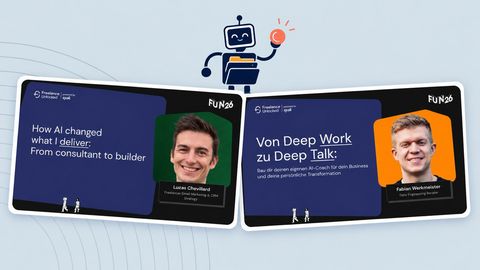

Two freelancers at Freelance Unlocked 2026 showed working AI assistants they built themselves, with numbers. Lucas Chevillard turns recorded client calls into to-dos, content ideas and draft deliverables with an app on Lovable and the Claude API: 57 calls processed, 159 content ideas, about $25 a month plus roughly 5 cents per call. Fabian Werkmeister runs a personal coach on about 900 markdown files and a few index files, no database, any model on top. Both are copyable in a weekend. The part most people skip is legal: client calls in a third-party AI are personal data, and recording needs consent first.
"Companies are burning millions in tokens" was the headline of the year. The two freelancers who showed their own AI assistants at Freelance Unlocked 2026 pay a subscription and cents, or nothing beyond a chat plan. Here is what they built, what it costs as of September 2026, and what German data protection law asks before you copy it.
Setup 1: Client calls in, to-dos and drafts out
Lucas Chevillard has freelanced in email marketing and CRM strategy for two and a half years: seven to ten clients a year, three at a time, mostly audits. His stack was ordinary: Notion for everything, Accountable (affiliate link) for finances and taxes, a lot of calls.
He recorded calls to improve his sales process, then noticed the transcripts were "super valuable information." First use: paste a discovery-call transcript into Claude with his Notion template.
"You get something that's 90% ready. [...] The process really went from like one to two hours to: the call is done, 10 minutes, I add my secret sauce to it and then that's something I can send to the client directly." (Lucas Chevillard)
The current version is an app he built on Lovable. Record the call, get the transcript, send it to the app, Claude sorts it, and the output lands in three places: to-dos in his task list, content ideas in a LinkedIn brief queue, and project points in a workspace where the app starts drafting the deliverable against what he committed to.
His numbers: "57 calls, more interesting for the output, 159 content ideas, it's like almost half a year if I kind of like go for that." And the bill: "At the moment it's like Lovable, it's like $25 per month. If I do the Claude API call for each call processing, it's like 5 cents per 30 minute call, so it's totally manageable."
Two warnings from him are worth more than the demo. On scope: he "built some monstrosity because it was not clearly defined. So be clear about the MVP that you want." On output: "If you create or just write with AI, you who's delivering that, you really need to stand by everything that's written." Everything that leaves his desk, he has read.
Setup 2: 900 text files and a signpost
Fabian Werkmeister, a data engineering consultant who founded his company a year ago, went the other way. No app, no database, no code.
"That's just folders with text files. That's it." (Fabian Werkmeister, translated)
Three parts. A RAW folder as inbox: everything lands there as markdown, from call transcripts to clipped LinkedIn posts. A Wiki with his knowledge by topic: AI, business, his work, health. Project folders as isolated sessions for bigger jobs.
The trick that replaces a vector database is the index. "With every chat request I make, my model first reads the rulebook and the table of contents and then knows exactly what is where, and works its way deeper via these index files into the individual modules." The model writes and maintains those signposts itself. Size, from an audience question: "I have around 900 markdown files right now in my second brain, I guess around a million lines of text."
The engine is deliberately interchangeable: "Take the subscription you like, take the subscription you can afford and then just use it. It's completely interchangeable." Rename the instruction file and any model can read it, including a local one, his option if you do not want sensitive material on a US provider's servers.
His flagship use is a personal coach fed with his journal. The copyable business uses: feedback on his own sales calls, a CV and offer rewritten for a specific project posting. And one hard line, when asked about client data:
"I still separate client projects and the setup. That's too hot for me. That doesn't go in there, because I don't answer personal questions about client projects." (Fabian Werkmeister, translated)
What it costs, checked on 5 September 2026
Chevillard's figures are from August 2026. We checked the price lists on 5 September 2026; prices change, the links are in the sources.
Lovable. The subscription plans page lists a free plan with a few daily build credits, Pro from $25 a month for 100 credits (tiers up to $2,250), and Business from $50 a month. Annual billing is cheaper. Chevillard's $25 is entry-level Pro.
Claude API. Anthropic's pricing page lists per million tokens: Sonnet 5 at $2 input and $10 output, Haiku 4.5 at $1 and $5, Opus 5 at $5 and $25. Batch processing is half price.
Our estimate for one 30-minute call. Roughly 5,000 words, about 7,000 tokens in, perhaps 1,500 tokens of structured output. On Sonnet 5 that is about 3 cents; on Opus 5 about 7 cents. Chevillard's 5 cents sits in the middle, and 57 calls at 5 cents is under $3. Over a year, the app subscription is the cost. The AI is rounding error.
Werkmeister's version costs the chat subscription you already pay. Markdown is compact, and the index means the model "only reads what needs to be read."
The GDPR and consent box
Neither speaker had fully resolved this. Chevillard, asked whether clients know their calls go into AI, answered honestly: NDAs so far, and "I actually want to write in my contracts with them that I record all my calls to be on the safe side." Werkmeister keeps client projects out entirely. Here is the German frame, as a practitioner explainer.
1. Recording comes before AI. Under § 201 StGB, recording another person's non-public spoken word without authorisation is a criminal offence, up to three years in prison or a fine. Everyone on the call agrees before you press record. Say it, get a yes, note it. An NDA covers confidentiality; it is not consent to be recorded.
2. Client calls are personal data. Names, voices, what a stakeholder said about a colleague. The DSK Orientierungshilfe on AI and data protection (the joint guidance of Germany's data protection authorities, 6 May 2024) is explicit that blanking names does not help: "Um die Eingabe personenbezogener Daten zu vermeiden, reicht es regelmäßig nicht, Namen und Anschriften einer Eingabe zu entfernen."
3. The AI provider is usually your processor. Section 2.1: if you use an external provider's AI for your own purposes, for example as a cloud solution, the provider acts as your extended arm, and "dann besteht zwischen dem Anbieter der Anwendung und dem Verantwortlichen häufig ein Auftragsverarbeitungsverhältnis gemäß Art. 28 f. DS-GVO." You need a processing agreement under Art. 28 GDPR. API and business plans of the big providers offer one; consumer chat accounts often do not.
4. You need a legal basis, and so does your client. Section 3.1: "Für die Verarbeitung personenbezogener Daten in KI-Anwendungen und die evtl. erfolgende Übermittlung dieser Daten an Anbieter von KI-Anwendungen muss außerdem jeweils eine Rechtsgrundlage erfüllt werden." For stakeholder interviews that usually means the client, as controller of its employees' data, agrees to the tooling in writing and you have a processing agreement with them. Ask before the first call.
5. Choose tools that do not train on your inputs. Section 1.9: "Datenschutzrechtlich vorzugswürdig sind daher Anwendungen, die die Ein- und Ausgabedaten nicht zu Trainingszwecken verwenden." Switch training off where you can, prefer tiers where it is off by default, check where data is stored.
6. Separate, minimise, delete. Werkmeister's line is the operating rule: client material in its own folder or project, never in your personal knowledge base. Keep what the deliverable needs, delete transcripts when the project closes.
This box is general information for practitioners and does not replace legal advice. If you process client recordings at scale, have a data protection lawyer or the client's DPO look at the setup once.
Which setup is yours?
Chevillard's route fits if your work produces a stream of similar inputs and you want structured outputs in tools you already use: a subscription, a weekend, and MVP discipline. Werkmeister's route fits if your value is accumulated knowledge and judgment and you want zero lock-in: nothing you do not already pay.
Both rest on one foundation: the model performs only when it knows your business. The three-tier context file in use AI without losing your edge is that foundation in three hours. To turn the same building skills into a product for others, watch Christine Vallaure's session; for automations that need no app, start with how to automate your freelance routine with AI.
What to do on Monday
- Run Chevillard's audit: which task repeats across clients and eats the most hours, and what do you add that is in no tool?
- Choose the route, app or folder, and write down the smallest version that works on one real case.
- Before any client call enters either, add one sentence on recording and AI processing to your engagement letter, and check that your provider tier has an Art. 28 agreement and a no-training setting.
- Build the smallest version this week, run one real input through it, fix what it gets wrong.
- Create a client folder separate from everything personal. Put a deletion date on it.
If the assistant hands you back a few hours a week, spend them on client conversations. A free 9am profile is one place they can start.
Freelance Unlocked is co-organized by 9am together with Uplink and freelancermap. This article draws on the sessions of Lucas Chevillard and Fabian Werkmeister at Freelance Unlocked 2026. Watch the full talks above, and join us at the next edition: freelanceunlocked.com.