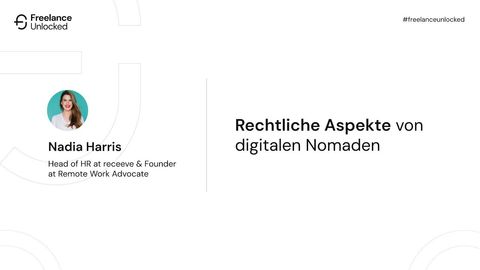
"Nobody will find me." That's the sentence Nadia Harris hears most often when digital nomads talk about taxes and contracts. Her answer at Freelance Unlocked 2024: there is no problem, until there is one. As founder of remoteworkadvocate.com, Nadia advises companies worldwide on remote work and compliant setups with freelancers, and she has seen the cases where "nobody will find me" turned into a double tax bill.
As of summer 2024. Visa, tax and social security rules change constantly. Check the current official information before any longer stay abroad.
Who can actually be a digital nomad
Nadia's first clarification kills a common misconception: the classic digital nomad is not a regular employee. Employees have an employer, labor law and policies, and when a company says you can't work from abroad for months, it's rarely bad will. It's simply not regulated, and the company carries the risk.
The exception is the workation: working from abroad for a few weeks up to a few months, based on a proper company policy. You can't buy that policy off the shelf. It has to be built per company, on the basis of tax treaties, labor and social security law and data protection. Within the EU a lot is possible; for destinations like Bali or Russia, companies decline for good reason. And it needs internal criteria for who can go: someone whose residence status hangs on conditions like the Blue Card, or who works at the front desk, can't just leave.
For everyone else the rule is: digital nomads are self-employed. Which makes them business owners, not staff.
You are a business. Act like one.
Nadia's favorite anecdote from practice: a freelancer complains after 30 days that everyone else has been paid through payroll except him. Her question back: where's your invoice? His answer: what invoice?
That's where the journey fails more often than you'd think. If you work as a digital nomad, you're treated like a business owner: you issue invoices, you set up your structure, you manage your own workload. How much formal setup that takes depends on the country. In the US, an independent contractor essentially needs a Social Security number; in Germany, the path is more formal. Contracts deserve a second look too: Nadia regularly sees remote-first companies signing "something with someone somewhere," and in the end nobody knows what actually applies.
False self-employment travels with you
The biggest recurring legal issue is one the German freelance scene knows well, but Nadia was clear: false self-employment exists almost everywhere with EU-style labor law. The criteria are similar internationally:
- Taking instructions. If your freelance contract says you're a "direct report" of some manager, that's a red flag.
- Integration. Someone presenting as "Head of HR" of a single company looks like an employee. Nadia herself works fractionally for several companies, and that's exactly the difference.
- A single client. One invoice a month, always to the same company, for years: "How self-employed am I then, really?"
- Fixed compensation. Self-employed people typically bill by daily or hourly rate, with amounts that vary month to month, rather than a fixed salary-like lump sum.
Two details from the talk are worth writing down. First: auditors really do check LinkedIn. If you list yourself as "full-time" at your main client, you're handing over the evidence for free; choose "freelance," "contract," or nothing at all. Second: some companies have freelancers sign a declaration that they are not their only client. That sometimes helps in an audit, but rescues nothing if the other criteria go wrong.
You don't have to guess how risky your own setup is: 9am's free false self-employment self-check shows you in a few minutes. For the German legal foundations, see our article on understanding false self-employment.
The six legal areas to keep in view
Nadia's map for every country move:
Visas and entry. Entering as a tourist and staying seven months is not a strategy. Many countries now offer digital nomad visas, and the list keeps growing. Before every destination, the question is: am I allowed to work here at all, and under which status?
Taxes. The famous 183-day rule of thumb, under which your tax residence is usually where you spend more than six months a year, is exactly that: a rule of thumb, not a free pass. Nadia's cautionary tale: a freelancer with Brazilian citizenship worked from Brazil for EU clients, for seven or eight months, and everything seemed fine. Until he wanted to buy an apartment there and disclosed his documents. The result: tax liability in Brazil, on top of the tax already paid in the EU, twice over. Which countries have double taxation agreements with Germany is officially listed by the Federal Ministry of Finance. Before moving, clarify: where do I register, where do I deregister, where am I liable?
Social security. Within the EU, the principle is that only one country covers you at a time, and you can't pick it. For temporary work in another European country there's the A1 certificate, which also covers the self-employed. But, as Nadia stressed: the A1 works in the EU, the EEA and Switzerland, not in South America, North America or Asia. Outside Europe, coverage is yours to sort out.
Insurance. For life on the road she recommended international nomad insurers such as SafetyWing or Insured Nomads, which adapt flexibly as you change countries. You'll find more vetted tools for freelancers in the 9am Freelancer Toolbox.
Labor law and data protection. False self-employment can catch up with you in your host country if you work there long enough. And data protection co-decides where you may work at all: if your clients are banks or handle sensitive data, EU data often may not be touched from third countries. Nadia knows nomads who never read the contract and lost the client over it.
Banking. Not every payment platform works in every country, and some can't be linked to local accounts. If you find that out when your first invoice is due, you're stuck in the wrong country.
"Everything is good until something happens"
The Q&A brought the inevitable question: what about people who never stay anywhere longer than a few months and simply pay no taxes at all? Nadia's answer was the bluntest of the day:
"This is wrong, to begin with. And it's wrong for yourself, not just because you think you're fooling everyone: you pay in nowhere, you have nothing for retirement. Everything is good until something happens, until someone suddenly gets sick or wants to buy property. Hello, how do I do that? This is definitely not a long-term solution." (Nadia Harris, lightly condensed)
Whether invoicing through your own GmbH protects you from false self-employment got her most diplomatic answer: "Yes and no, I'd say 50 percent yes." It stays a question of the overall picture: sole client or not, share of your income, contract duration, and all the other criteria.
Her closing checklist is unspectacular and useful for exactly that reason: check visa rules, take out international insurance, respect local laws, clarify tax obligations and register and deregister properly, set up a legal work structure, organize banking. Or in Nadia's short version: research, research, research, and only then get on the plane.
The most stable foundation for nomad life, by the way, is a client base that doesn't hang on a single company. A free profile on 9am keeps your DACH pipeline filled, whatever time zone you're working from.
This article is for general information and does not constitute legal or tax advice.
Freelance Unlocked is co-organized by 9am together with Uplink and freelancermap. This article is based on Nadia Harris's session at Freelance Unlocked 2024. Watch the full talk above, and join us at the next edition: freelanceunlocked.com.