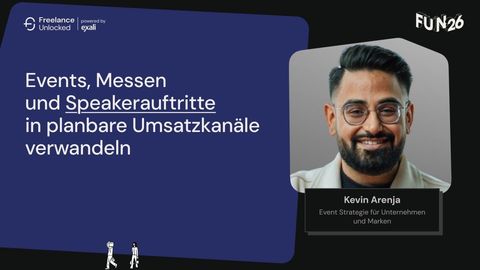
Kevin Arenja opened his Freelance Unlocked 2026 session with an uncomfortable question: you paid 50 to 300 euros for your ticket. Who has already earned that back, in actual euros? One hand went up. One.
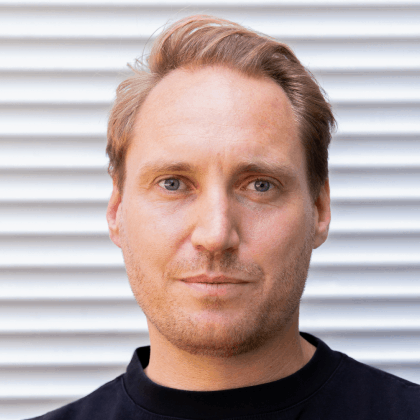
His conclusion was blunt: if all you take home from an event is knowledge, and not a single contact that can turn into revenue, you've wasted your time. Kevin Arenja has been an event manager since 2013, has delivered more than 120 events, started out as a freelancer himself and now runs a team of seven. His talk is a playbook in four stages: as a guest, as a speaker, as an exhibitor, and eventually with your own event. One event run on this approach, he says, generated over 250,000 euros in revenue.
The dry numbers say there's a real lever here. According to the Freelancer-Kompass 2026, 61% of freelancers in the DACH market are struggling with a lack of assignments and 62% call acquisition their biggest hurdle. Meanwhile, the German trade fair association's AUMA Exhibitor Outlook 2026/2027 ranks trade fairs among the top-rated instruments in the B2B marketing mix (77.5% top-two ratings), with roughly half of companies measuring success primarily in leads and new customers. The companies that could book you are already there. The only question is whether you show up with a plan.
Why events? People buy from people
Kevin's foundation is a sentence he repeats throughout:
"People buy from people. For that I first need an actual encounter, and I need to build a relationship." (Kevin Arenja)
Precisely because anyone can post AI-generated content now, the biggest buying blocker is trust: Is this real? Can this person actually do it? A personal encounter answers that faster than any campaign. Research agrees: as Vanessa Bohns showed in a study covered by Harvard Business Review, a face-to-face request is 34 times more successful than the same request by email.
Hence his first rule, deliberately provocative: a LinkedIn connection alone is worthless. If a great conversation ends with a QR-code scan, you have nothing. Swap a real, validated phone number. That's someone you can call, message on WhatsApp, meet for coffee. His follow-up tip is as simple as it is uncomfortable: on the train home, send a WhatsApp with a selfie. "Hey, great meeting you today." Relationship built before the contact goes cold.
Events tap into an ancient pattern he calls the campfire principle: people gather, show off a little, want to learn from each other, and eventually the chief explains how to bag five deer. A talk, a program, real conversations. Understand that this mix is what produces trust, and you can use it deliberately.
Stage 1: attend with a plan, not with hope
Kevin's most important question came as a show of hands: who knows which events their customers attend? Only a few hands rose. Yet that's the entire trick. Your existing customer is the prototype of your next one, and companies in an industry travel in herds.
His first steps for guests:
- Call your best client on Monday, just to chat, and ask: "Are you going to any trade fair this autumn?" Go there, learn the event, and apply as a speaker for next year.
- Buy the VIP ticket. Everyone is at the 39-euro mass event. The people with budgets want some peace and sit in the pricier area. The upgrade doesn't buy you status. It buys you access to the right room.
- Sell through stories, not pitches. Tell people which problem you solved for your last client and watch for buying signals. Someone asking "and how exactly did you do that?" isn't asking out of boredom.
- Use every event for research. What keeps your customers up at night? Kevin told how a tool developer described his target-group problem over conference lunch and walked away with a new hypothesis after five minutes. Getting that insight through surveys would have cost real money.
- Look for partners as well as clients. Your customer has a problem before and after your piece of the chain. Whoever runs ads needs someone for landing pages; whoever builds landing pages knows someone for SEO. Understand the chain and have partners for it, and you earn through referrals or subcontracting while your client stays longer.
Stage 2: the stage is a cash cow
A talk changes the math of networking. Kevin ran the numbers from the stage: speaking one-on-one with 50 to 60 people at six minutes each would take around 300 minutes. A talk reaches the same people in half an hour, and they're people demonstrably interested in your topic. Two or three solid contacts per appearance is realistic.
Then there's the effect that keeps working after the event: the photos.
"Every single picture of every single talk raises my perceived expertise. That's personal branding no AI can generate." (Kevin Arenja)
Kevin pays the event photographer extra for the rights to his stage shots and plays them across LinkedIn, his website and, his insider tip, WhatsApp status stories. Few channels get him more replies. And someone who wasn't even there regularly messages: "Saw you spoke at that event. Can you send me your slides?" That's a lead too.
Which leaves the Q&A question: when do you get paid to speak, and when do you pay? Kevin's answer, lightly sanitized: whoever has the bigger reach and the scarcer knowledge gets paid. If the stage is mainly building your leads and reputation, you pay for it or arrange a barter, and collect the return afterwards. He offset his own Freelance Unlocked appearance against services.
Stage 3: the booth that doesn't look like a booth
Not everyone wants a stage. For quieter people, Kevin has two examples showing how small an effective presence can be.
An SEO freelancer in his circle used a German founders' subsidy to book a discounted booth in the startup area of OMR, one of Europe's biggest marketing festivals. The result: three mandates from major brands, close to 100,000 euros in revenue. "They would never have taken him seriously otherwise," Kevin said. The same freelancer later gave a talk at a 400-person conference with a plain one-meter roll-up banner next to it. That produced two contracts worth a combined 35,000 euros in monthly retainers. He has since hired two people.
Example two: a ghostwriter whose booth was essentially a bookshelf holding his actual books, several of them bestsellers. No booth builders, no agency. Anyone gets what this man does in two seconds. "The best salesperson is the finished project," Kevin says. Show what you've built, even if it's on the monitor you carried from your desk. And if a crowd of 100 scares you: a demo for two or three interested people at a booth is a stage as well.
Direct contact has one more advantage no ad can offer: an honest reaction. On Meta your ad gets swiped away; at a fair you get a yes, a no or feedback. Even 100 rejections are market research.
Stage 4: your own event, but only at the right size
Hosting your own events is the top tier, and Kevin warns explicitly that you can burn serious money here. His rules of thumb:
- Under 20 clients: no events, dinners. Take your most important clients out for a proper meal every nine months or so. Nobody tells you the small thing that quietly annoys them on a scripted status call. Over dinner they do.
- From around 50 clients, client events pay off. Expect only about 20% to show up, and an event starts making sense from ten attendees. Every developer knows more developers, every Google Ads specialist knows others from their scene: a client event delivers referrals in concentrated form.
- Use events to requalify leads. The SEO agency from his example collected around 300 leads across three events but initially converted only eight. Instead of writing off the list, they invite everyone to a compact afternoon of training and rebuild the missing trust touchpoint.
- It can even pay for itself. One of Kevin's clients, a fitness coach, runs an annual event his existing customers pay 1,500 euros each to attend: two days of sport, talks and a good hotel. Client retention that funds itself.
The thread through all four stages: give first. "For every advance contribution, something comes back," Kevin says. In the end, events aren't a sales trick but systematized relationship care, which is exactly why they work for people who hate cold outreach. We've made the broader case for real-world networks over timelines in Forget LinkedIn: how freelancers actually win clients through networking.
One closing note, from the event professional himself: treat all of this as a buffet. Take the two or three tactics that fit you and leave the rest. Not every move suits every person. But never again walk into an event without a goal. And so the contacts from the fair can find you afterwards, set up a free profile on 9am that shows your projects.
Quotes translated from German.
Freelance Unlocked is co-organized by 9am together with Uplink and freelancermap. This article is based on Kevin Arenja's session at Freelance Unlocked 2026. Watch the full talk above, and join us at the next edition: freelanceunlocked.com