A draft law that officially doesn't exist has occupied Germany's freelance scene more than any bill that actually passed this year. The labor ministry's draft on the "neue Selbständigkeit" (new self-employment) reached the public via Süddeutsche Zeitung before the government had agreed on it internally. At Freelance Unlocked 2026, three people who know the file inside out took it apart on stage, right after the talk by BMAS state secretary Lilian Tschan.
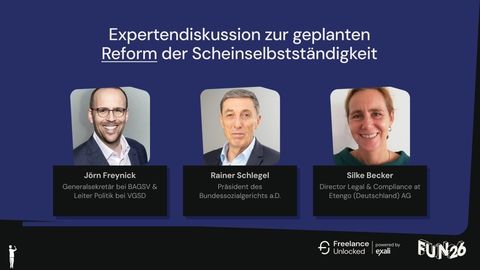
The panel: Jörn Freynick, secretary general of BAGSV, the umbrella organization of 31 self-employment associations, and head of policy at VGSD. Next to him Silke Becker, Director Legal & Compliance at Etengo (Deutschland) AG, who sees the topic from the client side. And Prof. Dr. Rainer Schlegel, retired president of Germany's Federal Social Court, the very court whose case law decides today whether you count as self-employed or falsely self-employed.
A draft that was never meant to circulate
A quick look at procedure explains the drama. Before a draft bill formally goes out to the other ministries, the coalition coordinates internally. In the middle of this early coordination, the fully drafted text landed with the press. Schlegel described what happened next: the Chancellery halted the process and blocked the draft from being sent to the other ministries, something that almost never happens. Since then, the conservative CDU/CSU and the labor ministry have been negotiating the substance behind closed doors.
Was the leak deliberate? Freynick suspects a trial balloon: the ministry wanted to test the mood. "And the mood, as we've all noticed, is not exactly good."
What the "new self-employment" draft actually says
Schlegel summarized the leaked text on stage. You would count as self-employed if four conditions are met:
- Both sides agree. Client and contractor assume at the point of signing that this is self-employed work.
- The work shows entrepreneurial conduct. More on that in a second.
- No prior employment. Anyone employed by the same client immediately beforehand is out.
- The client registers the engagement with the social insurance collection agency within six weeks, just as for employees.
Entrepreneurial conduct, under the draft, exists only if the contractor has the right to send a substitute. On top of that, at least two of four markers must apply: profit and loss risk, not working essentially for a single client, business-typical expenses such as your own equipment and travel costs, and actively marketing yourself.
The consequence of qualifying is the part with teeth: mandatory pension insurance. The client withholds 18.6 percent on 90 percent of the agreed fee and pays it straight into the statutory pension scheme, up to the contribution ceiling. And all of this applies to social insurance law only. Employment law is explicitly untouched, tax law all the more so.
Where the experts say it falls apart
Becker delivered the practitioner's verdict:
"We get a completely new legal construct that applies only to social insurance law. For a practitioner like me, that's a catastrophe." (Silke Becker)
Her scenario: the freelancer counts as a "new self-employed" for social insurance, the client dutifully remits pension contributions. Then the tax office shows up, applies the classic tests of instructions and integration, which the draft excludes for social insurance purposes, and demands payroll tax. VAT and input tax have to be unwound. "It's not thought through," Becker said. She also considers client-side withholding a design flaw: a client can't know what a freelancer earns overall when that freelancer is invoicing other customers too.
Freynick's main objection is the substitution right as a mandatory criterion. His example: if you book Angela Merkel as a conference speaker, you don't want Franz Müntefering walking on stage instead, however likeable he may be. Trainers and consultants get hired precisely for their individual track record. A criterion that treats self-employed professionals as interchangeable misses how their market works. Within two days, VGSD had collected more than 40 open questions for the ministry, because core terms like entrepreneurial risk remain undefined in the draft.
One genuine positive, both agreed: the draft works with positive criteria at all, markers that speak for self-employment rather than against it. Which criteria make the list is the fight worth having.
Retirement provision: the real battleground
Behind the status question sits a bigger one. Schlegel reminded the audience that a retirement provision obligation for the self-employed has been in the coalition agreements for three legislative periods running. That it will come is considered settled across parties, not least because the share of self-employed people needing basic income support in old age is, in percentage terms, twice as high as among employees. What's contested is the form. The SPD and the labor ministry see the statutory pension scheme as the only right answer; parts of the CDU/CSU want private provision to count as well.
Schlegel's own position is a liberal one: the state may demand that nobody becomes a burden on the public purse in old age. Whoever can prove secured retirement income above the basic-support level, roughly 1,000 to 1,300 euros a month, has met the target, no matter how.
"If the outcome is right, I'm covered, I'm providing for old age, then it's a secondary question whether this is dependent employment or self-employed work." (Rainer Schlegel)
Freynick added the point that hit closest to home for the room: every compromise so far foresaw a provision obligation only for future self-employed people. The leaked draft extends it to existing ones. For the large majority who already provide for retirement, through insurance contracts, property, or investment portfolios, an additional mandatory payment into the state scheme would be "a punch in the gut." The BMAS's own study on the social situation of the self-employed found that most self-employed people do put money aside, while a minority saves nothing or too little. That gap is the problem worth solving, not the majority.
So what's realistic?
For all the criticism, the panel wasn't gloomy. Freynick counted the state secretary's appearance, and her promise of a bill this year, as a sign of respect toward the self-employed in itself. The community has never been this close to a new rulebook: that was the shared read on stage. Toward the end, the panel sketched what a workable path could look like:
- Assess the person, not each contract. Someone who is set up as a business overall should count as self-employed overall, instead of being re-examined engagement by engagement.
- Sensible positive criteria that reflect real business models, without a mandatory substitution clause.
- A provision obligation with freedom of choice. Coverage above the basic-support level as the target, the statutory pension as one option among several, and grandfathering for everyone who already provides.
Whether that's what emerges depends on the ongoing negotiations between the CDU/CSU and the labor ministry. Both association representatives on the panel expect movement before the year is out.
What you can do now
Until the new law lands, the current rules apply, including status determination procedures and audits. For how the current legal situation works and what auditors look for, start with our guide to false self-employment in Germany. For concrete steps that lower your own risk, see how freelancers avoid false self-employment. And if you want a quick read on where your own setup stands under today's criteria, 9am's free false self-employment self-check takes a few minutes.
And if you want the coming law to be better than the leaked draft, the panel's advice boils down to visibility. Join an association, take part in surveys like VGSD's on positive criteria, and follow Schlegel's parting tip: "Nagging helps." Write to your local member of parliament and tell them a bill is moving that affects how you earn your living.
Want to stand on solid ground regardless of what Berlin decides? Create a free profile on 9am and work with clients who take compliance seriously.
This article is for information only and is not legal advice.
Freelance Unlocked is co-organized by 9am together with Uplink and freelancermap. This article is based on the panel discussion with Jörn Freynick, Rainer Schlegel and Silke Becker at Freelance Unlocked 2026. Watch the full talk above, and join us at the next edition: freelanceunlocked.com.