
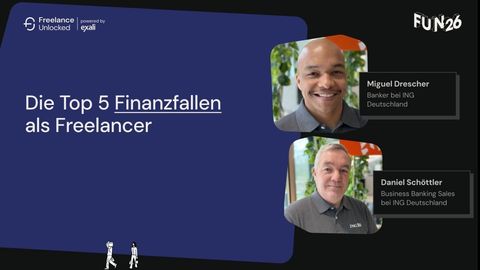

A salesman earns serious money in eight months of freelancing, buys his dream car, and ends up selling the Audi TT at a heavy loss and borrowing from his grandmother because the tax office demands a nearly six-figure sum within ten days. The story is real, and it comes from a banker: Daniel Schöttler of ING told it about himself at Freelance Unlocked 2026. Together with his colleague Miguel Drescher, he walked through the five financial traps they keep seeing in founder consultations. Every example is either self-experienced or a real advisory case.
Quotes translated from German.
The timing matters. According to freelancermap's Freelancer-Kompass 2026, the average hourly rate in the German market fell for the first time since the survey began, to €103, and average monthly project revenue dropped about 21% to €6,653. When income gets shaky, financial habits decide who lasts.
Trap 1: The tax trap. Profit is not your income
Daniel's own story from the late 90s: first big freelance project in Berlin, numbers he'd never seen growing up in a village near Flensburg, and a lifestyle that scaled up instantly. Car, apartment, holidays.
"I completely forgot that I had to pay taxes." (Daniel Schöttler)
Then the letters arrived: a payment notice for a nearly six-figure amount, due in ten days, plus advance payments for the months ahead. It ended his first stint of self-employment. And no, this is not a 90s relic; the same cases still land on his desk in founder consultations today.
The rule behind it:
"The revenue you generate is never fully your money. Taxes always come with a delay." (Daniel Schöttler)
Set aside a fixed share from day one and keep an eye on future liquidity, beyond today's balance. Budget for surprises too, like mandatory memberships in chambers and professional associations, which depending on your field can run to high four figures. For the tax side in detail, see our guide to the 7 tax mistakes freelancers in Germany make.
Trap 2: The cost trap. Corporate equipment without a corporate budget
Anna, 15 years a consultant at one of the Big Four, goes independent. Business plan: excellent. Financial plan: solid. Then she carries over the standard she knows from corporate life: a leased car at nearly €2,000 a month ("I can't show up at a client's in a Renault Clio"), a premium video tool at a three-figure monthly price even though her Office license already includes one, an expensive Berlin office, a business phone plan costing four times her private one.
Within weeks the numbers stop working. The advisory session becomes a teardown: car gone, coworking space instead of her own office, meeting rooms rented only when needed. A heavy block of fixed costs shrinks to something reasonable, and Anna sleeps again.
The lessons for the start: keep fixed costs low. Prefer variable costs over fixed ones, even if the monthly price is slightly higher, because being able to exit a contract at any time is worth it. Tie investments to actual demand. And Daniel's northern German principle:
"Only spend the money you have. You'll sleep better." (Daniel Schöttler)
Trap 3: The client trap. 80% of revenue from one customer
An IT freelancer works for a large client for three years. The collaboration is excellent. Then the project gets killed, and with it around 80% of his revenue. In practical terms, he was out on the street.
Miguel's rule of thumb: no single client should account for more than roughly 30% of your revenue. Keep a warm pipeline alive even when you're fully booked, take smaller projects alongside the big one, and regularly check how your revenue splits across clients.
Dependency also has a legal face. If you work almost exclusively for one client, in their offices, on their equipment and under their direction, you risk being classified as falsely self-employed. When in doubt, the status determination procedure of the German Pension Insurance gives you a binding answer, free of charge and even before a project starts. Our guide to avoiding false self-employment covers how to set up your contracts and working practice cleanly from the start.
Trap 4: The account trap. Running everything through your private account
A marketing manager starts out with a handful of clients and runs everything through her private bank account. At first it's manageable: holidays, business dinners, expenses, client payments, all in one app. Then the business grows, and suddenly there are hundreds of transactions where she herself has to think hard whether that dinner was business or with a friend. At year-end, her tax advisor bills every one of those untangling hours.
So: a business account from day one, fully separated from private life. Pay yourself a small "salary" from it to your private account, capture receipts digitally and match them continuously with accounting software.
Daniel's addition from banking practice: German law doesn't force freelancers to have a business account. But practically every German bank's terms and conditions prohibit commercial use of a private account, and he knows of none that explicitly allows it.
Trap 5: The liquidity trap. Full order books, empty account
A wedding photographer, fully booked through the summer. Then everything hits at once: the camera needs repairs, several clients pay late, and he's out sick for a few days. Full order books, and still nothing moves.
"Revenue is not your profit. Liquidity is the money sitting in your account that you can actually pay your bills with." (Miguel Drescher)
Their recommendations: on top of your tax reserve, build an emergency fund covering three to six months of fixed costs, ideally six. Plan your cash flow four to six months ahead instead of living from one incoming payment to the next. Automate your payment reminders, whatever your volume. Agree on deposits or partial payments for bigger projects before you start. And insure the risks that can actually hit you, from equipment to health.
That last point carries a cost people forget: health insurance keeps running in months without projects. For voluntarily insured self-employed members of Germany's statutory scheme, insurers assume a minimum monthly income of €1,318.33 in 2026 even when nothing comes in. Fixed items like that belong in your emergency-fund math.
How big should the reserve be?
The audience question after the talk: how large should a liquidity reserve be relative to annual income? The answer is refreshingly unspectacular. Work out what your life plus your business costs per month, fixed costs and living expenses combined. That number times six to twelve is your target. There's no universal figure, because every life phase looks different.
"Transparency and above all predictability are the most important things in self-employment." (Miguel Drescher)
All five traps share one root: they don't come from bad work, they come from missing visibility. Get your reserves, costs, client mix, accounts and cash flow set up cleanly once, and you've defused practically all of them.
The best insurance against the client trap is still a full project pipeline: 9am connects freelancers with vetted projects from companies across the DACH region. Create your free profile and broaden your client portfolio.
Freelance Unlocked is co-organized by 9am together with Uplink and freelancermap. This article is based on Daniel Schöttler and Miguel Drescher's session at Freelance Unlocked 2026. Watch the full talk above, and join us at the next edition: freelanceunlocked.com.