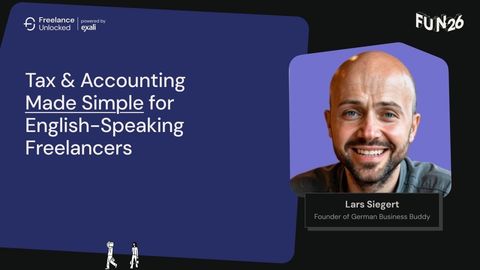

Most freelancers in Germany believe at least one of three myths: you need a tax advisor by law, you need an accounting background, or one mistake will end your business. All three are wrong, and they keep international freelancers paying for help they don't need or, worse, putting their finances off entirely. Lars Siegert, founder of German Business Buddy, spent his Freelance Unlocked 2026 session dismantling them with a system simple enough to run yourself.
His credibility on this is personal. When his wife went freelance in 2020, the two of them started with an Excel sheet, made mistakes, traded letters with the tax office, and refined the setup year by year. Today she handles her finances herself, and so does he. The framework below is what survived. It's built for freelancers and sole proprietors using cash-basis accounting (the EÜR method), which covers you unless your trade business exceeds €80,000 in annual profit or €800,000 in revenue.
One caveat before the details: thresholds and rates change almost yearly in Germany. The figures here are current as of September 2026; check the linked sources before you act on them.
Step 1: Open the right bank accounts (1 + 2)
Lars's formula is one personal account plus two business accounts. The first business account handles daily operations. The second is your tax reserve, and it's the part most starters skip.
Into the reserve goes, no matter what:
- All the VAT you collect from clients. It was never your money.
- Around 30% of your profit for income tax.
- 15-20% for health insurance.
Whatever remains, roughly half, is actually yours to spend. Why so strict? Because the tax bill arrives with a delay, often together with advance payments for the current year.
"You don't want to panic in year two or three, when the tax letter congratulates you: hey, great profits! But here's the tax bill." (Lars Siegert)
Keeping business and personal money separate also makes your accounting dramatically easier, and it means the tax office never needs to see your private spending.
Step 2: Write invoices that hold up
Two details from German invoicing rules cause most of the trouble:
- Simplified invoices: if the gross amount stays at or under €250, a reduced set of mandatory details is enough. Useful for small amounts, and you need less information from your client.
- EU business clients: put your VAT ID and the client's VAT ID on the invoice, plus a reverse-charge note. Skip that and the invoice is non-compliant: VAT deductions are at risk, penalties become possible, and the client will send it back, which means late payment and double work.
The VAT logic by client type is simpler than it looks. German client (business or private): charge German VAT, usually 19%. Small business rule: charge no VAT, but state on the invoice that none is charged under section 19 of the VAT Act. EU business client: no German VAT, both VAT IDs, reverse charge, and the client handles VAT at home. Business client outside the EU: no German VAT; the details depend on the country, so look up your case.
Lars's habit: take the extra minute to check every invoice you send, and 30 seconds for every invoice you receive.
Step 3: Decide on the small business rule with a calculator, not a feeling
The Kleinunternehmerregelung is not a tax-saving scheme, and "I'm small, so I should use it" is not a reason. It's voluntary, and since 2025 it applies if your revenue stayed at or under €25,000 last year and won't exceed €100,000 this year.
The upside: no VAT on invoices, no VAT returns. The drawback: you can't reclaim the VAT you pay. Lars's example: buy equipment for €2,500 plus 19% VAT and €475 is simply gone. That's why the default scheme usually wins. The rule makes sense mainly if you serve consumers (you're 19% cheaper for them), plan to stay under €25,000 permanently, and have low running costs. And remember that stating "small business" on every invoice tells corporate clients you're a small fish.
For income tax, one clarification that confuses many newcomers: only profit is taxed, never revenue. Revenue minus deductible business expenses is what counts. The first chunk of income is tax free (the basic allowance is €12,348 in 2026), and everything above it is taxed at progressive rates. If the tax office expects you to owe money, it will ask for quarterly advance payments and settle the difference after your annual return.
Step 4: Know your two kinds of deadlines
There are only two rhythms to internalize:
- Ongoing: advance VAT returns, monthly or quarterly, due by the 10th after the period ends.
- Annual: the VAT annual return, the income tax return, and for trades the trade tax return. For the 2025 tax year, the standard deadline is 31 July 2026 if you file without an advisor.
Lars's advice on the July deadline: don't use all of it. "In July, when it's hot and you're on vacation, you don't want to deal with taxes." The return covers the previous calendar year, so you have more than half a year to get it done early.
Step 5: Build the boring digital system that makes an audit a non-event
No document management software needed. Lars runs everything on three pieces:
A folder structure. One folder per calendar year, subfolders for revenue, expenses, tax returns, and one inbox folder. Everything new gets dumped into the inbox first, whether it's a scanned receipt or an emailed invoice, so nothing has to be hunted down later.
A file naming convention. Year, month, day, then counterparty, document type and a short description: "2026-03-14 Telekom invoice internet". Files sort chronologically even when metadata gets lost, and you never open a file to find out what it is.
Three tools. Cloud storage, because records must survive for years and you want access anywhere. A scanner app for paper receipts. And accounting software made for freelancers to book transactions and submit returns. Lars's own pick is Accountable (affiliate link), which files German VAT returns entirely in English; it is also listed in the 9am Freelancer Toolbox.
The monthly routine: on a fixed date, download your bank statement, then match every transaction to a document.
"There's a golden rule of accounting: no booking without records." (Lars Siegert)
If a document is missing, track it down; without proof, the expense won't count. Rename each file with the bank payment date so statement and documents link up, move everything from the inbox into its folder, and submit whatever returns are due. Done. One evening a month.
A note on retention: Lars works with the classic 10-year horizon. Since 2025, the required period for invoices and accounting records has actually dropped to 8 years, with 10 still applying to some records. Either way: keep everything, in the cloud, with a backup.
When you do need a tax advisor
With a clean setup and standard freelance income, you usually don't. You do when things get genuinely complex: multiple income streams, international or private clients, e-commerce, or major life and business changes. Lars is direct about why he teaches the DIY route anyway: good tax advisors are hard to get in Germany, and many internationals never find one. Knowing the system yourself is the safety net.
"Mistakes are fixable. The worst that happened to us was a late payment fee. As long as you comply and stay in communication, the tax office is pretty understanding with solopreneurs." (Lars Siegert)
That's the real reassurance: the Finanzamt is not hunting beginners. It wants clean records and honest communication, and this system produces both. For the traps that catch freelancers most often, from registering too late to skipping tax reserves, read our guide to the 7 tax mistakes freelancers in Germany make.
Sorted finances are half the game; the other half is a steady flow of good projects. 9am matches freelancers with vetted projects at companies across Germany, Austria and Switzerland. Create your free profile and put the admin hours you just saved into billable work.
This article is for information only and is not tax advice.
Freelance Unlocked is co-organized by 9am together with Uplink and freelancermap. This article is based on Lars Siegert's session at Freelance Unlocked 2026. Watch the full talk above, and join us at the next edition: freelanceunlocked.com.