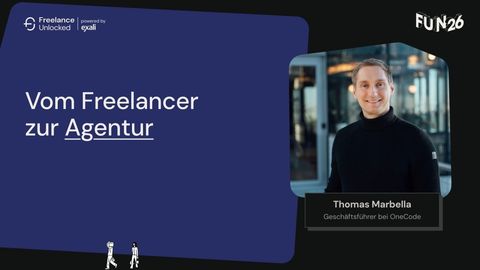

When Thomas Marbella joined the 9am podcasts a good two years ago, the topic was freelancer fundamentals: give value first, then reach the decision-maker, 100 messages, one deal. At Freelance Unlocked 2026 he was back on stage with the next chapter: how does a freelancer who has mastered that kind of acquisition turn into an agency with 15 people and 3 million euros in revenue? And above all: what do the numbers look like?
Because the numbers are exactly what's usually missing. Scaling is the scene's favorite word, and almost nobody gets specific. Or, in Thomas's words:
"Among freelancers, scaling is like making out among teenagers: everyone talks about it, hardly anyone actually does it." (Thomas Marbella)
Quotes translated from German.
For anyone with a short attention span, he front-loaded the three most important facts: an employee earns you roughly 4,000 euros of profit per month. You need the employee first, then the project. And with 10,000 euros in reserves you're in decent shape; 20,000 covers the worst case. The rest of the talk is the derivation.
Seven years in five minutes: from glorified employee to a company that runs without him
Thomas went freelance after ten years in corporate and quickly noticed: more money, same role. "I felt like a better-paid employee. Instead of a boss, I just had a client." The way out: employees. The first was Jan, a long-time acquaintance he invited to dinner and brought into what was then a two-person company. The pitch was trust, not salary.
He repeated the pattern until the crisis hit four years ago: six of 15 people suddenly sat without a project, the account held 130,000 euros against a monthly burn of 50,000. Two and a half months to insolvency. The self-described introverted nerd learned cold acquisition out of necessity: phone, meetups, ads, LinkedIn. From 1,000 outreaches came exactly one client. A miserable conversion, but it existed, so he repeated it. The following year: 17 people, around 3 million in revenue, half a million in profit.
Today OneCode has deliberately settled at around 13 to 15 people. Jan is a part-time COO, and Thomas ran the ultimate stress test: three months in Bali, yoga every day. "There were small fuckups, but it worked." His workload now, by his own account, is about four hours a week: company culture, one hour of acquisition metrics, one hour of admin. More growth would be possible, but he has met too many entrepreneurs sitting unhappily in a hamster wheel despite seven-figure profits. Freedom was the reason to go freelance. It stays the yardstick.
The math: what an employee costs and returns
The most valuable part of the talk is a calculation you rarely hear this openly. A senior developer currently costs about 70,000 euros gross per year on the German market. Add roughly 21% employer social contributions plus 5 to 10% for admin and hardware, and the real cost lands just under 90,000 euros. Realistically, that employee can bill about 200 days or 1,600 hours a year, after vacation, sick days and idle time.
At an average rate of 85 euros an hour, that's around 136,000 euros in revenue, so roughly 48,000 euros of profit a year, or 4,000 a month, calculated conservatively. Three employees: a good 120,000 euros in profit. Margin scales linearly with billed hours and rate.
Three things keep the math stable in practice:
- Blended calculation. Thomas had one developer who cost him 110,000 euros all-in and sat on a project at 70 euros an hour (he wanted the reference client), and another on a 70,000 salary billing at 120. Individually, one of those loses money; blended, it works. From two or three employees on, you can't avoid thinking this way.
- A bonus model instead of risk. He sets the last 10% of salary as a bonus: the first 1,400 billed hours are the threshold, the next 200 are fully rewarded. Someone who only reaches 1,400 costs less. Someone who "rocks" 1,800 gets 7,000 to 10,000 euros more and brings in 30,000 to 40,000 euros of extra revenue.
- Consulting beats agency work. A definition worth keeping: agency means projects run internally and the client never sees your developers. Of almost 200 OneCode projects, about 20 ran that way, at rates of 110 to 120 euros, and Thomas would "never do it again": too much project management, scope creep, endless renegotiation. The boring body-leasing model, where permanent employees sit in client teams like freelancers, is deeply unsexy but low-stress and linearly scalable.
On hiring itself: the first employee is the biggest emotional hurdle, first payroll, first social responsibility. Still, don't take the first decent candidate. Before hiring Jan, Thomas talked to 20 or 30 people to get a feel for the market. His interview format: 20 minutes about weather, family and the latest thing on Steam, then a small coding test. If your gut says no despite a matching CV, walk away.
The acquisition numbers almost nobody says out loud
No pipeline, no team, and here Thomas gets more specific than almost any speaker. His LinkedIn outreach conversion from the past two years: of 100 connection requests, about 40 accept, ten reply, five of those positively, that yields roughly one demo call, and one in four calls buys. Bottom line: 400 to 500 outreaches per closed deal. He sends around 1,000 a month and wins one or two retained clients from it.
If that sounds frustrating, you've understood the point. Asked by the host how long you're supposed to hold out through 499 failed messages, his answer was that the real problem is rarely the ratio, it's the offer. "If I'm selling someone an AI transformation expert, I write to 50 people and have nine clients." Positioning drives the conversion; three months of consistency does the rest. That the market has hardened is confirmed by the Freelancer-Kompass 2026: 49% of freelancers report a worse order situation than a year ago, and the average hourly rate has dipped for the first time, to 103 euros. Thomas's version of the same trend: five years ago he could position himself as an Android developer with a clean-code profile at 100 to 120 euros an hour. "You just don't get that anymore."
Two blunt verdicts: cold email campaigns, after seven marketing consultants and a lot of burned money, have "basically never worked" for him, AI personalization included. And sales beats marketing: his LinkedIn and YouTube content brings one or two inquiries per quarter, his outreaches one or two clients per month. Until at least 20 employees, sales stays the founder's job, because a decent salesperson costs 100,000 euros and up and only pays off from about 1.5 million euros of brokered volume.
His smartest move as a billing founder: he was always on two-month projects himself, then offered the client an equally strong employee at 10% less and onboarded that person personally. 80% said yes. Four or five retained clients a year, with zero extra acquisition.
What he wishes he'd known earlier
Five of his ten lessons stand out:
- Resilience is the product. Projects collapse, employees get sick, he nearly ended up in court twice. "What makes you a managing director isn't hiring a few people and marrying them to projects. It's being able to sleep well when things go wrong."
- Never decide emotionally. The nasty client email at night, the "got a minute to talk?" on Slack: almost nothing has to be decided within 24 hours. Sleep on it, even on positive impulses like spontaneous raises.
- Mentors, but vetted ones. Without his mentors he wouldn't be where he is, including a 20,000-euro LinkedIn mentor who was worth it. But the scene is full of frauds. His fact-checking tool against revenue braggarts: look up published accounts in the Bundesanzeiger, "the one thing you can't fake."
- Take concentration risk seriously. OneCode had two major clients with tickets of a million and half a million euros. New CFO, both gone. From two or three employees on, you need retained clients and an acquisition engine that can replace lost business within three months.
- GmbH plus holding, without the tax tricks. From a reproducible 100,000 to 150,000 euros of revenue, the structure pays off: around 26 to 27% tax inside the GmbH, profits moved up into the holding and invested there. Everything sold beyond that as a tax-saving scheme he considers "shady."
His operating system as a boss is openly shaped by Tim Ferriss's The 4-Hour Workweek: delegate maximally, no false ego, no calls or emails that an accountant, bookkeeper or assistant could handle. And inward, the opposite of micromanagement: "I pay you well. Do what you enjoy, bring me a result, I'll enable you." Plus remote as the default, one or two workations a year, and a gaming session on Fridays.
Is it worth it?
Thomas's conclusion is unexcited: scaling is not rocket science. The first employee is the hardest step; after that it gets almost boring. What separates you from an agency founder isn't a network or a magic pipeline, but the nerve to step into the unknown before conditions are perfect. For that first hire you need three or four warm clients, 10,000 to 20,000 euros in reserves, and a working understanding of acquisition. Nothing more.
If you're still on step one, filling your own calendar: a free profile on 9am makes you visible to companies looking for freelancers right now. The warm client base that might one day become an agency starts exactly there.
Freelance Unlocked is co-organized by 9am together with Uplink and freelancermap. This article is based on Thomas Marbella's session at Freelance Unlocked 2026. Watch the full talk above, and join us at the next edition: freelanceunlocked.com.