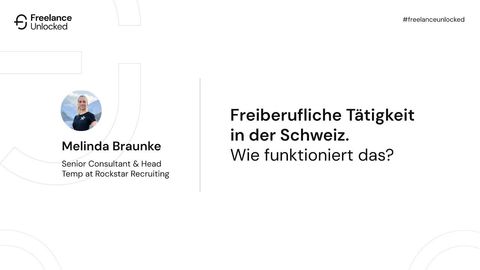
Total deductions under 20 percent, salary paid by the 5th of the following month, rates comparable to what you charge at home: Switzerland sounds like a dream market for DACH freelancers. The catch: hardly any country sets the bar for recognized self-employment as high. At Freelance Unlocked 2024, Melinda Braunke, Senior Consultant and Head Temp at Zurich agency Rockstar Recruiting, framed the Swiss market as what it really is: a video game level with three bosses and one secret weapon.
As of summer 2024. Permit, tax and social insurance rules change. Check the current information from the Swiss authorities before starting a project.
Boss 1: Clients who demand employment
Talk to Swiss corporates or agencies for the first time and you'll be surprised: many insist on temporary employment instead of signing a service contract with your business. That's not chicanery, it's risk management. The Swiss AHV, the old-age and survivors' insurance, reviews every single project to decide whether it counts as genuine self-employment. If it later reclassifies you as an employee, the pain lands mostly on your client: back payments of social contributions, penalties, admin. For you, reclassification is comfortable at first. For the company it's expensive, which is exactly why many rule out freelance contracts upfront.
Boss 2: The 90-day limit
The second boss decides whether and how long you may stay in Switzerland for work at all. The good news: for up to 90 effective working days per calendar year, EU citizens only need the online notification procedure. You register each working day in advance with the canton where your client is based and work under a normal service contract. Taxes and social security stay in Germany.
That model also works for long engagements, as long as your physical presence stays short. Melinda's example: a twelve-month project, mostly remote, with one on-site week every two months. You stay under 90 days, no problem. What doesn't work, as the Q&A made clear, is slicing contracts into 90-day chunks: the limit applies per calendar year. "Nice try," Melinda said, "but I probably wouldn't be standing here if it were that easy."
From the first working day beyond the limit you need a work and residence permit. As an EU citizen, the Agreement on the Free Movement of Persons gives you a right to one, but only once you have a Swiss employment contract: L for short stays, B for longer ones, G for cross-border commuters. And that's the catch-22: the permit hangs on an employment contract, not on a freelance engagement.
Final boss: The AHV and its criteria
The hardest opponent is recognition of self-employment itself. What matters to the AHV is not your contract but the actual working relationship: self-employed is someone who works in their own name, on their own account and at their own economic risk, assessed case by case.
"You can have the most beautifully drafted service contract. If the AHV concludes from the criteria that this is not self-employment, what's written on paper simply doesn't matter." (Melinda Braunke, translated from German)
The criteria Melinda listed will sound familiar from the German debate: Is this your only client? Are you economically dependent? Does the client provide your laptop, phone or an internal email address? Do you have to join meetings, work on site or at fixed hours? Does the project run longer than 90 days? From roughly 50 percent of your capacity for one client, the AHV starts paying attention, and most clients want 80 to 100 percent. Her dry verdict on stage: game over, the Swiss system has defeated you.
The underlying logic is the same as Germany's false self-employment rules. If you want to know how your setup would score at home, you don't need an official audit: 9am's free false self-employment self-check shows you where you stand in a few minutes, and our guide on avoiding false self-employment covers the criteria in depth.
The secret weapon: Personalverleih
Melinda's answer to all three bosses is Personalverleih, the Swiss staff leasing model of temporary project employment. Before you think of German temp agencies and head for the exit: in Switzerland, staff leasing is an established, licensed model supervised by SECO, without the stigma the concept carries in Germany.
Here's how it works. The client commissions the leasing agency for a project, say nine months of Java development. You are employed by the agency for exactly that project duration and leased to the end client. Billing works the way you know it: timesheets, hourly or daily rates, at levels comparable to what you'd charge as a contractor. Contractually there are two parts: a framework agreement covering basics like probation, notice and confidentiality, and an assignment contract fixing rate, duration and the actual task.
What makes the model a secret weapon, according to Melinda:
- False self-employment is off the table. You're employed, so the AHV review disappears, and even strict corporate policies are satisfied. Your freelance status in Germany initially stays untouched.
- Less admin. Invoicing, payment reminders and payroll are the agency's job. You keep the timesheet.
- Fast, reliable money. Instead of 30 to 45 day payment terms, wages arrive by the 5th of the following month. If the end client doesn't pay, that's the agency's risk, not yours.
- A social safety net. After twelve months in Swiss projects you qualify for unemployment insurance, which proved valuable when projects were cancelled during the pandemic. From eight hours per week you're covered by accident insurance, including leisure accidents, mountain bike crashes included. You also pay into a pension fund, and under certain conditions that balance can be paid out after the project ends.
Taxes: why your canton of residence is worth thousands
Once you're employed with a permit beyond 90 days, you pay Swiss taxes, withheld directly from your salary as source tax, a blend of federal, cantonal and municipal rates. The basis is the double taxation agreement between Switzerland and Germany: Swiss income is taxed in only one of the two countries, and your center of life decides which.
Melinda's worked example: a single full-stack developer, 45, nine-month project in Zurich, 100 francs gross hourly rate, 160 hours a month. Living in the canton of Zug, source tax in her example is 10.62 percent, and social contributions plus tax together stay under 20 percent. Living in Zurich, the tax is 16.64 percent, a difference of several thousand francs net over the project. Commuting can literally pay in Switzerland.
Her most practical tip concerns rate negotiations: always ask whether a quoted rate is your gross or the employer's gross ("all-in"). The employer's gross still contains roughly 10 percent of employer costs before your own deductions even start. Two agencies both saying "100 francs" can differ by around 10 percent net. Serious agencies will send you a sample payslip calculation to take to your tax advisor. Melinda herself stressed on stage that she is not a tax advisor and every setup needs an individual check, especially if you keep a German company running alongside: the Swiss employment brings no revenue into your firm while its running costs continue.
Who the level is worth playing for
If you stay remote in Germany and under 90 on-site days, you need none of this: normal service contract, notification procedure, invoice without VAT under reverse charge. A German GmbH doesn't change the Swiss rules either, once a person effectively works on site long-term. And fully remote setups have become a harder sell since the pandemic; Swiss clients increasingly want people in the room. But if you want or need to be on site regularly, staff leasing is hard to avoid, and in return you get project experience in one of Europe's most innovative markets, from blockchain to medtech, in a model that's financially attractive. Melinda's advice: build relationships with Swiss recruiters who hold framework agreements with their clients, so you're on their radar when projects come in.
And if you want to broaden your pipeline on the DACH side in parallel, a free profile on 9am connects you with projects on both sides of the border.
This article is for general information and does not constitute legal or tax advice.
Freelance Unlocked is co-organized by 9am together with Uplink and freelancermap. This article is based on Melinda Braunke's session at Freelance Unlocked 2024. Watch the full talk above, and join us at the next edition: freelanceunlocked.com.