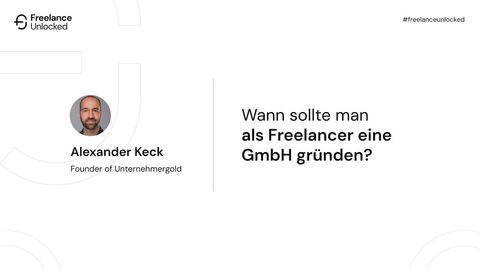
For every 10,000 euros a successful sole proprietor in Germany earns beyond their cost of living, roughly 1,200 euros go to the tax office that wouldn't have to. Not because of sloppy bookkeeping, but because of the legal form. That was the core calculation Alexander Keck presented at Freelance Unlocked 2024. Alexander is an entrepreneur and the author of “Weniger Steuern & mehr Vermögen” (“Fewer taxes & more wealth”), and he calls his mission tax literacy: breaking tax topics down so that normal people can make their own decisions.
Two myths that save you nothing
Before getting to the GmbH, Alexander cleared out two classics.
Myth 1: Collecting receipts saves taxes. Documenting real business expenses, yes. But the self-employed person who pockets the restaurant bill after dinner with friends is committing, in his words, "tax evasion for absolute peanuts". Worse, if an audit catches it, the tax office starts doubting your legitimate expenses too.
Myth 2: The tax return is where you save. By the time you file, everything tax-relevant has already happened. You're just declaring it.
"You don't really save taxes in the past. You save taxes in the future." (Alexander Keck, translated from German)
And the biggest lever for future decisions, he argues, is your legal form.
The problem: one funnel for everything
Most freelancers start as sole proprietors, whether freiberuflich or gewerblich. Rightly so, says Alexander, it's the lowest barrier to entry. The catch: all of your income runs through a single tax funnel. Freelance fees, rental income, everything lands in your personal income tax, whether you need the money to live on or want to invest it.
That funnel gets expensive fast. What matters is the marginal rate, the tax on every additional euro. In 2024 the first 11,604 euros are tax-free, then the rate climbs in stages until the top rate of 42 percent kicks in from 66,761 euros of taxable income (2024 tax brackets).
Alexander's example: say you need 60,000 euros pre-tax for living costs. Everything above that would be wealth-building money. But exactly that part gets taxed at 42 percent. Of every extra 100 euros you earn, you invest 58.
The second funnel: how the GmbH does the math
You can run your freelance business as a GmbH even solo. Alexander's short definition: a GmbH is a legally independent person with its own income and assets. It can only act through you. As managing director you're the hands, as shareholder the brain.
That gives you two tax funnels. Your invoices now flow into the GmbH, and profits that stay there are taxed at roughly 30 percent, combining corporate tax, solidarity surcharge and trade tax. Official statistics back the number: the Federal Ministry of Finance puts the total statutory burden on German corporations at just under 30 percent.
What you need for living costs, you pay yourself as salary. You sign the employment contract on both sides, once as employer, once as employed managing director. You set the amount and adjust it, for instance when rental income covers part of your living costs.
The ground rule from the talk: consumption belongs in your personal income. Wealth-building stays in the GmbH, taxed at 30 instead of 42 percent. Those 12 percentage points are the whole game: 1,200 euros saved per 10,000 euros taxed inside the company rather than privately.
What that means over 25 years
Alexander ran the numbers for a freelancer with 150,000 euros of annual profit and 60,000 euros of living costs: about 10,000 euros of taxes saved per year, after the GmbH's running costs. Over 25 years, that's 250,000 euros. Invest the saved taxes in ETFs each year, at a historical average return of about 7 percent, and roughly 350,000 euros of investment gains come on top. In the end you retire with around 600,000 euros more wealth in the GmbH, purely because the saved taxes were working for you.
For Alexander, wealth isn't just a balance. It's the ability to say no to projects you don't believe in, and yes to ideas that only pay off long-term.
"For me, wealth is nothing other than another word for freedom." (Alexander Keck, translated from German)
The GmbH as your private bank
The capital inside the GmbH is not locked away. Three options from the talk:
- Loans to yourself. Your GmbH can lend you equity for a private property purchase. You pay interest to your own company instead of a bank, and repayment terms are far more flexible to negotiate.
- Investing with a tax edge. When a GmbH sells shares at a profit, the effective tax is only around 1.5 percent. In a private portfolio, a good 26 percent in withholding tax plus surcharge comes straight off. The GmbH also deducts full investment costs, from brokerage fees to an investing course, while private investors are capped by the flat saver's allowance.
- Employee perks. As an employed managing director you can, for example, pay yourself the Inflationsausgleichsprämie, up to 3,000 euros free of tax and social contributions, still available until the end of 2024. The bigger lever is a direct pension commitment (Pensionszusage): your GmbH promises you a pension without an insurer in between, and the capital keeps working inside the company.
For the payout phase there are options too, such as the pension itself, or selling privately held real estate to your own GmbH, tax-free privately after the ten-year holding period. The one thing to avoid, according to Alexander: the classic profit distribution, which triggers withholding tax on top of the corporate tax.
Looking solid, but no free pass
One side effect that matters to freelancers: a GmbH looks more established to clients. It also reduces the appearance of false self-employment, because the contract goes to a company, not to you personally. Alexander was blunt about the limits, though: if you're factually integrated like an employee, taking instructions, sitting in team meetings, using a company email address, the GmbH won't protect you. You can pressure-test your own setup in a few minutes with 9am's free false self-employment self-check, and our guide on avoiding false self-employment walks through the criteria auditors actually apply.
What a GmbH costs, and when a UG is enough
The price for all this: more admin. A GmbH must prepare full balance-sheet accounts. Alexander's rule of thumb: budget 1,000 to 1,500 euros in bookkeeping and advisory costs per 100,000 euros of income. For context, commercial sole proprietorships have to switch to full accounting anyway from 80,000 euros of annual profit; only Freiberufler stay permanently exempt.
The minimum share capital of a GmbH is 25,000 euros, of which half must be paid in at formation. If you don't have the 12,500 euros in cash, you can start with a UG, which works the same way. Alexander's dry take: the mandatory "haftungsbeschränkt" suffix tells everyone in the know that the money wasn't there for a proper GmbH yet. If you have the capital, form the GmbH right away. And once you have employees and real liability risks, add a holding company that separates your wealth from the operating risk.
One warning that came up repeatedly in the Q&A: do not simply deregister your existing freelance business and write the next invoice from the new GmbH. The tax office can treat that as a withdrawal and value your business at 13.75 times its annual profit. There are proper conversion procedures for the switch, and this is exactly where a tax advisor belongs at the table, briefed with specific questions.
When the time is right
Alexander's conclusion is refreshingly unhyped: earn money first, happily as a sole proprietor. Once you consistently earn well beyond your cost of living, start thinking about the GmbH. The effect compounds with every year of head start, because the saved taxes need time to work. And you should understand the decision yourself instead of outsourcing it entirely: "You need the tax literacy yourself. Work with your tax advisor the way you work with any other service provider."
The better your project pipeline, the sooner the GmbH question even arises. A free profile on 9am connects you with DACH clients and the kind of income that makes wealth-building possible in the first place.
This article is for general information and does not constitute legal or tax advice.
Freelance Unlocked is co-organized by 9am together with Uplink and freelancermap. This article is based on Alexander Keck's session at Freelance Unlocked 2024. Watch the full talk above, and join us at the next edition: freelanceunlocked.com.