A study of 775 Swedish solo workers published in April 2026 found that hope and optimism about the future predicted job and life satisfaction in both business owners and gig workers. Self-efficacy, the belief that you are good at your work, ran the other way for owners: more of it went with lower job satisfaction. So did a high appetite for risk. Nobody has measured how common imposter feelings are among freelancers specifically. The one habit with decades of evidence behind it is deciding in advance when and where you will do the thing.
The advice given to freelancers who feel like frauds is almost always some version of "believe in yourself more." A study published on 16 April 2026 in Frontiers in Psychology suggests that is aimed at the wrong variable. What tracked with satisfaction was not confidence in your skills. It was a general sense that things ahead will work out.
What the study measured
Håkan Fougner and Claudia Bernhard-Oettel at Stockholm University surveyed 775 Swedish solo workers: 510 business owners and 265 gig workers contracted through umbrella companies. Overall, 56.7% were women, the mean age was 53, and 53.1% held a bachelor's degree or higher. Owners had been self-employed for 12.4 years on average against 5.3 years for gig workers, and 74.9% of owners took their whole income from self-employment against 43.2% of gig workers. The researchers measured four psychological resources with a shortened version of a standard questionnaire: hope, optimism, self-efficacy and resilience.
The results split cleanly. Hope predicted job satisfaction (b = 0.44, p < .001) and life satisfaction (b = 0.26, p < .001) among business owners. Optimism predicted both as well, most strongly on life satisfaction (b = 0.44, p < .001). Among gig workers the same two mattered, with hope carrying life satisfaction hardest (b = 0.51, p < .001). Resilience, the quality every freelancer article tells you to build, was not significantly related to either outcome in either group.
The finding that reverses the usual advice
Among business owners, self-efficacy was negatively associated with job satisfaction (b = −0.39, p = .008). Higher belief in your own capability, lower reported satisfaction with the work. Risk tolerance went the same way: owners reported more of it than gig workers, and among owners more of it was linked to lower life satisfaction (b = −0.38, p = .023). The authors had expected an inverted-U pattern, some risk appetite being better than none or too much. They did not find one.
Three caveats before anyone builds a personality around this. It is Swedish, not DACH. It is correlational, so nothing here shows that self-belief causes dissatisfaction; a plausible reading is that people who rate their own ability highly also hold their own work to a standard it rarely meets. And it is one study on a group with a mean age of 53, tilted toward experienced owners.
What survives the caveats is the ranking. The forward-looking, non-skill-specific resources did the predicting. The "I am good at this" resource did not, and where it moved at all, it moved the wrong way.
What nobody has measured
There is no study of how common imposter feelings are among freelancers or the self-employed. The most cited prevalence figure, 62% across 30 studies and 11,483 people, comes from a 2025 meta-analysis in BMC Psychology whose population is health service providers: medical students, residents and physicians. It is a real number about a real group, and that group is not us. When you see it recycled as a freelancer statistic, it has been borrowed.
That gap matters, because the structural argument for why solo work makes these feelings louder is strong and does not need a borrowed number.
Structure, not discipline
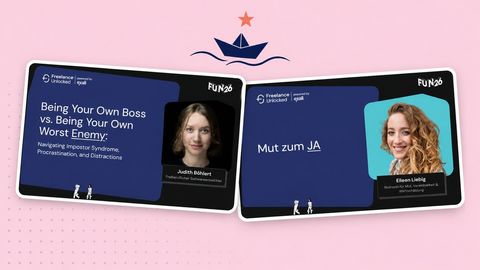
Judith Böhlert is a freelance software developer who gave a talk at Freelance Unlocked 2026 about her own bad two years, including being let go by a client for work she agrees was not good enough. Her framing is the most useful thing in this article:
"You didn't just lose your discipline, you lost the structures that were holding it up." (Judith Böhlert)
She lists what disappears the week you go solo: performance reviews, salary steps, a manager checking in, colleagues, a commute that ends the day, meetings that impose a shape on a week. "With less validation, imposter syndrome might fill the gap. With less accountability, procrastination moves in. And with fewer structures, distractions take over."
And the specific freelance twist: "In freelancing specifically, imposter syndrome can be an even bigger problem because there are fewer linear markers of success." Your wins are invisible, because you delivered them quietly. Your misses are loud, because there is no team to absorb them.
She is also sharp about the advice industry around this. Being handed a productivity hack for a structural problem is what she calls cruel optimism: "You are offered a tiny and individual solution to a big and systemic problem." You stay optimistic that the trick will work, and then blame yourself when it does not.
Her practical moves are small and unglamorous. Say "I don't know" more often, and pair it with a next step or a referral. Talk about it out loud with people you trust, because "imposter syndrome feeds on silence and community can be the antidote here." Keep a running note for every urgent thought that shows up mid-task. And redefine what counts as doing well: "Lately, for me, my only measure of success has been whether or not I like how I spend my time on a random Tuesday."
Action first, confidence later
Eileen Liebig built an event agency out of saying yes to services she did not yet have, then founded a second company in three days during the pandemic. Her version of the same point is blunter (translated):
"Whoever is strong is not brave. Whoever is afraid and acts anyway, that person is brave." (Eileen Liebig, translated)
She describes the trap plainly. If you avoid the difficult conversation, your brain files the avoidance as evidence that there was danger, which makes the next attempt harder. She had to be walked into one such conversation by a friend. Every one after that she handled alone.
The mechanism she describes is the reward-timing one, and it lines up with Böhlert's "just start" advice (translated):
"You do not get rewarded when the presentation is finished. You get rewarded when you start making the presentation." (Eileen Liebig, translated)
Her example of a first step is deliberately tiny: tomorrow, spend ten minutes reading what the presentation actually has to contain. Böhlert's is the same shape. She wrote her talk after weeks of avoidance by opening a file on a random exhausted Monday night and putting down a few lines, and the resistance dropped immediately because something had moved.
The one habit with real evidence behind it
If you take one technique from this, take implementation intentions: deciding the situation and the response in advance, in an if-then sentence. Peter Gollwitzer and Paschal Sheeran's 2006 meta-analysis is the foundational review behind it. That is twenty years old, which makes it well established rather than new, and it remains one of the better-evidenced things you can do about the gap between intending and doing.
Applied here: "If I open the client file and feel the urge to check something else first, I write one sentence before I check anything." Or Liebig's: "If the difficult call is tomorrow, I spend ten minutes today writing down the first three things I want to say."
Note what the if-then does. It removes the moment where you have to feel capable in order to begin. That is exactly the moment the Stockholm data suggests you should stop trying to fix directly.
What to do on Monday
- Write down the structures you lost. Feedback, deadlines, colleagues, an end to the day. Pick the one you miss most and rebuild a cheap version of it this week.
- Book one hour with two freelancers you trust and talk about what went badly this quarter. Not a networking call. A failure call.
- Write one if-then sentence for the task you have been circling for two weeks, and make the "then" absurdly small.
- Replace your success metric for a month. Böhlert's version: do you like how you spend a random Tuesday?
- Say "I don't know, and I will find out by Friday" once, out loud, to a client. Notice that nothing happens.
None of this is about becoming more certain. If the Swedish data is pointing anywhere, it is that certainty is not the ingredient. What predicted satisfaction was expecting things to work out, and that gets easier when the next three months are not empty. A free 9am profile is one way to keep that pipeline visible. For the mental traps that come with the territory, the psychology of successful freelancing covers more of them, what actually helps against freelancer loneliness covers the isolation half, and why switching off fails covers what to do with the evenings.
Freelance Unlocked is co-organized by 9am together with Uplink and freelancermap. This article draws on the sessions of Judith Böhlert and Eileen Liebig at Freelance Unlocked 2026. Watch the full talks above, and join us at the next edition: freelanceunlocked.com.